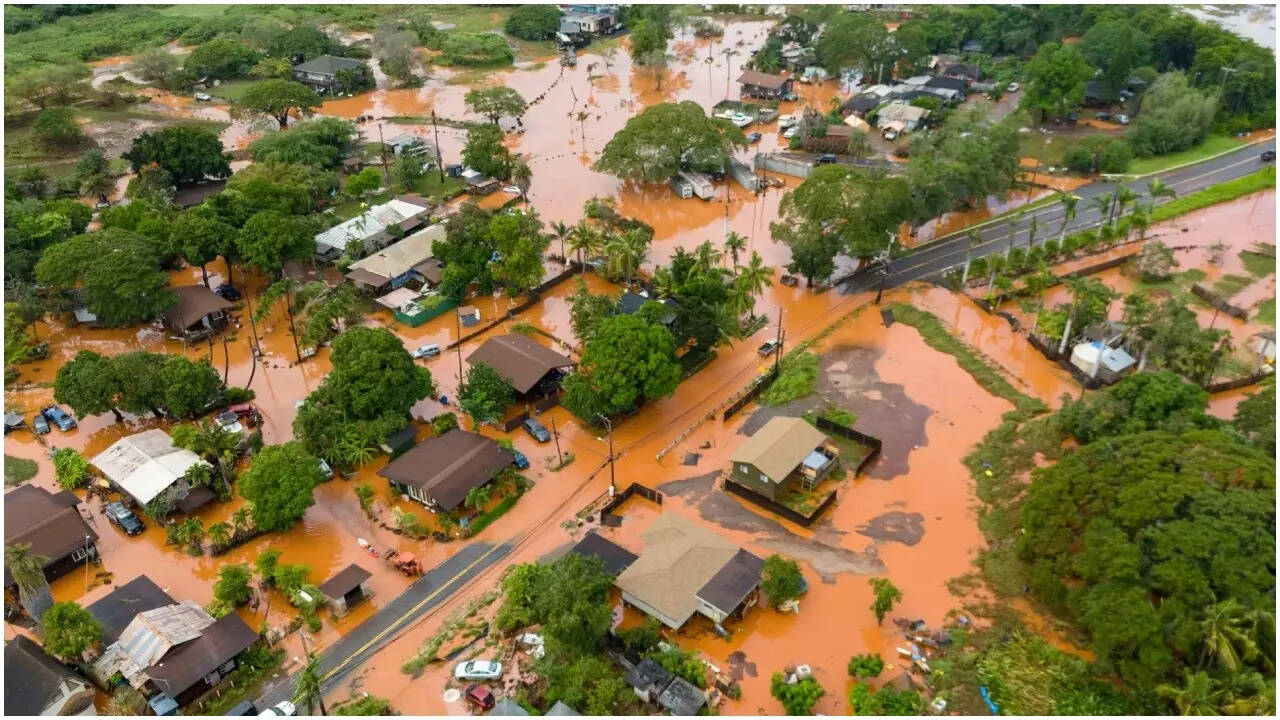
The first thing you notice isn't the sight of the water. It is the sound. Not the rhythmic, meditative pulse of the Pacific crashing against a reef, but a low, visceral growl that vibrates in the marrow of your bones. It is the sound of a landscape being reorganized.
In Hawaii, the word aina means more than just "land." It implies a kinship, a living connection to the earth that feeds you. But in the early weeks of this month, that kinship felt fractured. The sky turned a bruised, heavy purple, and then it simply opened. For days, the rain didn't fall so much as it occupied the space where air used to be. By the time the gauges were read, parts of the islands had seen more than two feet of water in a single 48-hour window. This wasn't just a storm. It was a 20-year anomaly, a "Kona Low" that parked itself over the archipelago and refused to budge.
The Weight of Two Feet of Water
Imagine a single gallon of water. It weighs about 8.3 pounds. Now imagine trillions of those gallons dropping onto the volcanic peaks of Oahu, Maui, and Kauai. Because the terrain is vertical—dramatic spires of emerald green—that water doesn't just sit. It gathers speed. It finds every crack, every dry stream bed, and every residential street, turning them into chutes of debris and red mud.
Consider a family in the Hanalei Valley. For them, the "worst flooding in two decades" isn't a headline; it’s the sight of their living room rug floating toward the ceiling. It is the frantic internal calculation of what to grab when the sirens start. The photo albums? The dog? The emergency kit you prepped but never thought you'd actually need?
When the Governor declared a state of emergency, it was a formal recognition of a chaotic reality: the ground was saturated. It could hold no more. The infrastructure, designed for the paradise we see on postcards, was screaming under the pressure of a changing climate.
The Anatomy of an Evacuation
Evacuation is a clinical word for a terrifying experience. It happens in the dark. It happens when the power flickers and then dies, leaving you with only the beam of a flashlight reflecting off the rising tide in your driveway.
On Oahu, the North Shore became an island within an island. Bridges were bypassed by the sheer volume of the surge. When the orders came to "leave now," they weren't suggestions. They were lifelines. More than a thousand people were displaced in a matter of hours, moved to high schools and community centers that smelled of damp clothes and collective anxiety.
But the real story isn't just the numbers. It’s the invisible stakes. It’s the small business owner in Haleiwa watching twenty years of sweat equity disappear under a foot of silt. It’s the farmer whose taro patches—the lifeblood of Hawaiian culture—were buried under landslides. These are the ripples that remain long after the water recedes.
Why the Old Maps No Longer Work
We like to think of disasters as "once in a lifetime" events. The "hundred-year flood" or the "twenty-year storm" provides a sense of comfort, a statistical shield that suggests we are safe for the next few decades. That shield is crumbling.
The meteorology behind this event was a perfect, devastating alignment. A Kona Low—a type of seasonal cyclone—sucked up vast amounts of tropical moisture and funneled it directly into the mountains. In the past, these storms were predictable. Now, they are fueled by a warmer ocean, holding more moisture and moving with less predictability.
The logic of the past told us where it was safe to build. But as the floodwaters reached homes that had been dry since the mid-90s, that logic was proven faulty. We are living in a period where the maps are being redrawn in real-time by the elements themselves.
The Silence After the Surge
When the rain finally stops, a strange silence settles over the islands. It’s not a peaceful silence. It’s the heavy, humid quiet of a place that has been scoured.
As the sun began to break through the clouds over Honolulu, the extent of the damage became clear. Cars were buried to their windows in mud. State highways were sliced in half by washouts. The cost will be measured in the hundreds of millions, but the emotional cost is harder to quantify.
There is a specific kind of exhaustion that comes with cleaning up after a flood. It is the weight of the mud, which is heavier than you think. It is the smell—a mix of earth, salt, and decay—that lingers in the floorboards for months.
Yet, in the midst of this, something else rose. It wasn't organized by the government or dictated by a state of emergency. It was the sight of neighbors with chainsaws and shovels, clearing paths before the official crews could arrive. It was the communal kitchens popping up in garage ports to feed those who had lost everything.
The water showed us our vulnerability. But the aftermath showed us our gravity—the way people pull toward one another when the world becomes fluid.
We often treat the environment as a backdrop to our lives, a scenic screen that remains static while we move through our days. This month reminded Hawaii that the land is a protagonist. It has its own rhythms, its own breaking points, and its own voice. Sometimes, that voice is a whisper in the trade winds. Sometimes, it is the roar of a river that wasn't there yesterday.
The mud will eventually be hosed away. The roads will be paved. The tourists will return to the beaches, unaware that the sand they are lying on was moved there by a historic surge. But for those who stood on their roofs and watched the horizon disappear, the sound of the rain will never be just a sound again. It will be a memory of the day the aina reminded everyone who was really in charge.
The clouds have parted, but the ground remains damp, a dark, heavy reminder that the next twenty-year event might not wait twenty years to arrive.