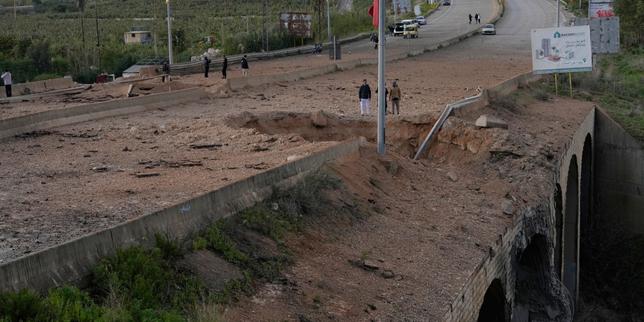
The sound of a door closing in Tel Aviv is never just the sound of a door closing. It is a sharp, metallic percussion that, for a split second, mimics the distant thud of an interception. For Miriam, a mother of three whose apartment overlooks the sprawl of the white city, every mundane noise has become a question. Is that the wind? A car door? Or is the sky about to break again?
Miriam represents the millions living in a state of suspended animation. She is not a soldier, but her life is dictated by the logistics of war. When the news cycles through the latest updates—the declarations of "several more weeks of combat" against the northern front and the distant, shadowy reach of Tehran—she doesn't see a map of tactical movements. She sees the calendar. She sees the missed birthdays, the shuttered businesses on her street, and the hollowed-out look in her husband’s eyes when he returns from reserve duty.
The reality of this conflict has shifted from a series of skirmishes into a grueling, grinding marathon of attrition. It is no longer about a single decisive blow. Instead, it is a test of who can hold their breath the longest under water.
The Geography of Anxiety
To understand why the Israeli military is signaling a prolonged timeline, you have to look past the headlines and into the rugged, limestone hills of Southern Lebanon. This is not a flat desert where tanks can roll unimpeded. It is a labyrinth. Hezbollah has spent decades carving into this earth, turning ancient villages into fortresses and orchards into launchpads.
Imagine trying to clear a house where every floorboard might be a trigger and every window hides a ghost. Now multiply that by thousands of structures across hundreds of miles.
The "several weeks" mentioned by military planners is an admission of this complexity. You cannot rush through a maze of tunnels and hidden stockpiles without paying a price in blood that no society can easily stomach. So, the pace slows. The precision increases. The tension, however, only tightens.
While the tactical focus remains on the Hezbollah Radwan forces, the shadow of Iran looms over every calculation. It is a strange, modern alchemy of war. A drone launched from a thousand miles away can cause as much psychological havoc as a rocket fired from across the fence. This is the new front line: it is everywhere and nowhere at once. It is in the GPS signals that flicker and fail, the flight boards at Ben Gurion Airport that turn red with cancellations, and the quiet conversations held in stairwells during sirens.
The Hidden Ledger
War is usually measured in casualties and territory, but the true cost of a "prolonged engagement" is written in the invisible ledger of a nation's psyche.
Economics is often treated as a dry subject, a matter of percentages and GDP. But on the ground, economics is a local bakery that can’t find staff because the bakers are in uniform. It is a tech startup in Haifa losing its edge because its lead engineers are sitting in a tank. The Israeli economy is a high-performance engine being forced to run on fumes and adrenaline.
When the government speaks of weeks of combat, they are also speaking of weeks of economic paralysis for the north. Tens of thousands of people are internal refugees, living in hotels or cramped apartments, their lives packed into suitcases that have remained unopened for months. They are waiting for a "security reality" that allows them to go home, but that reality is a flickering mirage.
The human element is the ultimate variable. How long can a parent explain to a child why they can't play in the park? How long can a shopkeeper stay solvent with zero foot traffic? The strategy of the adversary—Iran and its proxies—is built entirely on these questions. They aren't trying to win a conventional battle; they are trying to break the social contract of their opponent.
The Architecture of the Intercept
Living under the "Iron Sky" is a marvel of engineering, but it is also a psychological trap. The Iron Dome and the Arrow systems provide a shield that is nearly miraculous. You see the streaks of light, the puff of smoke, and the boom that rattles your windows.
But a shield is heavy.
There is a specific kind of exhaustion that comes from being protected. It creates a false sense of normalcy that is shattered every time the phone alerts go off. It allows the war to fade into the background of daily life until it suddenly, violently, becomes the foreground.
The military's insistence on a longer timeline is a rejection of the "quick fix." They are signaling that the aim is to dismantle the infrastructure of threat so thoroughly that the residents of the north can return to something resembling a life, not just a survival. But "thoroughly" is a word that demands time. And time is the one thing everyone is running out of.
Consider the perspective of a reservist. Let's call him David. He is thirty-four, a father, and a middle manager at a logistics firm. He has been called up three times in a year. His life is a series of jarring transitions between changing diapers and carrying an assault rifle. Each time he comes home, he feels like a stranger in his own living room. The news says "weeks more," and David wonders if his job will still be there, or if his daughter will remember the sound of his voice without the distortion of a grainy video call.
The Silent Front
Beyond the rockets and the rhetoric, there is the quiet struggle of the middle ground. Most people, whether in the bomb shelters of Kiryat Shmona or the suburbs of Tel Aviv, just want the noise to stop. But the noise is a symptom of a much deeper, structural rot in the region's security.
The combat is not just against militants; it is against a philosophy of permanent instability. Iran’s "Ring of Fire" strategy is designed to keep its enemies in a state of constant, low-grade fever. It is a slow poison. The Israeli military’s current posture is an attempt to administer an antidote, but the process is invasive and painful.
There are no easy exits in this narrative. The "several weeks" could easily bleed into months. The history of the Middle East is littered with "limited operations" that became decades of entanglement.
What remains is the grit of the people. It is the volunteer kitchens that feed the displaced. It is the teachers holding classes over Zoom from bomb shelters. It is the stubborn refusal to let the rhythm of life be completely dictated by the rhythm of the sirens.
Miriam still checks her windows every morning. She watches the Mediterranean, blue and indifferent, and wonders what the next few weeks will actually bring. The headlines provide the facts—the troop movements, the diplomatic deadlocks, the casualty counts—but they fail to capture the heavy, humid air of a country waiting for the other shoe to drop.
The sky is clear today, but in this part of the world, clear skies are just a canvas for the next streak of white smoke. The door closes again, sharp and loud. Miriam doesn't flinch this time. She just keeps moving. That is the only strategy left when the war refuses to end.
The sun sets over the Galilee, casting long, orange shadows across empty playgrounds and reinforced concrete walls, a reminder that peace is not merely the absence of war, but the ability to hear the wind without wondering if it is a warning.