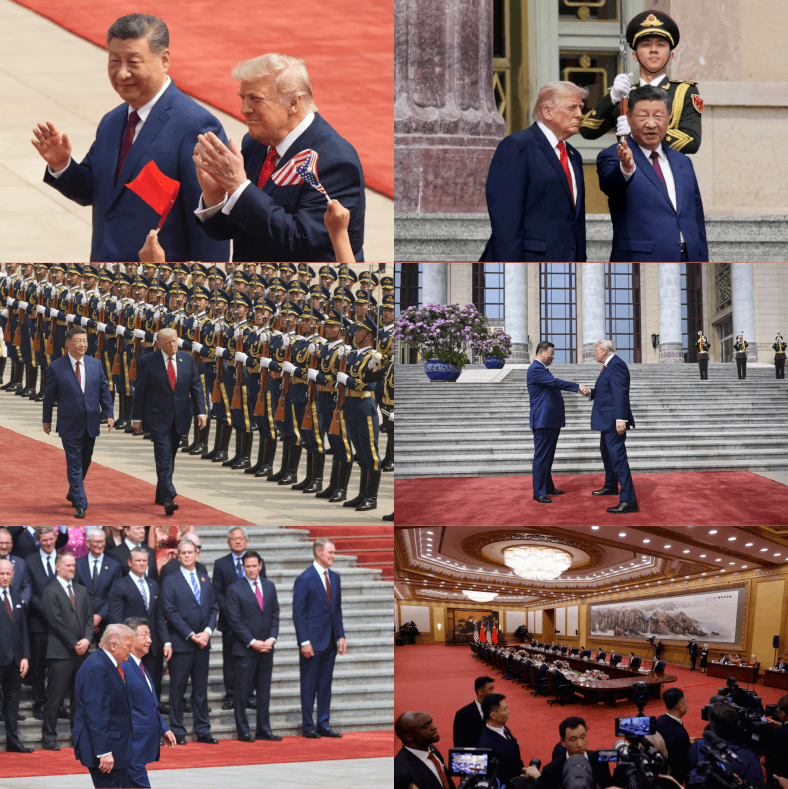
The initial stage of Donald Trump’s 2017 visit to Beijing functioned as a high-stakes calibration of the bilateral power dynamic, moving beyond mere diplomatic theater into a calculated exchange of political capital. While media narratives often focus on the spectacle of the "state visit-plus" reception, the structural reality was a confrontation between two distinct economic and geopolitical philosophies: transactional bilateralism versus long-term systemic expansion. The efficacy of the visit can be measured by the tension between symbolic concessions and the underlying rigidities of the U.S.-China trade deficit.
The Architecture of State Visit-Plus Diplomacy
The Chinese government’s decision to grant a "state visit-plus" designation served as a psychological and logistical framework designed to neutralize American confrontational rhetoric through overwhelming hospitality. This framework operated on three primary levels of influence:
- Status Validation: By hosting the welcoming ceremony at the Forbidden City, Beijing utilized historical prestige to signal China’s return to a central position in global affairs. For the American delegation, this provided the optics of respect and parity required to satisfy domestic political branding.
- Information Control: The curated nature of the tour functioned as a buffer. By filling the schedule with cultural rituals, the Chinese hosts effectively compressed the time available for granular, low-level technical negotiations where trade friction is most acute.
- Relationship Personalization: The emphasis on the personal rapport between Xi Jinping and Donald Trump was a strategic attempt to bypass institutional bureaucracies. Beijing calculated that a top-down agreement would be more durable than the iterative, friction-heavy processes of the U.S. State or Commerce Departments.
This architectural approach created a paradox. While the imagery suggested a new era of cooperation, the lack of movement on structural market access issues indicated that the "plus" in the visit title was largely ceremonial rather than substantive.
Quantifying the $250 Billion Commercial Package
The centerpiece of the first day was the announcement of trade deals totaling approximately $250 billion. However, a rigorous analysis of these figures reveals a significant delta between gross value and net economic impact. The package was composed of three types of agreements:
- Non-Binding Memoranda of Understanding (MOUs): A substantial portion of the $250 billion consisted of non-binding agreements for future purchases. These are contingent on market conditions and lack the legal enforcement of finalized contracts.
- Recycled Announcements: Several deals, particularly in the aerospace and agricultural sectors, represented extensions or formalizations of previously discussed or existing procurement plans.
- Long-Term Infrastructure Pledges: Investments in energy sectors, such as the Alaska LNG project, involve multi-year—often multi-decade—development timelines. Their immediate impact on the trade deficit is zero.
The cost function of these deals for China was low. By aggregating disparate purchase orders into a single "quarter-trillion dollar" headline, Beijing provided the Trump administration with a political victory to export to its base without requiring China to alter its fundamental industrial policy or "Made in China 2025" objectives.
The Strategic Bottleneck of North Korean De-escalation
The geopolitical priority of the visit was the coordination of pressure on Pyongyang. The logic of the U.S. position rested on the "Chinese Leverage Hypothesis"—the belief that because China accounts for over 90% of North Korea’s external trade, it possesses the mechanical means to force a cessation of the nuclear program.
China’s counter-logic is defined by the "Buffer State Stability Threshold." Beijing views a collapsed North Korean regime as a catastrophic risk involving refugee flows and the potential for a unified, U.S.-aligned Korea on its border. Consequently, China’s participation in sanctions is not a binary choice but a sliding scale. During the first day of the summit, the dialogue shifted from if sanctions should be applied to at what point they threaten the internal stability of the Kim Jong-un government.
This creates a bottleneck in bilateral relations. The U.S. seeks a definitive resolution to the nuclear threat, while China seeks a managed status quo. The first day's discussions confirmed that while China would increase enforcement of UN-mandated sanctions, it would not cross the threshold of total economic strangulation.
Market Access and the Reciprocity Gap
The underlying tension of the summit remains the fundamental lack of reciprocity in market access. The U.S. delegation arrived with a mandate to address "forced technology transfer" and the "Joint Venture Requirement" that hampers American firms operating in China.
The Chinese response was to offer "The Strategy of Incremental Openness." This involves the slow lifting of foreign ownership caps in specific sectors, such as banking and automotive manufacturing, on a timeline that allows domestic Chinese champions to consolidate their market leads before facing full competition.
The friction here is rooted in two different views of the state's role in the economy:
- The U.S. View: Markets should be open by default, with government intervention as a corrective measure.
- The Chinese View: The market is a tool of the state, and access is a sovereign privilege to be granted or retracted based on national strategic needs.
Because these two views are ideologically divergent, the first day of the summit resulted in no movement on the core intellectual property concerns that would later fuel the 2018 trade war.
Operational Limitations of the Transactional Model
The Trump administration’s preference for transactional diplomacy—achieving discrete "wins" rather than systemic reforms—encountered a significant limitation in Beijing. Transactionalism requires the opponent to be willing to trade long-term structural advantages for short-term political peace.
China, however, operates on a "Centennial Strategic Horizon." They are willing to grant the U.S. temporary trade concessions (such as purchasing more soy or Boeing aircraft) to preserve their right to maintain a state-led economic model. The first day of the visit demonstrated that while the U.S. could extract high-value optics, it lacked the leverage to force a pivot in China’s core economic trajectory.
Resource Competition in the Indo-Pacific
Beyond the bilateral meetings, the visit occurred against the backdrop of the emerging "Free and Open Indo-Pacific" (FOIP) concept. This framework is the U.S. response to China’s "Belt and Road Initiative" (BRI). The contrast between the two is sharp: BRI is a centralized, state-funded infrastructure push, while FOIP is a decentralized, rule-of-law-based investment philosophy.
The discussions in Beijing signaled that the U.S. would not formally join BRI, viewing it as a vehicle for Chinese geopolitical expansion. This refusal marks a permanent shift toward competition for regional influence. The "state visit-plus" could not mask the reality that both nations are now engaged in a race to define the standards of 21st-century infrastructure, digital governance, and maritime security.
The strategic play following the first day’s events is not to view the $250 billion in deals as a resolution, but as a temporary ceasefire. Organizations and investors should anticipate that the structural issues regarding IP theft and market access will remain unresolved, likely leading to an escalation of tariff-based pressure. The "plus" in the diplomacy was a tool for time-acquisition; Beijing bought time to strengthen its domestic markets, while the U.S. secured a political narrative. The long-term trajectory points toward a decoupled supply chain where symbolic summits are increasingly replaced by rigorous, unilateral economic defenses.