The shipping industry is currently pricing in a nightmare. While political rhetoric suggests a swift clearing of the Strait of Hormuz in the event of an Iranian mining operation, the mathematical and mechanical reality of mine countermeasures (MCM) dictates a timeline of roughly 180 days to restore full commercial confidence. This isn't a failure of American naval power. It is a fundamental reality of underwater physics and the sheer geography of a twenty-one-mile-wide artery that carries twenty percent of the world’s petroleum. Clearing a minefield is not a sweep; it is a meticulous, inch-by-inch forensic investigation of the seabed.
The Arithmetic of an Energy Blockade
Modern naval mines are not the spiked, floating spheres seen in cinema. They are sophisticated, bottom-dwelling sensors that can distinguish the acoustic signature of a destroyer from that of a supertanker. Iran possesses thousands of these devices, ranging from primitive contact mines to sophisticated "smart" influence mines. When a single vessel strikes one of these hidden threats, the Strait does not just "slow down." It stops.
Insurance premiums for tankers jump to prohibitive levels instantly. Ship captains refuse to enter the corridor. The U.S. Navy’s Fifth Fleet is then forced to transition from a posture of deterrence to one of active clearance.
The primary bottleneck is the detection-to-neutralization ratio. In the cluttered, shallow waters of the Persian Gulf, sonar frequently identifies "false positives"—discarded refrigerators, old shipwrecks, or rock formations—that look exactly like a Manta or an EM-52 mine. Each one must be inspected by an autonomous underwater vehicle (AUV) or a clearance diver.
The Persistence of the Invisible Threat
Clearing the Strait involves three distinct phases: detection, classification, and neutralization. The U.S. Navy relies on the Avenger-class mine countermeasures ships and the newer Littoral Combat Ship (LCS) MCM packages. However, the process is agonizingly slow.
Why Sonar Struggles in the Gulf
The waters of the Strait are a nightmare for acoustic sensors. The high salinity and varying temperature layers create "shadow zones" where sonar beams bend or bounce unpredictably. This allows mines to hide in plain sight.
Furthermore, Iran has mastered the art of "saturated mining." By deploying a mix of high-end magnetic influence mines and cheap, "dumb" contact mines, they force the Navy to treat every square meter of water with the same level of extreme caution. You cannot rush this. Speed in mine hunting leads to missed targets, and a missed target leads to a sunken tanker.
The Human and Robotic Toll
While we often hear about the MQ-4C Triton or various underwater drones, the final stage of mine disposal often requires a human being or a highly specialized disposal charge.
A single "mine-like object" can take several hours to verify. Multiply that by the hundreds of miles of shipping lanes that must be cleared to create a safe "Q-route"—a verified safe passage—and the calendar begins to slide. Military planners estimate that even with a surge of international partners like the British Royal Navy or the Japanese Maritime Self-Defense Force, establishing a single, narrow safe lane would take weeks. Expanding that into a fully functional commercial corridor takes months.
Beyond the Hardware The Economic Siege
The goal of an Iranian mining operation would not be to sink the entire U.S. Navy. It would be to break the back of the global energy market.
Markets loathe uncertainty. If the Pentagon announces that the Strait is "90% clear," the shipping industry hears that there is still a 10% chance of losing a $200 million hull and a billion dollars worth of cargo. Until the Navy can guarantee a near-zero risk environment, the "blockade" remains effective even if no more mines are being laid.
This is the psychological shadow of mine warfare. It is the cheapest way for a mid-tier power to paralyze a global superpower. The cost of a single Iranian mine is roughly $15,000 to $30,000. The cost of the specialized ships, divers, and lost economic activity required to find it runs into the billions.
The Technological Deficit
For decades, the U.S. Navy prioritized carrier strike groups and stealth submarines over the unglamorous work of mine sweeping. This has left a gap in capability. The aging Avenger-class ships are being retired, and their replacements—unmanned systems operating from the LCS—are still maturing.
The current strategy relies heavily on the MK 18 Mod 2 Kingfish UUVs. These drones can map the seafloor with high resolution, but they still require a mother ship to be relatively close to the danger zone. If Iranian shore-based anti-ship missiles (like the Noor or Gader) are active, those mother ships cannot operate safely.
This creates a secondary requirement: before you can even begin the six-month process of clearing the water, you must first spend weeks suppressing the coastal defenses. The clock doesn't start until the "shooting war" on the surface is largely won.
The Strategy of Asymmetric Exhaustion
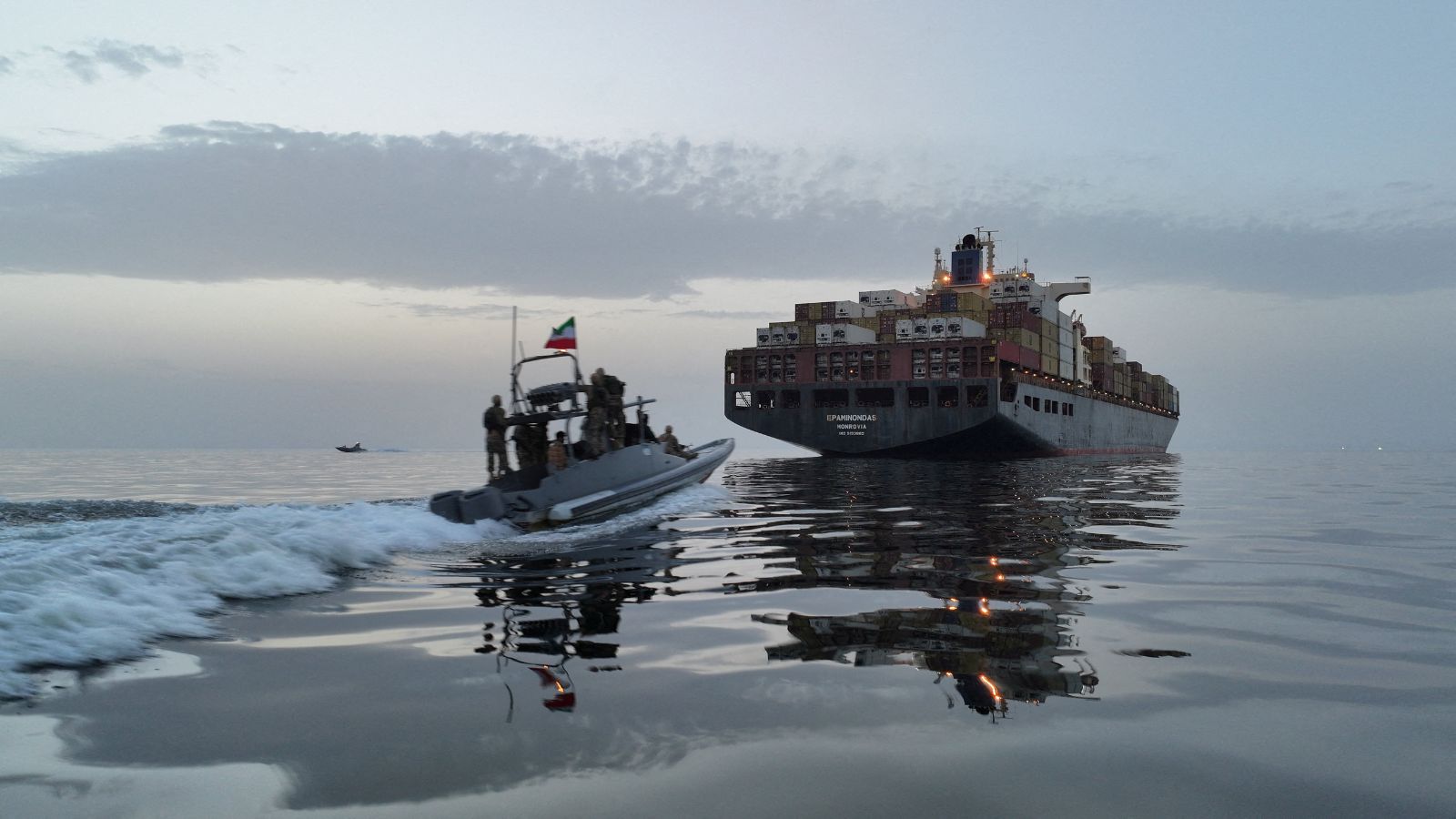
Iran’s Islamic Revolutionary Guard Corps Navy (IRGCN) understands that they do not need to win a naval battle. They only need to persist.
By using small, fast boats to intermittently drop mines at night, they can reset the "six-month" clock. If the Navy clears a lane on Monday, and a dhow is spotted dropping three objects on Tuesday, that lane is officially compromised again. It requires a total maritime lockdown, a feat that is historically difficult to maintain in one of the busiest waterways on earth.
The Fragility of Global Supply
Most modern economies operate on "just-in-time" delivery. Refineries in East Asia and Europe do not keep months of crude in reserve. A thirty-day disruption causes price spikes; a sixty-day disruption causes industrial slowdowns; a six-month disruption triggers a global depression.
This reality gives Tehran immense leverage in any negotiation. They aren't just threatening ships; they are threatening the internal stability of every oil-importing nation.
The Reality of Clearance Operations
To understand the six-month timeframe, one must look at the physical area. The Strait is not a uniform bathtub. It is a complex terrain of varying depths, currents, and shipwrecks.
- Phase One: Sea Control. Eliminate the shore batteries and fast-attack craft. (1-2 weeks)
- Phase Two: Deep Water Clearance. Use AUVs to clear the primary transit lanes for deep-draft tankers. (4-8 weeks)
- Phase Three: Identification and Verification. Sending EOD (Explosive Ordnance Disposal) teams to every hit on the sonar map. (12-16 weeks)
- Phase Four: Maintenance. Continuous patrolling to ensure no new "re-seeding" of the minefield occurs. (Ongoing)
The transition from Phase Three to Phase Four is where the most time is lost. This is the "verification" stage. It is grueling work. Divers often operate in near-zero visibility, feeling their way along the hull of a suspected mine. It is dangerous, slow, and entirely dependent on weather conditions. High winds or heavy seas in the Gulf can halt MCM operations for days at a time.
The False Promise of Quick Fixes
There is a recurring myth that "pressure waves" or massive underwater explosions can "pre-detonate" a minefield, clearing a path instantly.
This is largely fantasy. Modern mines are designed with "ship counters." They might ignore the first three massive shocks, only detonating when they sense the specific magnetic and acoustic signature of a fourth vessel. You cannot trick a smart mine with a simple blast. You have to find it, identify it, and physically disable it.
The Strategic Miscalculation
The greatest risk is that the West underestimates the Iranian commitment to this "denial" strategy. For Tehran, the mine is the ultimate equalizer. It negates the advantage of a multi-billion dollar aircraft carrier. It turns the geography of the region into a weapon.
The U.S. and its allies have spent years practicing "International Mine Exercise" (IMX) maneuvers in the region. These exercises are impressive, involving dozens of nations and hundreds of drones. But an exercise is conducted in a permissive environment where no one is firing missiles at the minesweepers.
In a real-world scenario, the friction of war slows every movement. A six-month estimate is not a pessimistic "worst-case" scenario. It is a sober, technical assessment of what it takes to scrub a seafloor clean when the stakes are the survival of the global economy.
The world’s energy security currently rests on the hope that this math is never put to the test. If it is, the "chokepoint" will not just be a metaphor; it will be a half-year strangulation of global commerce that no amount of naval bravado can shorten. The mechanical limitations of sonar, the endurance of divers, and the deceptive simplicity of a $20,000 mine ensure that once the Strait is closed, it stays closed for a very long time.
Investing in faster, more autonomous mine-hunting technology is the only way to shorten this timeline, yet the pace of procurement remains sluggish. We are preparing for a twenty-first-century war with a nineteenth-century bottleneck. Until the Navy can find and neutralize a mine as fast as an adversary can drop one, the Strait of Hormuz remains the most vulnerable piece of real estate on the planet.