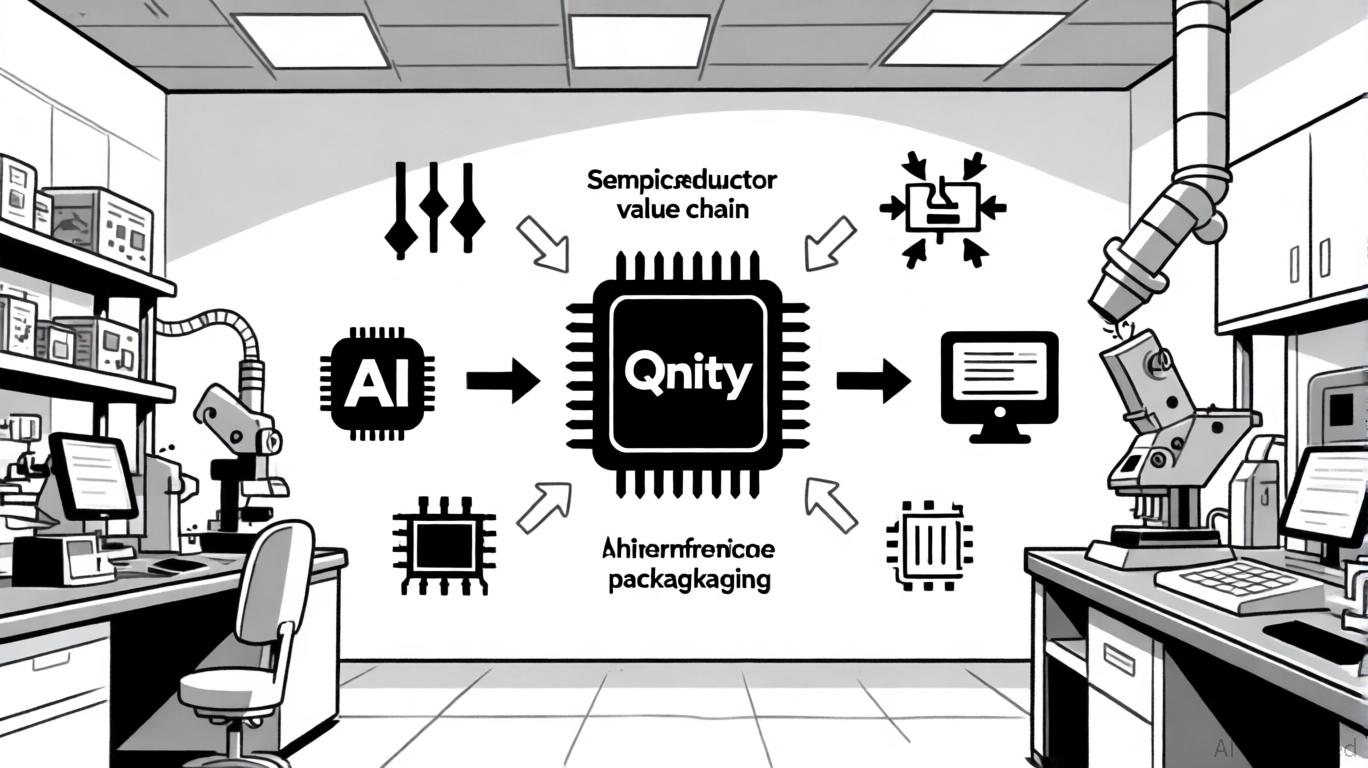
Qnity has officially separated from its parent conglomerate, stepping into the public markets not as a legacy hardware provider but as a pure-play artificial intelligence firm. This move is more than a simple corporate restructuring. It is a calculated bet that the future of computing resides at the edge—on local devices and private servers—rather than in the massive, centralized data centers controlled by a handful of tech giants. By shedding its industrial baggage, Qnity aims to capture the surging demand for low-latency, privacy-focused processing that current cloud infrastructures cannot provide.
The market has noticed. While initial reports focused on the "force" of their entry, the real story lies in the technical architecture Qnity has spent three years quietly building. They aren't just selling software; they are deploying a proprietary layer of "neural compression" that allows complex models to run on hardware that would typically buckle under the weight of a standard Large Language Model (LLM). This is the infrastructure play that investors are starting to realize could disrupt the current dominance of cloud-first AI providers.
The Architecture of Autonomy
To understand why Qnity is causing a stir, one must look at the physical limitations of the current AI boom. Most AI today is "tethered." When you ask a digital assistant a question or request a code snippet, that data travels to a server farm, often hundreds of miles away, processes, and returns. This creates a bottleneck. For autonomous vehicles, factory floor robotics, and medical devices, a two-second delay is the difference between a successful operation and a catastrophic failure.
Qnity’s core intellectual property centers on localized inference. Instead of sending data back to the mothership, their systems process information where it is generated. This is achieved through a technique known as weight quantization and pruning, where the AI model is stripped of its redundant data points without losing its predictive accuracy.
This isn't a new concept, but Qnity has managed to automate the optimization process. In a typical development cycle, shrinking a model to fit on a smartphone or an industrial sensor takes months of manual engineering. Qnity’s platform reduces this to hours. They have effectively built a "shrink-wrap" factory for intelligence, making it possible for mid-sized enterprises to deploy sophisticated tools without a $100 million cloud budget.
Breaking the Cloud Dependency
The narrative in Silicon Valley for the last decade has been that bigger is better. More parameters, more GPUs, more electricity. Qnity is the first major spin-off to explicitly reject this "brute force" philosophy. Their leadership, comprised mostly of former semiconductor engineers and systems architects, argues that the next phase of the industry will be defined by efficiency, not scale.
Consider the economics of the cloud. Companies using third-party APIs for their AI needs are essentially renting intelligence. As they scale, their costs grow linearly—or worse, exponentially. Qnity flips this model by selling an "edge-first" license. A manufacturer pays for the software once, installs it on their proprietary hardware, and runs it indefinitely with zero data transmission costs.
This approach addresses the three primary anxieties of the modern CTO:
- Data Sovereignty: Sensitive corporate data never leaves the internal network, neutralizing the risk of a third-party breach.
- Predictable OpEx: Operating costs remain flat regardless of how many queries the system processes.
- Reliability: The system works in "dark" environments with no internet connectivity, such as underground mines or remote offshore rigs.
The Competitive Moat of Proprietary Silos
While the "Big Tech" firms are busy training models on the entire open internet, Qnity is focusing on vertical integration. They don't want to write poems or generate images of cats. They are targeting high-precision industries: defense, specialized manufacturing, and grid management.
In these sectors, general-purpose models are often a liability. A model trained on Reddit and Wikipedia is useless when trying to calibrate a high-speed turbine. Qnity’s strategy involves "Small Language Models" (SLMs) that are hyper-tuned on industry-specific datasets. Because these models are smaller, they are inherently more accurate within their narrow domain and far less prone to the "hallucinations" that plague broader systems.
The skepticism surrounding Qnity usually stems from their hardware-agnostic claims. Critics argue that without their own chips, they are at the mercy of Nvidia’s supply chain. However, Qnity’s software layer is designed to run on existing ARM and RISC-V architectures. They aren't waiting for the next generation of GPUs; they are making the chips already in the world smarter. This "brownfield" approach allows them to enter markets that their competitors, who require specialized AI accelerators, simply cannot touch.
The Hidden Risk of the Spin Off
No veteran analyst would call this a guaranteed victory. The separation from the parent company was clean, but it leaves Qnity without the massive capital cushion it once enjoyed. They are now in a race against time to prove that their efficiency gains can outpace the falling costs of cloud computing.
There is also the "talent war." Qnity is competing for the same pool of researchers as Google and Meta. While Qnity offers the allure of "pure" engineering challenges, they lack the stock-option-fueled treasury of the giants. Their success depends entirely on whether the industry truly values on-premise privacy over the convenience of the cloud. If the market decides that data privacy is a secondary concern to raw power, Qnity’s edge-focused strategy could become a niche play rather than a market-defining one.
The Industrial Reality Check
Walk onto any modern factory floor and you will see the problem Qnity is trying to solve. You see machines from 1998 running alongside 2024 sensors. The "digital transformation" of the last decade has left behind a mess of incompatible systems.
Qnity’s platform acts as a universal translator. By deploying containerized AI modules, they can sit on top of legacy infrastructure and pull meaningful insights from "dumb" hardware. This isn't about building a futuristic utopia; it's about making the world we already built function with a higher level of precision.
The "force" that investors shouldn't ignore isn't just the company's valuation or its pedigree. It is the realization that the centralized cloud is a bottleneck for the physical world. If you want a robot arm to stop the millisecond it detects a human finger in the wrong place, you cannot wait for a signal to bounce off a server in Northern Virginia. You need the intelligence to live in the arm itself.
Quantifying the Value Proposition
The numbers behind the spin-off suggest a lean operation. By shedding the parent company's administrative bloat, Qnity has reduced its internal "compute tax"—the cost of its own R&D—by nearly 40%. They are moving faster because they have to.
In the most recent pilot programs, Qnity-powered systems demonstrated a 90% reduction in bandwidth requirements for real-time video analytics. In a smart city application, this translates to millions of dollars in saved infrastructure costs. These aren't abstract "synergies." They are hard line items that impact the bottom line of municipal budgets and corporate balance sheets alike.
The company is currently targeting three specific milestones for the fiscal year:
- Deployment on 10 million nodes: Moving beyond pilot programs into massive-scale hardware integration.
- Zero-latency Vision Systems: Achieving sub-10ms processing for high-speed industrial sorting.
- Cross-Platform Parity: Ensuring their software runs with identical efficiency on three different chip architectures.
The Strategic Pivot
Qnity is not trying to be the next OpenAI. They are trying to be the operating system for the autonomous world. This distinction is vital for anyone trying to value the company. While the hype cycle focuses on chatbots, the real money is moving toward the "Internet of Truly Smart Things."
The challenge will be the "walled garden" problem. As Microsoft and Amazon build their own edge solutions, Qnity must remain fiercely independent and compatible with everything. Their value lies in being the Switzerland of AI—a neutral, high-performance layer that works regardless of whose hardware or cloud you use.
If Qnity can maintain this neutrality while continuing to lead in model compression, they won't just be an "AI force." They will be the standard. The move to spin off was the first step in proving that intelligence is most valuable when it is distributed, not hoarded.
Check the hardware specifications of your current edge providers. Compare their latency benchmarks against on-premise inference models. If the gap is closing, the centralized cloud's monopoly on intelligence is officially over.