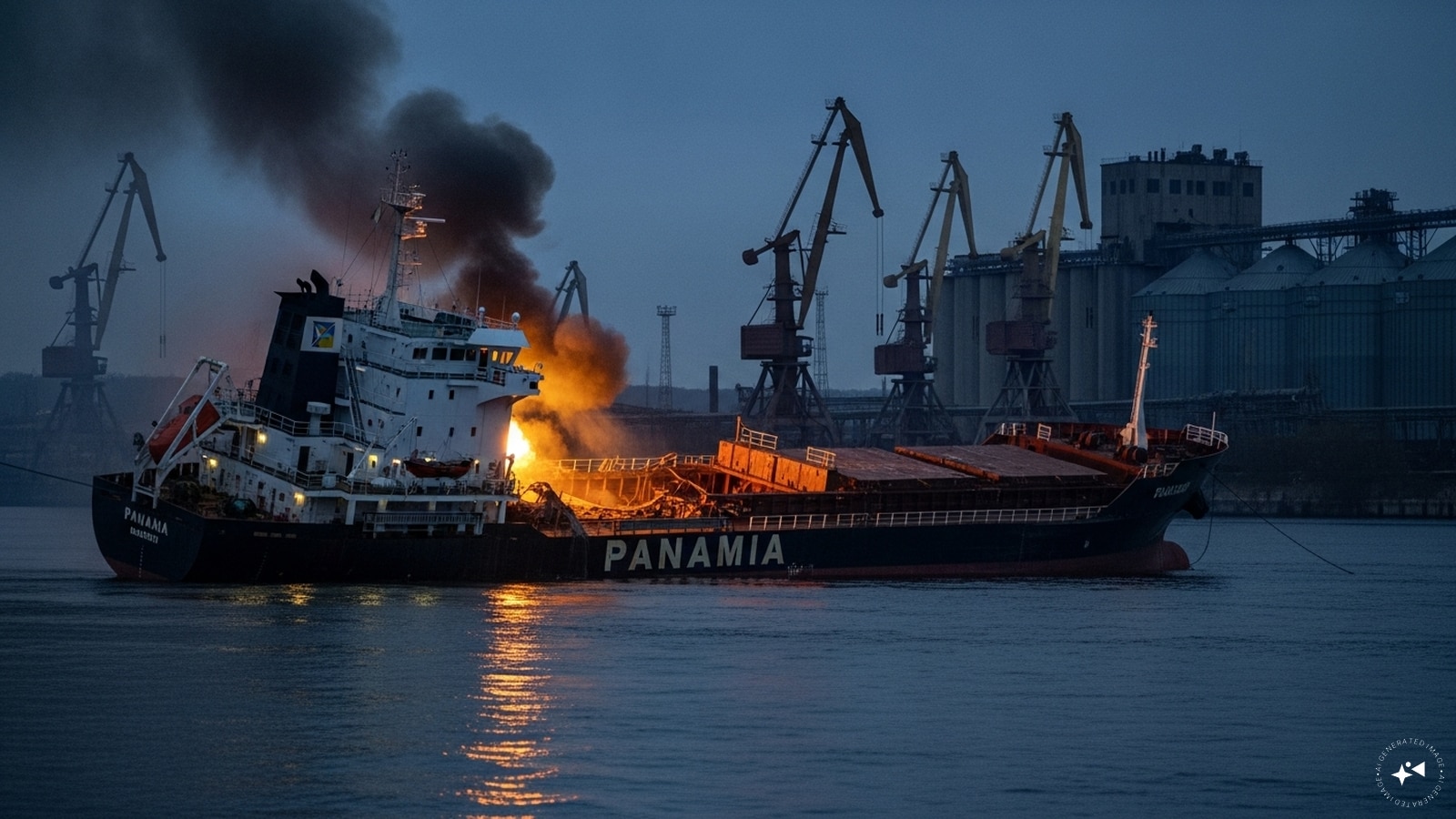
The air in Izmail usually smells of river silt and diesel. It is a working smell. It is the scent of a city that functions as a straw, drawing the golden lifeblood of the Ukrainian plains and pouring it into the thirsty mouth of the global market. But last night, that smell was replaced by the acrid, metallic tang of burnt wiring and scorched hull plating.
A Panama-flagged container ship does not belong to a country so much as it belongs to the world. It is a floating piece of international clockwork. When a Russian Shahed drone—a piece of flying lawnmower engine and high explosives—slams into the side of such a vessel, it isn't just attacking a hull. It is attacking a calorie. It is attacking the very idea that a ship can move from Point A to Point B without becoming a target.
Oleksiy (a name we will use for a man who spent his night in a damp cellar near the docks) didn't see the drone. He heard it. The sound is a low-frequency buzz that vibrates in the teeth. It is the sound of a mechanical predator that costs less than a used car but can paralyze a billion-dollar industry. When the explosion finally came, it wasn't the cinematic roar of the movies. It was a sharp, localized crack, followed by the groaning of stressed steel.
The ship, the Shui Spirit, took the hit while the port of Izmail was already reeling from a wave of strikes. Deputy Prime Minister Oleksiy Kuleba later confirmed the damage: a Panama-flagged civilian vessel, a warehouse full of grain, and the fragile peace of a Tuesday night, all shattered.
The Calculus of Chaos
War is often discussed in terms of territory gained or lost. We look at maps and see shifting red and blue lines. But the reality of the strikes on Izmail is found in the logistics of a loaf of bread.
Every time a drone finds its mark in the Danube delta, a maritime insurance underwriter in London adjusts a spreadsheet. The premiums go up. The number of captains willing to risk their crews goes down. This is the invisible siege. You don't need to sink every ship to stop the flow of food; you only need to make the risk too expensive to bear.
The Shui Spirit represents more than just steel and cargo. It is a data point in a brutal economic experiment. Since the collapse of the Black Sea Grain Initiative, the Danube has become the "Road of Life" for Ukrainian exports. It is a narrow, winding bottleneck. By targeting the ports of Izmail and Reni, the objective is simple: choke the straw.
Consider the physics of the attack. These drones are not precision instruments designed to win a battlefield engagement. They are terror-tools. They are launched in swarms to overwhelm air defenses, looking for anything that reflects a radar pulse—a crane, a silo, or the bridge of a merchant ship.
The Human Cost of a Blip on a Screen
We talk about "infrastructure" as if it is something inanimate. A port is not just concrete and iron. It is a collection of lives.
There is the crane operator who knows exactly how much the wind will catch a container. There is the customs official who checks the stamps on the bill of lading. There is the cook on the Shui Spirit, perhaps a man from the Philippines or Turkey, who was likely woken up by the shudder of an impact he had no way of preventing.
When the drone hit, it didn't care about the flag on the mast. It didn't care that the ship was civilian. The explosion tore through the side of the vessel, a jagged wound in the dark.
The "Invisible Stakes" here are the people who will never hear about Izmail. They are the families in Egypt, Lebanon, and Somalia who rely on the grain that sits in the warehouses currently being turned into ash. Every ton of wheat destroyed in a port strike is a thousand meals that will never happen. It is a direct correlation. One drone, one warehouse, ten thousand empty stomachs.
The Technology of Displacement
The Shahed-136 drone is a crude piece of technology. It uses a basic GPS guidance system and an engine that sounds like a moped. It is slow. It is loud.
Yet, it is devastatingly effective because of its cost-to-damage ratio. It costs roughly $20,000 to build. The missiles used to shoot it down can cost ten times that. This is the lopsided math of modern warfare. Ukraine has become a laboratory for this kind of asymmetrical exhaustion.
The port of Izmail is a maze of old Soviet architecture and new, shiny grain elevators. It was never meant to be a frontline. It was meant to be a place of commerce. But in 2026, there are no rear lines. The front is wherever a drone can fly.
Kuleba’s report was clinical. It listed the damage to the "Panama-flagged vessel" and the "grain storage facilities." But between those lines is the story of a port city that hasn't slept properly in years. The residents have learned to distinguish the sound of an incoming drone from the sound of an outgoing interceptor. They have learned that the silence following an explosion is the most terrifying part, because that is when the fire starts.
The Fragility of the Global Web
We live in a world that assumes the lights will stay on and the shelves will stay full. We have built a global civilization on the premise of "Just-in-Time" delivery.
The attack on the Shui Spirit is a reminder that this system is incredibly fragile. It relies on the shared understanding that civilian ships are off-limits. Once that rule is broken, the entire web begins to unravel.
If a ship in the Danube isn't safe, is a ship in the Red Sea safe? Is a ship in the Strait of Hormuz? The precedent being set in the smoke of Izmail is that the global commons are now a free-fire zone.
The repair crews arrived at the docks before the sun was fully up. They moved with the practiced efficiency of people who have done this many times before. They cleared the debris. They assessed the hull. They checked the grain for fire damage.
There is a quiet, stubborn defiance in the way the port workers return to their posts. It is not the loud, chest-thumping defiance of a political speech. It is the grim, tired defiance of a man picking up a broom while the smoke is still rising.
The Shui Spirit will eventually be patched. The grain that survived will be loaded onto another ship. The river will continue to flow.
But the silence in the streets of Izmail today isn't peaceful. It is the heavy, expectant silence of a city waiting for the next buzz in the night, the next flash on the horizon, and the next time the world’s dinner is held hostage by a flying engine and a few kilograms of plastic explosive.
The water of the Danube reflects the charred remains of the cranes, shimmering in the wake of passing tugboats, a reminder that the river remembers every hit, even if the rest of the world eventually looks away.