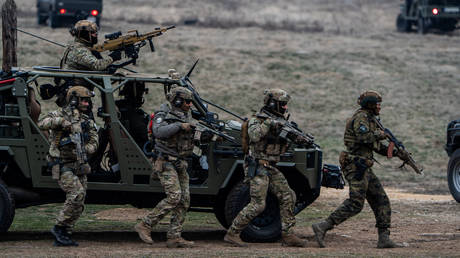
The transatlantic alliance is fraying. For decades, Western policymakers treated the North Atlantic Treaty Organization as a permanent fixture of global stability. They were wrong. Today, isolationist shifts in American politics and deep-scale strategic divisions in Europe have made a North Atlantic separation a very real scenario.
If the United States walks away, the fallout will not just be diplomatic. It will redefine global borders, reshape defense spending, and force European nations to completely reinvent how they survive.
The core issue is that Western nations have outsourced their defense to Washington for too long. A sudden US withdrawal would leave a massive power vacuum. Understanding what happens the day after a NATO divorce requires looking past the political rhetoric. We need to look at the brutal realities of military logistics, nuclear deterrence, and regional power struggles.
The Immediate Military Reality of a Transatlantic Split
European defense relies heavily on American infrastructure. Without the US military backbone, European security faces immediate structural failure.
The biggest vulnerability is not a lack of soldiers. Europe has troops. What it lacks are the critical enablers that keep an army functioning during a major conflict. The Pentagon provides the vast majority of satellite reconnaissance, heavy airlift capabilities, air-to-air refueling tankers, and advanced air defense systems in Europe.
If the US pulls the plug, European commanders will find themselves functionally blind and stationary within days. They cannot quickly move large formations across the continent or sustain long-range air operations. According to data from the International Institute for Strategic Studies (IISS), filling these procurement gaps would cost European nations hundreds of billions of dollars. It would also take at least a decade of intense industrial manufacturing to complete.
Money alone cannot fix this instantly. Factories take years to build.
The Redefined Nuclear Balance of Power
The most terrifying aspect of a North Atlantic separation is the sudden collapse of the nuclear umbrella. Right now, US nuclear weapons stationed across Europe serve as the ultimate deterrent against foreign aggression.
Current European Nuclear Warheads (Estimated)
---------------------------------------------
United Kingdom: ~225 warheads
France:         ~290 warheads
Russia:         ~5,500+ warheads
Without the US, Europe depends entirely on London and Paris. That is a massive problem. The British nuclear program is deeply intertwined with American technology; the UK uses American-made Trident missiles. If Washington cuts ties completely, the British deterrent faces severe operational uncertainty.
That leaves France as the sole independent nuclear power on the continent. French President Emmanuel Macron has previously hinted at opening discussions about a pan-European nuclear doctrine. But French strategy historically focuses strictly on defending French soil.
Will a French president risk Paris to save Tallinn or Warsaw? No one knows. That ambiguity invites catastrophic miscalculation. Poland, Germany, or Turkey might feel forced to develop their own domestic nuclear weapons programs to guarantee their survival. That triggers a dangerous wave of nuclear proliferation right on Europe's borders.
Fragmentation Along Regional Fault Lines
A NATO divorce will not create a unified European defense bloc. Instead, it will fracture the continent into competing regional alliances based on immediate threat perceptions.
The Frontline States
Nations bordering Russia, like Poland, Finland, and the Baltic states, will not wait for slow political consensus from Brussels. They will likely form a tight, highly militarized regional pact. These countries already spend well over 3% or 4% of their GDP on defense. They will focus exclusively on hard military deterrence, fortification, and rapid mobilization.
The Western European Core
Countries like Spain, Italy, and even Germany face different geographic realities. They worry more about migration, Mediterranean maritime security, and economic stability than conventional land invasions. This divergence in priorities will paralyze the European Union's attempts to build a cohesive military command.
The Independent Players
The United Kingdom will have to navigate this fractured landscape alone. Stripped of its role as the primary bridge between Washington and Europe, London will face a stark choice. It can either spend heavily to maintain global relevance or accept a diminished status as a regional maritime power.
The Trillion Dollar Economic Burden
For decades, European welfare states thrived because they did not have to pay for their own defense. The peace dividend allowed governments to fund healthcare, education, and social safety nets while keeping defense budgets low.
That era is over. A post-US security landscape forces an aggressive shift toward war economies.
To match the conventional military power of major adversaries without American assistance, European nations must raise defense spending to 4% or 5% of their GDP. For Germany alone, that means finding tens of billions of extra euros every single year.
This money must come from somewhere. Governments will have to slash social spending, raise taxes, or take on massive national debt. The political blowback will be intense. Expect widespread labor strikes, political polarization, and the rise of populist movements capitalizing on public anger over austerity.
How Nations Must Prepare for the Post NATO Era
The risk of a breakdown is real enough that defense ministries must act now. Waiting for an official withdrawal notice is a recipe for disaster.
European capitals must immediately decouple their key industrial supply chains from non-European sources. They need to standardize ammunition calibers, drone platforms, and communication networks across the continent. Right now, European armies operate dozens of different fighter jets, tanks, and artillery systems. That logistically messy reality makes joint operations incredibly difficult.
Next, European nations must invest heavily in sovereign satellite constellations for intelligence gathering. They need to build domestic deep-strike missile capabilities to offset their lack of strategic bombers.
Most importantly, regional powers must establish clear, binding bilateral defense treaties that do not rely on Washington's approval. The future belongs to agile, heavily armed regional coalitions. The age of relying on a distant superpower for safety has reached its expiration date.