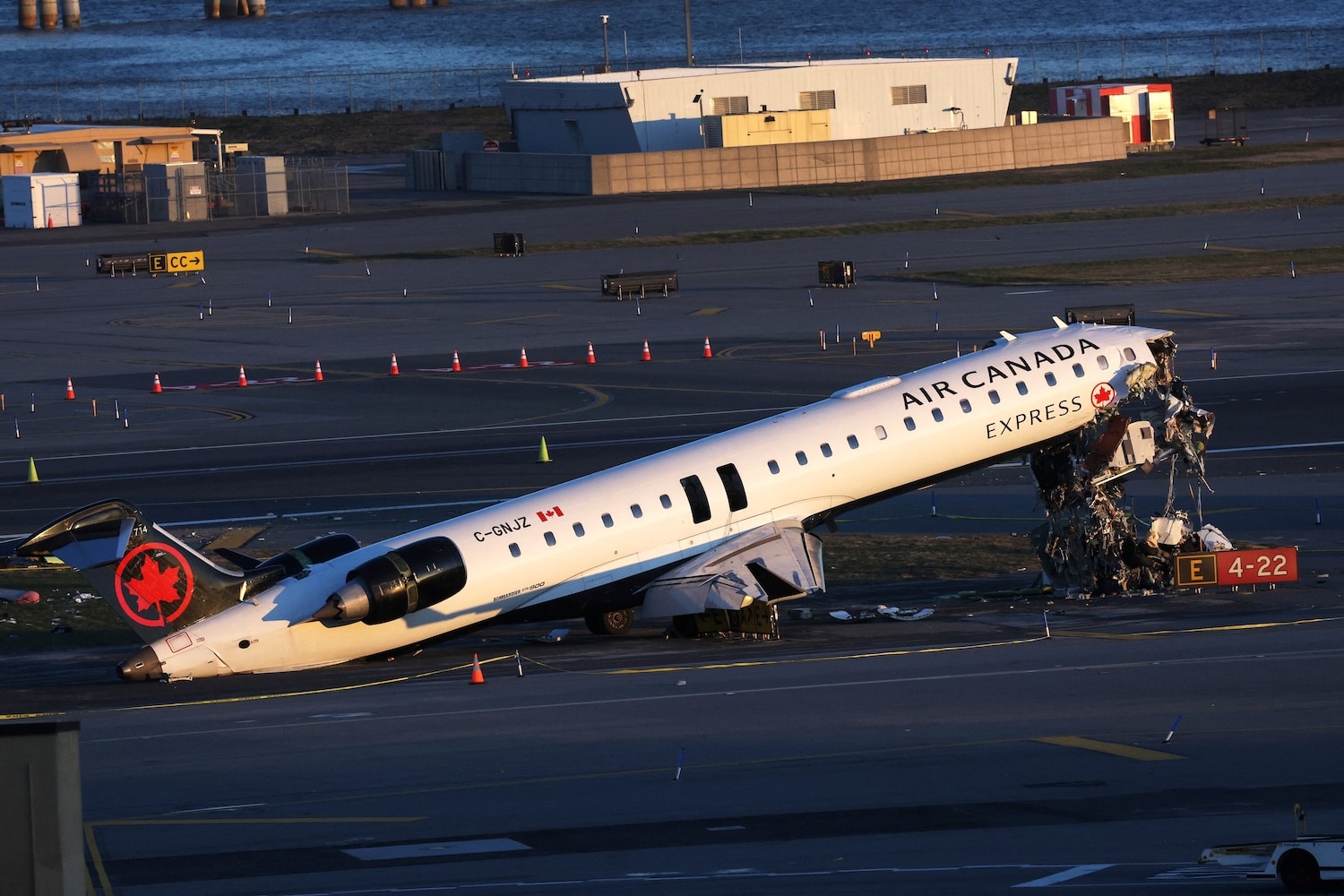
The metal scream is what stays with you. It isn't a clean sound. When two massive aircraft—triumphs of engineering worth hundreds of millions of dollars—grind against each other on a dark taxiway, it sounds like the earth itself is being torn open. At LaGuardia Airport, this sound recently became the punctuation mark at the end of a long, frantic sentence that the Federal Aviation Administration has been writing for years.
On the surface, the incident was a "minor ground collision." A wingtip clipped a tail. No fire. No casualties. Just a lot of paperwork and a few hundred terrified passengers staring out of scratched plexiglass. But look closer at the internal documents surfacing in the aftermath. The real story isn't about the physics of jet engines or the radius of a turn. It is about the exhaustion of the people in the tower and the gamble we take every time we push back from the gate.
The Ghost in the Tower
Imagine a young air traffic controller named Sarah. This is a hypothetical scenario, but Sarah represents the composite reality of the workforce currently holding the line in Queens. It is 6:00 PM. The rain is turning the tarmac into a black mirror, reflecting thousands of red and white LED lights. Sarah has been on duty for nine hours. She is working six days a week. This isn't a choice; it is a mandatory requirement because there simply aren't enough people to staff the consoles.
Her eyes track the blips on the surface movement radar while her ears process a constant stream of pilot voices, each one demanding a piece of her attention. At LaGuardia, the space is tight. It is often described as trying to park a dozen semi-trucks in a backyard. Every inch matters. When Sarah’s brain begins to fog from the sheer cognitive load of a sixty-hour work week, those inches begin to disappear.
The FAA’s own records now show that staffing levels at LaGuardia have plummeted to critical lows. We are talking about a facility operating at roughly 54% of its required certified professional controller workforce. Think about that number. If you went into surgery and found out the hospital only had half the necessary nurses and anesthesiologists, you would walk out. But at 30,000 feet, or while taxiing toward Runway 13, you don't get to see the skeletal crew behind the curtain.
The Math of Human Error
The numbers don't lie, but they do hide the stress.
Official documents reveal that the FAA has been relying on "forced overtime" to keep the lights on. This is a polite way of saying they are burning out their most vital assets. Research into human factors in aviation suggests that after a certain point, the brain stops "seeing" what is right in front of it. It’s called change blindness. A wing creeps too close to a vertical stabilizer, and the controller, staring at the screen, simply fails to register the closing gap because their neurons are spent.
Consider the layout of LaGuardia. It is a masterpiece of squeezed efficiency. Unlike the sprawling plains of Denver or the massive footprint of Dallas-Fort Worth, LaGuardia is a postage stamp. It handles over 30 million passengers a year on a patch of land that feels like an afterthought. When you combine that physical congestion with a half-staffed tower, you aren't just looking at an accident. You are looking at a mathematical certainty.
The collision involving the two jets wasn't an isolated stroke of bad luck. It was the physical manifestation of a systemic collapse. The document under scrutiny highlights a terrifying trend: as staffing levels drop, "operational errors"—the industry term for mistakes—climb in a near-perfect inverse correlation.
The Weight of the Silence
There is a specific kind of silence that happens in a cockpit right after a pilot feels a jolt they didn't expect. It’s the sound of a professional realizing the system failed them.
For years, the aviation industry has boasted about the "Gold Standard" of American safety. And it’s true; we haven't had a major domestic carrier crash in over a decade. But that record has created a dangerous sense of complacency. We have started to treat air traffic controllers like software—invisible, always on, and infinitely scalable.
But they aren't software. They are parents who haven't seen their kids all week because they’re stuck in the tower. They are professionals who drink too much coffee to stay sharp and spend their commutes worrying about the "near-miss" they just narrowly avoided. When a document reveals that LaGuardia is understaffed, it isn't just a budget line item. It is a confession that we are asking humans to perform at superhuman levels without the necessary support.
The FAA argues that they are "on a hiring spree." They point to the thousands of applications they receive every year. What they don't mention is the "washout rate." Training a controller for a complex environment like New York takes years. You can't just hire someone off the street and put them in front of a radar scope at one of the busiest airports in the world. You are looking at a lead time of three to five years before a trainee becomes a "Certified Professional Controller."
The crisis we see today is the result of decisions made half a decade ago. We stopped investing in the pipeline, and now the pipe is dry.
The Cost of Every Minute
Money usually speaks louder than safety warnings until the metal starts crunching.
Delay. It is the word every traveler hates. At LaGuardia, delays are often blamed on "weather" or "congestion." But frequently, the real culprit is a staffing "stop-move." When there aren't enough controllers to safely manage the volume of traffic, the FAA has to throttle the flow. They hold planes on the ground. They circle them in the air.
This isn't just an inconvenience. It’s a massive economic drain. Every minute a jet engine idles on a taxiway, it burns gallons of expensive fuel and spews carbon into the atmosphere. The "hidden cost" of understaffing isn't just the repair bill for a clipped wing; it is the cumulative billions of dollars lost in productivity and fuel as the system grinds to a halt because there aren't enough voices in the tower to keep it moving.
We are paying for a full-service aviation system but receiving a skeleton-crew reality.
The Night Shift
The sun sets over the Manhattan skyline, turning the glass towers into pillars of gold. At LaGuardia, the lights flicker on. The night shift arrives—or rather, the afternoon shift stays late.
The controllers look at the boards. They see the red delays stacking up. They know that tonight, like last night, they will be pushed to the edge of their mental endurance. They know the documents. They know the scrutiny. They know that if two planes touch, the world will blame the person on the radio, not the bureaucrats who failed to hire their replacement five years ago.
There is a visceral tension in that room. It is the tension of a rubber band stretched so thin you can see through it.
We often think of "safety" as a destination, a place we’ve already arrived at because of our technology. But safety is actually a verb. It is something that must be actively maintained, minute by minute, by people who are rested enough to care and focused enough to see.
When you walk down the jet bridge for your next flight out of New York, listen past the hum of the air conditioning and the chatter of your fellow passengers. Somewhere, a mile away in a concrete tower, a tired human being is making a split-second decision about where your plane needs to be. They are doing it with half the help they need. They are doing it because they have no choice.
The next time the metal screams, we won't be able to say we didn't see the warnings. The documents are on the table. The seats in the tower are empty. The only thing left is the hope that the people remaining don't blink.
One day, the luck runs out.