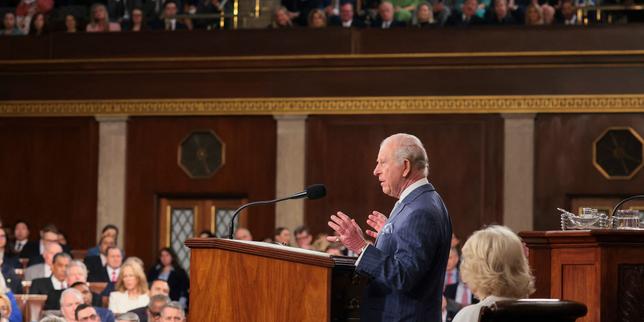
The address by King Charles III to a joint session of the United States Congress represents more than a ceremonial milestone; it is a calculated diplomatic intervention designed to arrest the accelerating decay of Atlanticist cohesion. As the United States faces internal pressures toward neo-isolationism, the British Crown is functioning as a non-partisan delivery mechanism for a specific strategic doctrine: that the cost of Western withdrawal from global security architectures far exceeds the price of sustained engagement. This analysis deconstructs the structural variables of this diplomatic maneuver, focusing on the defense-industrial link, the economics of isolationism, and the shift from "Special Relationship" sentimentality to cold-eyed interoperability.
The Triad of Atlanticist Stability
The cohesion of the Western alliance rests on three distinct pillars that the King’s rhetoric seeks to reinforce. When a sovereign speaks of "not turning inward," they are addressing a specific threat to these structural foundations: Don't miss our earlier post on this related article.
- Security Interoperability: The assumption that U.S. and UK intelligence and military assets remain integrated. Isolationism threatens the intelligence-sharing protocols of the Five Eyes, which relies on a predictable, outward-facing American foreign policy.
- Economic Standard-Setting: The prevention of fragmented regulatory blocs. A "closed" America forces the UK and Europe into a defensive economic posture, potentially leading to trade wars that degrade the collective GDP of the G7.
- The Democratic Deterrent: The psychological impact of Western unity on revisionist powers. The King’s presence in Washington serves as a visual and historical reminder that the current global order is a deliberate construction, not a natural state of affairs.
The Cost Function of Isolationism
Isolationism is often marketed as a cost-saving measure for the American taxpayer, yet the King’s argument implies a hidden "volatility tax" that accrues when the U.S. retreats. From a strategic consulting perspective, the cost of global engagement must be weighed against the projected cost of systemic collapse.
If the United States reduces its commitment to European security, the immediate result is an increase in regional arms races. For the UK, this necessitates a sharp increase in defense spending as a percentage of GDP, diverting capital from domestic infrastructure and innovation. For the U.S., the loss of overseas influence leads to a degradation of the dollar’s status as the global reserve currency. As nations seek security outside the American umbrella, they also seek financial clearing systems outside the SWIFT network. To read more about the background of this, Al Jazeera offers an informative summary.
The mechanism is clear: Isolationism leads to a multipolar financial system, which increases borrowing costs for the U.S. Treasury. The "savings" found by cutting foreign aid or military deployments are quickly erased by the rising interest rates required to fund the national debt in a less dollar-centric world.
The Defense-Industrial Symbiosis
A significant portion of the King’s appeal targets the practical reality of the AUKUS agreement and shared technology transfers. The UK-U.S. relationship has shifted from a historical bond to a high-tech manufacturing partnership.
The logic of the "withdrawal" that the King warns against would effectively decouple these industrial bases. We can categorize the risks of this decoupling into three operational bottlenecks:
- Research & Development Dilution: Shared costs in nuclear submarine technology and AI-driven surveillance are halved when two major powers collaborate. Isolationism forces redundant spending.
- Supply Chain Fragility: The UK provides critical aerospace components and specialized intelligence hardware that the U.S. defense sector relies on. A "Buy American" policy taken to its extreme disrupts the just-in-time delivery of components for platforms like the F-35.
- Talent Flow Stagnation: The restriction of movement and joint scientific ventures reduces the aggregate "brain trust" available to counter technological advancements from adversarial states.
Dissecting the Sovereign as a Strategic Asset
The British Monarchy operates as a unique instrument of "soft power" that possesses a durability longer than a four-year electoral cycle. In the context of a fractured U.S. Congress, the King’s role is to act as a "stabilizer" in the diplomatic circuit.
While a Prime Minister or a President carries the baggage of current partisan policy, the King represents the "Long State"—the institutional memory and permanent interests of the United Kingdom. His speech is not a request for specific legislation, but an attempt to recalibrate the American political class’s perception of its own identity. He frames global leadership not as a burden to be discarded, but as a core component of American exceptionalism.
This is a subtle psychological pivot. By framing the "inward turn" as a betrayal of the American legacy, the UK leverages its historical standing to influence modern legislative sentiment.
The Fallacy of the Zero-Sum Global Order
A common misconception in the current political climate is that global stability is a zero-sum game—that for the U.S. to "win" at home, it must "stop losing" abroad. The King’s address challenges this by highlighting the symbiotic nature of the Transatlantic partnership.
The data suggests that the "American Century" was built on a network effect. Much like a digital platform, the value of the American-led order increases with every additional participant who adheres to its rules. When the U.S. considers "turning inward," it is effectively devaluing its own platform.
The consequences of this devaluation include:
- A rise in regional hegemons who establish their own closed trade blocs.
- The loss of American soft power in emerging markets, specifically in the Indo-Pacific and Africa.
- The erosion of the legal and ethical standards that govern international waters and space.
Evaluating the Risks of Continued Engagement
Rigorous analysis requires acknowledging that the King’s vision is not without risk. For the United States, continued global leadership requires:
- Fiscal Strain: Maintaining a global presence during a period of high domestic debt.
- Political Overextension: The risk of being drawn into peripheral conflicts that do not directly affect core national interests.
- Public Fatigue: The widening gap between the foreign policy elite and a domestic population focused on localized economic concerns.
The King’s speech fails to address the specific mechanism by which the U.S. can balance these domestic pressures with its global responsibilities. He offers the "Why" but leaves the "How" to the technocrats.
Strategic Forecast: The Emergence of Flexible Multilateralism
The King’s visit signals that the era of the "blank check" in the Atlantic alliance is over. In its place, we should expect a transition toward a more transactional, project-based partnership.
The United States will likely continue its pivot to the Pacific, but it will do so by delegating more regional security authority to the UK and its European allies. This is the only logical path to prevent the "inward turn" that the King fears. By empowering allies to take a lead role, the U.S. can reduce its direct burden while maintaining the integrity of the overall system.
The UK must prepare for a future where it is no longer the "junior partner" in a U.S.-led world, but a primary regional coordinator that keeps the U.S. anchored to the European theater through deep industrial and intelligence ties. The King’s speech was the opening move in this long-term restructuring of the Western alliance.
For American policymakers, the move is to formalize these burden-sharing agreements now, while a friendly and stable British administration is in place. Waiting for a moment of crisis to renegotiate the terms of the Atlantic alliance will only increase the leverage of those who wish to see the system dismantled entirely. The focus must shift from general declarations of friendship to specific, codified agreements on energy security, semiconductor supply chains, and joint maritime patrols. This is the only way to transform the King's rhetorical appeal into a functional, resilient defense against the tide of isolationism.