The map on the table in Marjayoun doesn’t care about the diplomat’s pen. To a farmer looking out over the Litani River, a "ceasefire" isn’t a legal document printed on heavy vellum in Washington or Paris. It is the absence of a specific whistling sound in the air. It is the ability to walk to the edge of an olive grove without wondering if the earth is about to turn into a fountain of fire.
But the ink is drying differently this time. Also making headlines in related news: Quebec Premier Selection is a Performance for the Politically Blind.
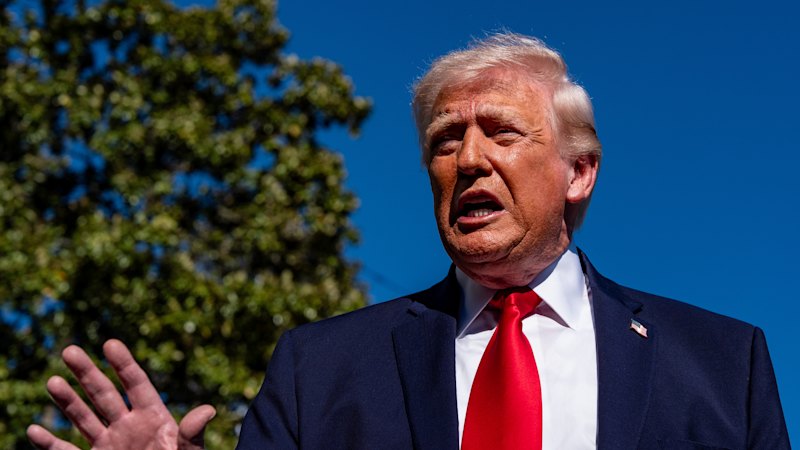
While the world watches the televised handshakes and the frantic shuttling of envoys, a stark reality has emerged from the Mar-a-Lago briefings and the war rooms of Tel Aviv. Donald Trump has signaled a green light for continued Israeli operations in Lebanon, specifically targeting the infrastructure of Hezbollah. The message is blunt. The ceasefire is a sieve. It is designed to let the civilians breathe while ensuring the hunt for the militants never quite stops.
The Geography of a Loophole
Imagine a house where the front door is locked, but the back wall has been entirely removed. That is the architecture of this deal. Further insights regarding the matter are explored by Associated Press.
Traditionally, a ceasefire is a frozen moment in time. You stop. I stop. We wait. But the shift in American policy, underscored by Trump’s explicit backing, creates a "selective peace." It distinguishes between the state of Lebanon—its shattered economy, its weary populace, its crumbling Lebanese Armed Forces—and the shadow state of Hezbollah.
By stating that Hezbollah is "not included" in the protections of the deal, the geopolitical landscape has been remapped. It suggests that the sovereign borders of Lebanon are no longer a shield. They are a translucent screen. Israel retains the "right to act" against what it deems imminent threats, a phrase that is as elastic as the rubber in a slingshot.
Consider the perspective of a hypothetical Lebanese Army sergeant, let’s call him Elias. Elias is told he must now move south to the border to ensure "stability." He is given a rifle, a worn uniform, and a set of orders that are intentionally vague. To his left, he sees the smoke of a precision strike on a hillside. To his right, he sees a village trying to rebuild. He is standing in the middle of a war that has been declared over, yet continues to scream around him.
The stakes for Elias aren't abstract. They are biological. If he interferes with the Israeli jets, he risks a wider conflagration. If he fails to stop Hezbollah's rearmament, he loses the trust of the international community. He is a ghost in his own country.
The American Pivot
The shift isn't just about military strategy; it’s about a fundamental change in the "American Guarantee."
For decades, the U.S. role in the Middle East was that of the frantic referee, blowing the whistle every time a player hit the turf. The goal was containment. Under the new Trumpian doctrine, the referee has decided that one player is permanently disqualified. By giving Israel the nod to continue "clearing operations," the U.S. is essentially outsourcing its counter-terrorism policy to the Israeli Air Force.
This isn't a game of chess. It’s a game of demolition.
The logic follows a cold, mathematical path:
- A ceasefire is signed to prevent a full-scale regional collapse.
- The "political" wing of Lebanon is given room to reset.
- The "military" wing of the opposition is treated as a separate entity, outside the law of the truce.
- Any retaliation by the opposition is framed as a violation of the peace, justifying further strikes.
It is a closed loop. A trap.
The Cost of a Moving Target
The problem with a selective ceasefire is that the "target" lives in the same room as the "civilian."
When a missile is directed at a hidden cache of rockets beneath a garage in a suburb of Beirut, the explosion doesn't ask for identification papers. The debris falls on the school next door. The shockwave breaks the windows of the bakery down the street. When Trump says Hezbollah is not included, he is effectively saying that the geography Hezbollah occupies is a "free-fire zone" regardless of the signatures on the peace treaty.
This creates a psychological haunting.
The people of Southern Lebanon are being asked to return to their homes under a "peace" that offers no immunity. It is like being told the storm is over while the lightning is still striking your backyard. You can plant the seeds, but you don't know if you’ll be there to see the harvest, or if your field will be designated a "strategic corridor" by a drone operator three hundred miles away.
The irony is thick. The deal is meant to empower the Lebanese state, to give it the "robust" authority it has lacked for years. But a state that cannot protect its territory from foreign incursions—even incursions targeting a group it technically opposes—is not a state. It is a landlord with no keys to the building.
The Invisible Stakes
Why does this matter to someone sitting in a coffee shop in London or a boardroom in New York?
Because it signals the end of the "Total Peace" era. We are entering the age of the "Managed Conflict." This is a world where wars don't end; they just change frequency. They become low-intensity hums that occasionally spike into screams.
The move to exclude Hezbollah from the ceasefire's protection is a pilot program for how future conflicts will be handled. It prioritizes the "security needs" of the dominant power over the "sovereignty needs" of the smaller nation. It is a return to a more transactional, brutal form of diplomacy where the weak are told to be grateful for the crumbs of quiet they receive.
The invisible cost is the death of the word "Cease."
If you can't trust that the fire has actually ceased, you never truly put down your guard. You don't invest. You don't dream. You just survive. You wait for the next "targeted operation" to remind you that your life is a footnote in a larger, more violent sentence.
The Echo in the Halls of Power
In Washington, this is seen as a masterstroke of "realism." It avoids the "forever war" by allowing a proxy to do the heavy lifting while claiming the moral high ground of a brokered peace. It is clean. It is efficient. It looks great on a teleprompter.
But realism has a habit of biting back.
By leaving the door open for continued strikes, the U.S. is betting that Hezbollah will simply take the hits and fade away. But history suggests that pressure doesn't just crush; it hardens. Every strike that happens during a "ceasefire" serves as a recruitment poster. It reinforces the narrative that the international system is a sham and that only the gun provides true protection.
We are watching a high-stakes gamble with the lives of millions as the chips.
The strategy assumes that the "human element"—the anger, the grief, the desperation—can be managed as easily as a troop movement on a digital map. It assumes that you can kill a movement without destroying the city that houses it.
The farmer in Marjayoun stands in his grove. He hears the drone, a persistent, metallic bee-sting of a sound. He looks at the paper in his hand—the one that says the war is over. He looks at the sky. He knows the truth that the diplomats haven't quite admitted yet.
The war isn't over. It has just become more precise in its cruelty.
The ink on the page is still wet, but the fire on the horizon hasn't gone out. It is merely waiting for the next coordinate to be entered into the system, a system that has decided that some people are worth the peace, and others are simply part of the landscape to be cleared.
The silence isn't peace. It’s just the sound of the world holding its breath, waiting for the next strike that everyone agreed was allowed to happen.