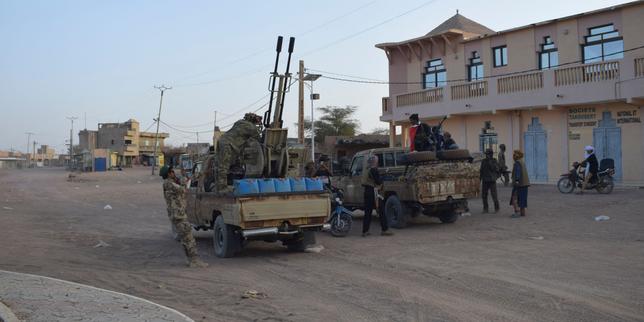
The sky over Kidal does not look like a battlefield. Most days, it is a searing, indifferent blue that stretches over the Adrar des Ifoghas mountains, a landscape of granite and sand where the wind speaks more often than the law. But recently, that blue was shattered. The sound didn't come from the ground, from the familiar rumble of a pickup truck or the call to prayer. It came from above.
When the Malian armed forces launched air strikes on this northern stronghold, they weren't just dropping munitions on a map coordinate. They were puncturing a fragile, decades-old silence. For the families huddled inside sun-baked mud-brick homes, the whistling of descending metal is a sound that collapses time, bringing the ghosts of past rebellions into the terrifying present.
Kidal is more than a city. To the Tuareg rebels who hold it, it is the heartbeat of an envisioned homeland. To the government in Bamako, it is the missing piece of a national puzzle, a symbol of sovereignty that has remained stubbornly out of reach. When the bombs fall, the geopolitical chess pieces move, but the human cost settles like the fine, pervasive dust that gets into everything—your water, your lungs, your memories.
The Midnight Suitcase
In a quiet apartment in Bamako, or perhaps a villa in the greener suburbs of the south, a phone glows in the dark. It is an alert from the French Ministry for Europe and Foreign Affairs. The message is polite but chilling. It recommends that French nationals "temporarily leave" the country.
There is a specific kind of hollow feeling that comes with that notification. It’s the realization that your life—your job at the NGO, your favorite café, the friendships you’ve built over spicy mafé—has suddenly been reclassified as a liability.
Consider the perspective of someone like "Clara," a hypothetical aid worker who has spent three years helping regional farmers implement sustainable irrigation. She isn't a politician. She isn't a soldier. Yet, when the military situation in the north escalates, the air in the south thickens with a different kind of heat. It is the heat of uncertainty.
Leaving isn't just about booking a flight. It is about deciding what fits into twenty-three kilograms of luggage when you don't know if you’re coming back. It’s the guilt of boarding a plane while your local colleagues stay behind to face an economy that might buckle and a security situation that is flickering like a dying candle. The "recommendation" to leave is a diplomatic euphemism for a looming storm.
The Geography of Ghost Towns
The struggle for Mali is often framed as a simple tug-of-war between a central government and separatist rebels. That is a convenient fiction. The reality is a labyrinth.
Kidal has long been the fortress of the CSP-PSD (Permanent Strategic Framework for Peace, Security, and Development), a coalition of armed groups. For years, a precarious status quo existed, propped up by international peacekeepers and foreign interventions. But the world shifted. The UN peacekeepers (MINUSMA) began their withdrawal, leaving behind a vacuum that both the Malian army and the rebels are desperate to fill.
When the army strikes from the air, they are signaling a new era of "reconquest." They are no longer waiting for permission or negotiation. This is a muscular, uncompromising push to reclaim the north. But Kidal is a city of shadows. The rebels are not a stationary army; they are part of the desert itself. They know the wadis, the caves, and the ancient trade routes that the satellites cannot see.
Every strike aimed at a rebel depot or a strategic outpost carries the risk of hitting the unintended. A marketplace. A school. A home where three generations are sleeping on the floor. In the aftermath of such strikes, the anger doesn't dissipate; it hardens. It turns into a recruitment tool. It ensures that even if the army takes the city, they may find they are governing nothing but resentment and rubble.
The Invisible Ties to Paris
Why does the French government react so sharply to events hundreds of miles away from the capital? The history between France and Mali is deep, jagged, and increasingly bitter.
For a decade, French boots were on the ground in Operation Serval and later Operation Barkhane. They were greeted as liberators in 2013 when they drove back jihadist militants. But gratitude has a short half-life in geopolitics. A decade of grinding conflict, coupled with a rise in nationalist sentiment and a shift toward new international partners like Russia, transformed the relationship.
Today, the presence of French citizens in Mali is a delicate matter. They are symbols of a colonial past and a complicated present. When the security situation worsens, they become potential targets for kidnapping or collateral damage in a growing anti-Western fervor.
The advice to leave is a recognition that the "old way" of doing things—where European powers could guarantee a degree of safety—is over. Mali is charting a course that is aggressively independent and fraught with peril. The departure of French nationals isn't just a safety precaution; it is the visual evidence of a divorce.
The Weight of the Wait
In Kidal, life doesn't stop, but it changes shape.
You learn to listen to the frequency of the engines. You learn which parts of the city are "loud" and which are "quiet." You stock up on grain and fuel because you know that when the fighting intensifies, the roads to the borders of Algeria or the southern reaches of Mali will become gauntlets of checkpoints and landmines.
The stakes are not abstract numbers or lines on a map. They are found in the eyes of a father who has to explain to his children why the horizon is flashing. They are found in the hands of a doctor in a poorly equipped clinic, trying to save a limb with supplies that were supposed to arrive two weeks ago.
The conflict in Mali is often described as "low-intensity" by those sitting in comfortable offices in Geneva or New York. But there is no such thing as low-intensity when it is your roof that might collapse. There is no such thing as a "temporary departure" when you are leaving your heart behind in a country that seems determined to tear itself apart before it can find a way to be whole.
The desert has a way of outlasting everything. It outlasts empires, it outlasts rebel movements, and it outlasts the men who drop bombs from the safety of the clouds. As the strikes continue and the foreigners flee, the people of Kidal are left with the only thing they have ever truly owned: the sand beneath their feet and the terrifying, beautiful silence of the dunes, waiting for the next sound to break the sky.
The planes will eventually run out of fuel. The politicians will eventually move on to the next crisis. But the child who watched the sky turn to fire will still be there, wondering if the blue will ever be just blue again.