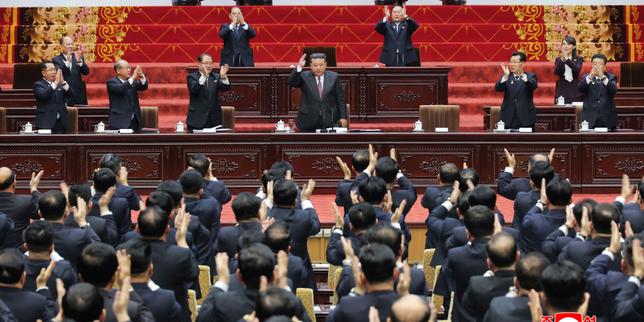
The March 2026 re-election of Kim Jong Un as President of the State Affairs Commission by the 15th Supreme People’s Assembly (SPA) is not a measure of democratic contestation, but a critical audit of institutional equilibrium within the Democratic People's Republic of Korea (DPRK). Western analysis frequently dismisses these events as theatrical. This reductionist view overlooks the precise administrative function of the SPA. The assembly does not exist to generate policy; it exists to codify it, converting the ideological directives of the Workers’ Party of Korea (WPK) into binding state law.
To evaluate the stability of the DPRK, analysts must deconstruct the mechanics of its governance. The March 2026 session provides a high-resolution data set regarding elite cohesion, constitutional maneuvering, and the state’s mid-term economic planning.
The Three Pillars of Unitary Governance
Power in the DPRK operates through three interlocking vectors: the Party, the Military, and the State. System stability requires synchronous rotation across all three. When the 9th Congress of the WPK re-elected Kim as General Secretary in February 2026, it satisfied the ideological pillar. The March 2026 SPA session satisfied the legal-state pillar.
This synchronization reveals a structured sequence of transmission:
- Ideological Definition (The Party Congress): Objectives are set, such as the parameters for the five-year national economic development plan.
- Constitutional Ratification (The SPA): The rubber-stamp legislature convenes to transpose these objectives into the state budget and legal code.
- Operational Execution (The Cabinet): Technocrats are appointed to meet the quotas.
Vague media descriptions of Kim's "absolute power" obscure the transactional nature of this system. Maintaining this structure requires a continuous re-shuffling of personnel to prevent any single bureaucrat from building an autonomous power base.
The 15th SPA session executed this exact protocol. Jo Yong Won was appointed Chairman of the SPA Standing Committee, replacing Choe Ryong Hae. Pak Thae Song was retained as Premier, but the creation of a First Vice Premier post—expected to be filled by Kim Tok Hun—indicates a structural split in economic oversight. By dividing executive economic management from legislative oversight, the regime prevents horizontal integration of power among its elites.
The Cost Function of the Two-State Doctrine
A primary objective of the 15th SPA session was the suspected constitutional codification of the "Hostile Two-State" doctrine. In early 2024, the regime directed the deletion of terms like "unification" and "homeland" from the state ideology, redefining South Korea not as a separated territory to be reclaimed, but as a permanent, hostile foreign adversary.
From a game theory perspective, this shift alters the DPRK’s external cost function:
- Under the Traditional Unification Model: Any economic or military engagement with the South was viewed through the lens of internal civil friction. The cost of kinetic conflict was high because it destroyed perceived future domestic assets.
- Under the Hostile Two-State Model: South Korea is reclassified as a foreign threat. This lowers the psychological and ideological threshold for conventional and nuclear posturing. It justifies the permanent allocation of state resources to the defense sector at the expense of light industry.
This ideological pivot is not rhetorical. It provides the legal architecture required to sustain a closed economic loop. When citizens are told that reunification is no longer the objective, the state no longer has to explain why South Korea possesses vastly superior economic outputs. It converts a comparative failure into a security imperative.
Measuring Legitimacy: The Limits of Quantifiable Data
Data from DPRK elections is notoriously binary. State media reported voter turnout at 99.99%, with 99.93% voting in favor of the single-candidate slates and 0.07% voting against.
Western observers view the 0.07% negative vote as a fabrication designed to simulate democratic pluralism. While statistically probable, a more rigorous interpretation views this micro-deviation as a stress test of the internal security apparatus. Because voting against a candidate requires a voter to physically cross out a name in a non-secret booth, the act is a visible data point of dissent. Reporting these infinitesimal fractions allows the internal security apparatus to demonstrate that it can detect, isolate, and quantify micro-anomalies within the population.
The limitation of interpreting this data is that it measures compliance, not consent. High turnout metrics do not track genuine political alignment; they measure the operational penetration of the local neighborhood watch units (Inminban). A decline in turnout would signal a breakdown in local administrative control, not a shift in political ideology. Since turnout held at 99.99%, the structural integrity of local surveillance remains intact.
Resource Allocation and Systemic Bottlenecks
The 15th SPA session also reviewed the state budget for 2026 and the execution of the five-year national economic development plan. In a command economy, state budgets are indicators of structural priorities.
The DPRK operates under a hard resource constraint. To expand the nuclear and ballistic missile programs, capital must be extracted from the agricultural or civilian manufacturing sectors. This creates a severe bottleneck. Chronic underinvestment in the energy grid limits industrial uptime. Without electrical consistency, heavy machinery cannot operate at capacity, which reduces steel output, which in turn limits weapon fabrication.
The regime attempts to bypass this bottleneck through external vectors:
- Cyber-Monetization: State-sponsored digital asset extraction (cryptocurrency theft) bypasses conventional banking blockades. This injects liquid capital directly into the military procurement chain without straining the domestic agricultural base.
- Military-Industrial Bilateralism: Supplying conventional munitions to external state actors in active conflicts provides the DPRK with petrochemical inputs and advanced telemetry data.
The SPA’s approval of the 2026 budget codifies this extraction model. By locking in state expenditures, the regime signals to its technocrats that defense allocations will remain static, and the civilian population will bear the brunt of any deficits.
Strategic Vectors and External Alignments
Looking at the structural adjustments made during the March 2026 assembly, the strategic playbook for the regime becomes clear. The state is entrenching itself for a prolonged period of isolation from the West, while deepening tactical integration with alternative economic spheres.
For intelligence analysts and external policymakers, the operational recommendation is to shift focus away from standard diplomatic overtures regarding denuclearization. The structural changes passed by the 15th SPA indicate that the DPRK has legally and ideologically foreclosed the possibility of standard rapprochement.
The next tactical play for external actors is to increase the friction within the regime's cyber-extraction and illicit maritime shipping networks. Since the domestic economy cannot generate self-sustaining growth, the regime's Achilles' heel is its dependence on these external grey-market revenues. Interdicting these financial flows breaks the feedback loop between external cash injection and domestic military production. If the external revenue stops, the regime will be forced to cannibalize its own internal systems to fund the military, accelerating elite friction and administrative degradation.