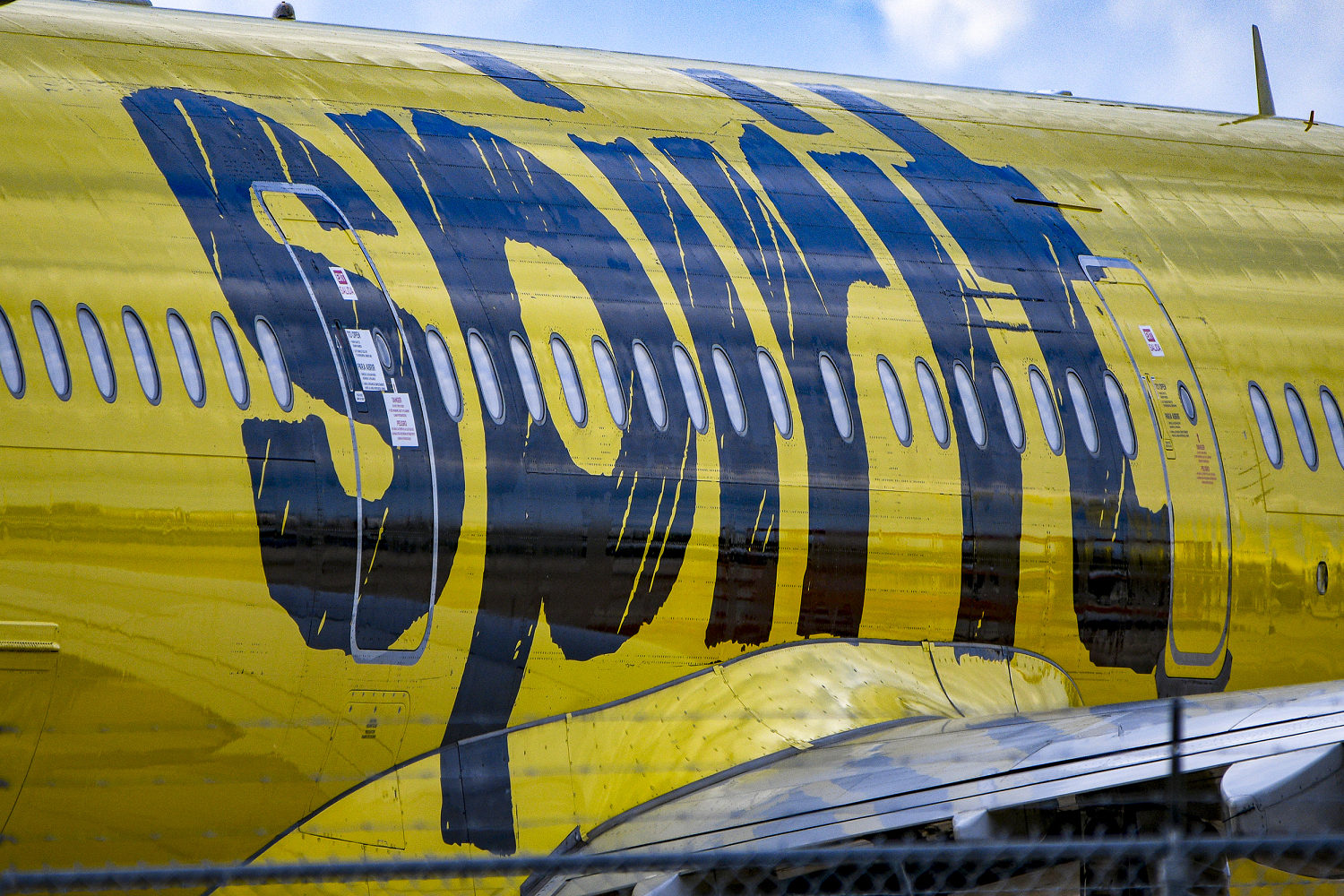
The air inside a Spirit Airlines cabin doesn’t smell like luxury. It smells like desperation, Lysol, and the frantic rustle of people trying to shove oversized backpacks under seats to avoid a fifty-dollar gate fee. It is the Greyhound bus of the clouds. For years, the Big Four airlines—Delta, American, United, and Southwest—have looked down at the bright yellow fleet with a mixture of pity and corporate disdain. To the elite flyer, Spirit is a punchline. But to the person who needs to get to a grandmother’s funeral on a fifty-seven-dollar budget, Spirit is a lifeline.
When the news broke that Spirit was spiraling toward bankruptcy, most of Wall Street yawned. The attempted merger with JetBlue had been blocked by the Department of Justice, leaving the carrier adrift with massive debt and engines that didn't always want to cooperate. The narrative was simple: another budget carrier bites the dust.
Then came the man with the plan. He didn't come from a boardroom. He came from the internet.
The Viral Architect of a Budget Empire
Dominic "Dom" Gallo didn't just post a tweet; he sparked a populist uprising. His proposal, wrapped in the irreverent "Get in loser, we’re buying Spirit" meme culture, suggested something radical. He wasn't looking to strip the company for parts or turn it into a boutique experience with hot towels and legroom. He wanted to lean into the chaos. He wanted the people—the actual flyers who rely on those yellow seats—to take the reins.
It sounds like a joke. It looks like a fever dream born on a late-night subreddit. Yet, beneath the memes lies a terrifyingly logical realization about the American economy. We are losing the middle, and we are losing the bottom. If Spirit dies, the price of every other ticket in the sky goes up. Competition isn't just a buzzword found in Econ 101 textbooks; it is the only thing keeping the giants from charging a thousand dollars for a puddle-jump from Peoria to Pittsburgh.
Dom’s plan was a crowdsourced turnaround strategy that treated the airline like a community asset rather than a failing ticker symbol. He looked at the balance sheets—the hundreds of millions in debt, the Pratt & Whitney engine issues—and saw a math problem that could be solved by sheer, unadulterated volume and brand loyalty.
The Invisible Stakes of the Budget Traveler
To understand why this matters, you have to look at the people standing in Zone 4 at the gate. Consider a hypothetical passenger we will call Elena. She is a nursing student in Florida. Her brother is getting married in New York. Elena doesn't care about the "experience." She doesn't need a complimentary ginger ale or a seat that reclines three inches. She needs a seat. Period.
If Spirit disappears, Elena doesn't just pay more for a Delta flight. She stays home.
The death of a low-cost carrier is a silent tax on the working class. When a company like Spirit fails, it isn't just the shareholders who lose; it's the mobility of the average citizen. The "Spirit Plan" wasn't just about saving a company; it was about preserving the right to be in the room when it matters, regardless of your bank account balance.
Dom recognized that Spirit’s greatest weakness—its reputation for being "trashy"—was actually its greatest shield. By leaning into the "yellow bus" aesthetic, the airline had built a moat. No one else wanted to be the bottom-feeder. But there is a lot of life at the bottom of the ocean.
A Mathematical Miracle or a Fool’s Errand
The numbers are brutal. Spirit’s debt load is a mountain of jagged glass. The company has struggled with liquidity, and the collapse of the JetBlue deal left them without a safety net.
Dom’s viral plan suggested a pivot toward a more aggressive, ultra-low-cost model that prioritized operational efficiency over everything else. He argued for a "people’s airline" approach. Imagine a world where the frequent flyers weren't just customers, but stakeholders in a literal sense. While the legalities of a mass-scale retail investor takeover are a nightmare of SEC filings and bureaucratic red tape, the sentiment resonated because it pointed out a fundamental truth: the current system is rigged against the small player.
The "Spirit Plan" isn't just about planes. It’s a metaphor for the desire to reclaim things that feel like they’re slipping away. Every time a budget brand is swallowed by a giant or goes under, the world gets a little bit smaller for everyone who isn't wealthy.
Consider the "Spirit Effect." This is a documented economic phenomenon where the mere presence of Spirit in a market forces every other airline to lower their prices. If Spirit exits a route, the prices on United and American often jump by forty percent overnight. That is the invisible hand reaching into your pocket.
The Psychology of the Yellow Plane
There is a certain honesty in a Spirit flight. They don't lie to you. They tell you exactly what you’re getting: a chair and a way to get from A to B. Everything else—water, bags, a smile—costs extra.
In a world of corporate gaslighting where "premium economy" is just a standard seat with a slightly different colored stitch, Spirit’s transparency is refreshing. Dom’s viral movement tapped into this. He saw that people were tired of the "luxury" lie. They wanted the utility.
He proposed streamlining the fleet even further, doubling down on the single-aisle Airbus models to keep maintenance costs in the basement. He talked about aggressive scheduling and turning planes around at the gate faster than a pit crew at Daytona. It was a vision of industrial beauty—a machine designed to move humanity with the efficiency of a conveyor belt.
But machines need fuel, and Spirit’s fuel is cash.
The struggle to save the airline isn't just happening in the cockpit; it's happening in the halls of power where antitrust laws are debated. The DOJ blocked the JetBlue merger because they feared it would eliminate the "Spirit Effect." They were right to be afraid. But by blocking the merger without providing a path for Spirit to survive on its own, they may have inadvertently signed the death warrant they were trying to prevent.
The Human Cost of Efficiency
We often talk about businesses as if they are abstract entities—boxes on a chart. We forget the mechanics who spend their nights in cold hangars in Detroit, or the flight attendants who have to handle the frustration of three hundred people who just realized their personal item is two inches too wide.
If Dom’s plan, or any version of it, succeeds, it won’t be because of a clever meme. It will be because thousands of people decided that having a "bad" airline was infinitely better than having no airline at all.
There is a strange, perverse pride in surviving a Spirit flight. It’s a shared ordeal. You land, you look at your seatmate, and you both acknowledge that you just cheated the system. You got across the country for the price of a nice dinner. You won.
That feeling of winning is what the viral movement was really selling. It was the idea that we don't have to accept the slow consolidation of everything into the hands of a few giant, overpriced entities.
The Final Descent
The runway for Spirit is getting shorter. Every day that passes without a massive infusion of capital or a radical restructuring brings the yellow planes closer to the boneyard in the desert.
Dom Gallo’s "plan" might remain a digital artifact—a moment in time where the internet tried to save a plane. But the conversation it started cannot be silenced. It forced us to look at the bottom of the sky and realize how much we depend on it.
We are living in an era where the gap between those who fly private and those who can barely afford a bus ticket is widening into a canyon. Spirit Airlines, for all its flaws, its cramped seats, and its yellow paint, is a bridge across that canyon.
When you see that bright yellow tail fin taxiing past the window of your terminal, don't laugh. Don't make the joke about the seats not reclining. Instead, think about the people on board. Think about the student going to an interview, the father going to see his daughter's graduation, and the families who are only together because someone decided to build an airline for the rest of us.
The sky shouldn't just belong to those who can afford the upgrade.
If the yellow planes stop flying, the air will get a lot quieter, and the world will get a lot more expensive. We might find ourselves looking up, wishing for the days when we could complain about a fifty-dollar flight, realizing too late that the real luxury wasn't the legroom—it was the opportunity to leave the ground at all.
The fight for Spirit is a fight for the messy, loud, uncomfortable, and absolutely essential reality of an accessible world.
Fasten your seatbelts. It’s going to be a bumpy ride.