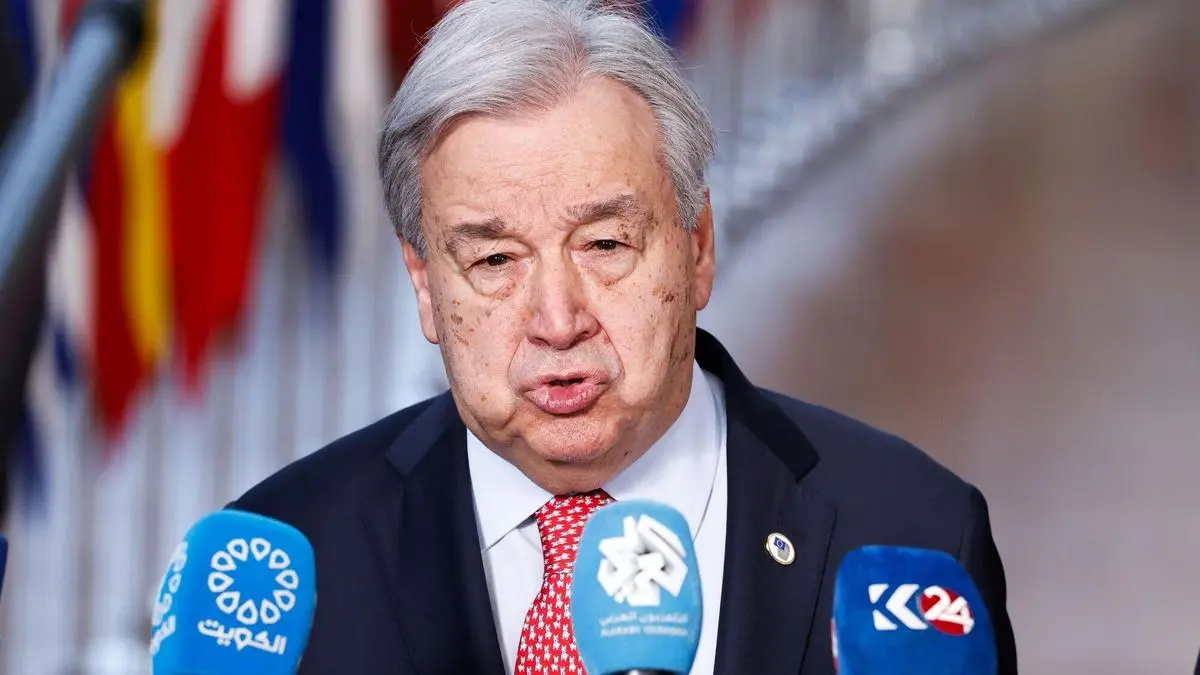
United Nations Secretary-General António Guterres recently cautioned that peace in West Asia cannot be manufactured overnight. While that statement carries the weight of historical realism, it also serves as a convenient shield for a diplomatic process that has become increasingly detached from the mounting body count on the ground. The insistence that "talks should continue" suggests a functioning mechanism is in place, yet the reality is a stalled engine while the car is sliding toward a cliff.
The core of the current crisis is not a lack of dialogue. It is a fundamental misalignment of incentives among the primary power brokers. For decades, the international community has leaned on a framework of incrementalism—the idea that small, successive concessions will eventually lead to a grand bargain. This approach is failing because the regional players have learned to weaponize the "process" itself. They use the cover of ongoing negotiations to consolidate territorial gains, harden political positions, and wait out the attention spans of Western mediators.
The High Cost of the Long Game
When the UN leadership calls for patience, they are essentially asking for more time in a theater where time is the enemy of the vulnerable. The diplomatic machinery in New York and Geneva moves at a pace that assumes a baseline of stability which no longer exists. We are seeing a shift where non-state actors and regional powers have calculated that the cost of defiance is lower than the cost of compromise.
This isn't a misunderstanding that can be cleared up with more summits. It is a cold, calculated geopolitical deadlock. The mediators are operating on a 20th-century playbook of statecraft, while the conflict has moved into a fragmented, multi-polar era. In this new environment, traditional leverage—like economic sanctions or the promise of international recognition—has lost its edge.
Breaking the Cycle of Meaningless Summits
To understand why these agreements remain elusive, we have to look at the internal politics of the nations involved. For many leaders in the region, the conflict is not a problem to be solved, but a condition to be managed. It provides a useful external enemy to distract from domestic economic failures or crackdowns on dissent.
True progress requires more than just keeping the seats warm at a conference table. It requires a radical shift in how the international community applies pressure. If the UN and major world powers continue to offer "continued talks" as the only solution, they are effectively subsidizing the status quo.
Accountability has been the missing ingredient. Without a clear mechanism to penalize parties that use negotiations as a stalling tactic, the talks will remain a performative exercise. We see this in the way ceasefire proposals are handled: they are accepted in principle to satisfy international observers, then picked apart by impossible "clarifications" until the momentum dies.
The Illusion of Neutrality
There is a persistent myth that the UN must remain a neutral arbiter at all costs. While neutrality is a core tenet of the organization, it often translates into a refusal to name the specific entities sabotaging the peace process. By treating all sides as equally committed to a peaceful outcome, the UN inadvertently provides cover for the side that is most interested in continuing the violence.
The Secretary-General's rhetoric reflects a desire to avoid a total collapse of the diplomatic track. If the UN admits the talks are dead, they lose their seat at the table. But there is a point where maintaining the table becomes an act of complicity.
Beyond the Rhetoric of De-escalation
Every official statement from the past six months has included the word "de-escalation." It is the most overused and least effective word in the diplomatic dictionary. You cannot de-escalate a situation where the underlying drivers of the conflict—land, sovereignty, and security—are being actively contested every day.
Instead of vague calls for restraint, the focus must shift to enforceable milestones.
- Verification Mechanisms: Moving beyond "trust" and implementing hard, third-party monitoring of troop movements and weapon transfers.
- Direct Consequences: Tying international aid and diplomatic standing to specific, timed benchmarks of progress.
- Inclusive Tables: Recognizing that excluding certain regional influencers, however distasteful their politics may be, only ensures they will act as spoilers from the outside.
The Strategic Value of Deadlock
We must confront the uncomfortable truth that some parties involved find the current state of "permanent crisis" preferable to a settled peace. A settled peace requires difficult concessions. It requires defined borders. It requires giving up the dream of total victory. Deadlock, by contrast, allows for the maintenance of a "heroic struggle" narrative that sustains political life cycles.
The international community's failure to recognize this dynamic is why we are stuck in a loop. We are treating a structural problem as if it were a series of unfortunate events.
The Neighborhood Effect
West Asia does not exist in a vacuum. The vacuum left by ineffective UN intervention is being filled by other global powers who have no interest in a liberal, democratic peace. They are interested in influence. When the UN says "talks should continue," these other players hear "the door is open for us to cut our own deals."
This competition for influence makes a unified peace plan nearly impossible. Every time a potential agreement gains traction, a secondary power center finds a way to pull a thread, unraveling the whole sweater. This is the reality of a multi-polar world that the UN's current structure is not built to handle.
Hard Realities for the Road Ahead
If we are to move past the "overnight" excuse, we have to stop treating the West Asia crisis as a technical problem that can be solved with the right wording in a resolution. It is a power struggle. Power only responds to power, not to the moral appeals of a global body that lacks an enforcement arm.
The Secretary-General is right that agreement is hard. He is wrong to suggest that the current trajectory of "continued talks" is anything other than a slow-motion failure. The diplomatic corps needs to stop measuring success by the number of meetings held and start measuring it by the amount of ground shifted.
We are witnessing the obsolescence of the traditional diplomatic mission. The people living through the shelling and the blockades do not have the luxury of "not overnight." For them, every night is a gamble that the international community is currently losing on their behalf.
The only way to break the cycle is to stop pretending that the current process is working. It isn't. It is a treadmill that gives the appearance of movement while the world stays exactly where it is—or worse, drifts further into the dark. If the talks are to continue, they must be fundamentally redesigned to prioritize immediate, tangible outcomes over long-term, abstract goals. Anything less is just noise to drown out the sound of the next explosion.
Stop talking about the process and start talking about the price of failure. The window for a managed solution is closing, and no amount of diplomatic patience will be able to pry it back open once it shuts for good.