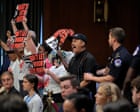
The shouting in the Dirksen Senate Office Building wasn't just noise. It was the sound of a math problem meeting a morgue. When activists from ACT UP and other advocacy groups stood up to interrupt Russell Vought, the man holding the eraser over the federal budget, they weren't merely protesting a number. They were protesting a death toll. The "Vought cuts kill people" slogan that echoed through the marble hallways isn't a metaphor—it is a literal projection of epidemiological outcomes when funding for HIV/AIDS research and treatment is stripped from the ledger.
The tension in that room highlights a fundamental rift in how the United States governs. On one side sits a fiscal ideology that views every dollar spent as a liability to the national debt. On the other sits the reality of public health, where every dollar withheld from a low-income patient with a manageable chronic illness eventually turns into a ten-dollar bill for an emergency room visit or a funeral. Russell Vought, as the architect of these fiscal blueprints, has become the face of a movement that treats federal health spending as an optional luxury rather than a preventative wall against a national crisis.
The Arithmetic of Attrition
To understand why the protests reached a fever pitch, you have to look at the specific programs targeted for the chopping block. We aren't talking about bureaucratic waste or "studies on snail mating habits." We are talking about the Ryan White HIV/AIDS Program, a safety net that provides care and treatment for over half a million people who have nowhere else to go.
When a budget director proposes a "flat" budget in a time of 4% inflation, they are proposing a cut. When they propose an actual reduction in the hundreds of millions, they are proposing an eviction from the healthcare system. The math is brutal and predictable.
The Cost of Treatment vs. The Price of Neglect
In the realm of infectious disease, "treatment is prevention." This is a scientific fact, not a political talking point. When an individual with HIV has access to antiretroviral therapy (ART) and achieves an undetectable viral load, they cannot transmit the virus to others. This concept, known as U=U (Undetectable = Untransmittable), is the cornerstone of ending the epidemic.
By cutting funding for these medications, the government effectively restarts the engine of transmission. It is a domino effect. One person loses their insurance coverage because of a budget "realignment." They stop taking their pills. Their viral load spikes. They become sick, requiring intensive, taxpayer-funded hospital care. Worse, they can now pass the virus to others. A $20,000-a-year medication cost saved in February becomes a $200,000 ICU bill in October.
The Shadow of the 1980s
For the activists who stormed the hearing, this isn't their first war. There is a deep, institutional memory within groups like ACT UP that remembers when a previous administration ignored a mounting body count for the sake of fiscal conservatism and social stigma. The fury directed at Vought is fueled by the fear that the progress made over the last twenty years—turning HIV from a death sentence into a manageable condition—is being reversed for the sake of a balanced sheet that will never actually balance.
Vought’s defense usually centers on the idea of "efficiency" and "returning power to the states." It sounds reasonable in a vacuum. However, in the context of public health, "returning power to the states" often translates to "giving states the permission to let people die." Many of the states with the highest HIV transmission rates are the same states that have refused to expand Medicaid. They are states with crumbling rural health infrastructures. Without federal mandates and dedicated funding streams, the safety net doesn't just fray; it vanishes.
The Ideological Wall
The argument from the budget office is that the federal government cannot be the "insurer of last resort" forever. They argue that private markets and charitable organizations should bridge the gap. This is a fantasy. No charity in the world has the logistics or the capital to manage the lifelong medication needs of 500,000 Americans.
The private sector thrives on risk management, and from a cold, corporate perspective, an indigent patient with a chronic infectious disease is a high-risk, low-reward liability. When the government exits the room, there is no one waiting in the wings to catch those who fall. They simply hit the floor.
Global Stakes and the PEPFAR Pivot
The domestic cuts are only half the story. The same fiscal hawks targeting domestic programs often have their sights set on PEPFAR (the President's Emergency Plan for AIDS Relief). Since its inception under George W. Bush, PEPFAR has saved an estimated 25 million lives globally. It is widely considered the most successful foreign policy initiative in American history.
Yet, it has become a bargaining chip.
By introducing ideological riders—such as language regarding reproductive health or "moral" requirements for NGOs—the budget office risks paralyzing a system that currently keeps millions of people alive across sub-Saharan Africa and Southeast Asia. If PEPFAR funding is disrupted, even for a few months, the global supply chain for life-saving drugs breaks. Resistance strains of the virus could emerge, potentially rendering current treatments useless. This isn't just a humanitarian concern; it is a global security threat.
The False Economy of Austerity
There is a stubborn myth in Washington that you can "cut your way to health." It suggests that by tightening the belt today, the system will become leaner and more resilient. The opposite is true in medicine.
Public health is an investment in human capital. When people are healthy, they work. They pay taxes. They raise families. They contribute to the economy. When you remove the floor of healthcare, you create a permanent underclass of the sick and the dying, which ends up costing the state significantly more in lost productivity and emergency intervention.
- Emergency Room Dependency: Uninsured patients use the ER as primary care. This is the most expensive way to deliver medicine.
- Lost Productivity: A worker on ART is a productive member of society. A worker with full-blown AIDS is a drain on disability and social services.
- Containment Costs: It is infinitely cheaper to treat one patient than it is to track and treat the ten people they might accidentally infect because they lost access to treatment.
Vought’s spreadsheets don't have a column for "Human Suffering" or "Societal Decay." They only have rows of numbers. But for those in the gallery, those numbers represent friends, partners, and their own lives.
The Modern Face of Resistance
The interruption of the hearing wasn't an act of "incivility." It was an act of survival. In a political environment where lobbying groups with deep pockets buy the ears of budget chiefs, those without money only have their voices and their bodies.
The strategy of the "die-in" and the vocal disruption is designed to force the bureaucrats to look up from their papers. It forces them to acknowledge that the $500 million they want to "reallocate" is actually the difference between a person being able to hold down a job or being confined to a hospice bed.
We are currently seeing a resurgence of this direct-action movement because the stakes have returned to 1980s levels of desperation. With the rise of the opioid crisis, HIV transmission rates in certain rural areas are spiking for the first time in decades. This is exactly the wrong time to be discussing a retreat from federal health spending.
The Rural Infection Gap
While major cities like New York and San Francisco have largely brought their epidemics under control through robust local funding and outreach, the "Red State" epidemic is growing. In places like West Virginia, Indiana, and Kentucky, the combination of needle-sharing and a lack of clinics is creating a "perfect storm."
When Russell Vought proposes cuts to "duplicative" services, he is often targeting the very mobile clinics and needle exchange programs that are the only line of defense in these rural zones. To a budget analyst in D.C., a mobile clinic in Appalachia might look like an inefficiency. To a person in an injection-drug-use cluster, it is a lifeline.
A Question of Value
The battle over the budget is, at its core, a debate about what a country is for. If the goal of the United States government is merely to manage a debt-to-GDP ratio, then Vought’s cuts make a cold kind of sense. But if the goal is to protect the life and liberty of its citizens, then these cuts are a dereliction of duty.
The protesters left the hearing in handcuffs, but they left a mark. They reminded the room that while budgets are written in ink, they are paid for in blood. There is no such thing as a "neutral" budget cut in public health. Every dollar removed from the system has a name attached to it.
The tragedy of the current fiscal approach is its shortsightedness. We are burning the blueprints for a house because we want to save money on the price of paper, all while the storm clouds are gathering on the horizon. If these cuts go through, the "efficiency" found today will be buried in the cemeteries of tomorrow.
The math is simple. The consequences are permanent.
Stop looking at the ledger and start looking at the people.