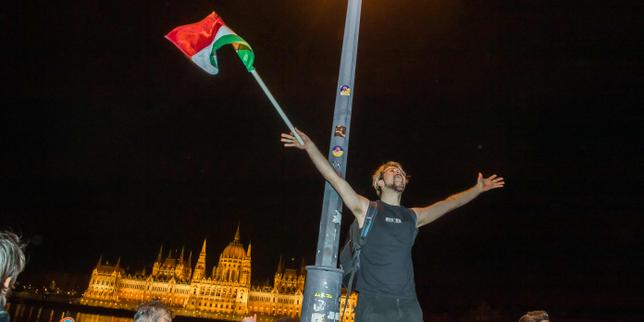
The streets of Budapest don’t usually sound like this. For years, the political atmosphere in Hungary felt like a lid pressed tightly over a boiling pot. But the recent electoral shift changed everything in a heartbeat. You’ve probably seen the shaky phone footage of crowds jumping, hugging, and screaming. The most jarring part wasn't just the celebration of a domestic win. It was the specific, rhythmic chant echoing off the neo-Gothic walls of Parliament. "Russians go home!"
This isn't just about a change in leadership. It’s a total rejection of the geopolitical path Viktor Orban paved over the last decade. People didn't just vote against inflation or corruption. They voted against a cozy relationship with the Kremlin that made many Hungarians feel like they were on the wrong side of history again. It’s raw. It’s loud. It’s a moment that caught the rest of Europe completely off guard.
Why the Russian Connection Finally Snapped
Orban played a dangerous game for a long time. He tried to sit on two chairs at once. One chair was the European Union and NATO. The other was a lucrative, often opaque partnership with Vladimir Putin. For a while, he convinced a majority of the electorate that this was "pragmatic." He promised cheap gas and security. He told Hungarians they could be a bridge between East and West.
That bridge collapsed. When the war in Ukraine dragged on and the economic perks of the Moscow deal started to evaporate, the "pragmatism" looked more like a liability. I’ve talked to people on the ground who described the mood as a slow-motion realization. You can’t claim to be a defender of national sovereignty while acting as the primary roadblock for European security measures.
The "Russians go home" chant is deeply symbolic. It’s a direct callback to the 1956 revolution. For older generations, those words carry the weight of tanks in the streets and decades of Soviet occupation. Hearing 20-year-olds scream it today shows that the historical trauma hasn't faded. It just found a new target in the modern era.
The Streets Speak Louder Than the State Media
If you watched the state-run television during the lead-up to the vote, you’d think Orban was invincible. The machinery was massive. Billboards everywhere painted the opposition as puppets of foreign powers. Yet, the jubilant scenes in Budapest proved that a digital-age uprising can bypass even the most expensive propaganda.
The crowds weren't just the "liberal elite" that the government likes to mock. You saw families. You saw students who have spent their entire lives under a single ruler. You saw retirees who remember the Cold War. This wasn't a curated political rally. It was an organic eruption of relief. Honestly, the sheer volume of the cheers felt like a collective exhale.
One specific video shows a group of protesters outside the Fidesz party headquarters. They weren't just celebrating a win; they were reclaiming their identity. For years, being Hungarian on the international stage had become synonymous with Orban’s specific brand of "illiberal democracy." These people were shouting that they wanted to be seen as Europeans again.
Breaking Down the Orban Defeat
How did it happen? It wasn't one single event. It was a pile-on of mistakes that finally broke the camel's back.
- Economic Isolation: The standoff with the EU over the rule of law meant billions in funding stayed frozen. You can’t run a country on rhetoric when the grocery bills are doubling.
- The Ukraine Factor: Orban’s refusal to allow weapons transit and his constant sniping at Kyiv alienated his closest regional allies. Poland, formerly Hungary's best friend in the EU, essentially stopped returning his calls.
- Generational Shift: There's a limit to how long you can sell a "traditionalist" vision to a youth that is hyper-connected to the rest of the world.
The defeat of the Fidesz machine in key districts wasn't just a loss of seats. It was a loss of the narrative. When the results started trickling in, the silence from the government camp was deafening. It was the sound of a system realizing its old tricks didn't work anymore.
What This Means for the Rest of Europe
Don't think this stays within Hungarian borders. This is a massive earthquake for the populist movement across the continent. For years, Orban was the poster child for how to dismantle a liberal democracy from the inside. He provided the blueprint. Now, that blueprint has a giant "FAIL" stamp on it.
Brussels is watching this with a mix of shock and cautious optimism. The dynamic in the European Council changes the moment Hungary stops being the "veto-power" for every major initiative. If the new leadership follows through on the promises made during those nights of celebration, we’re looking at a much more unified European front.
But let's be real. It’s not going to be a smooth ride. The "Russians go home" sentiment is a powerful start, but the infrastructure Orban built—the loyalists in the judiciary, the control over local media—is still there. Taking down the leader is the first step. Dismantling the "system of national cooperation" is the marathon.
The Reality of a Post-Orban Hungary
Moving forward, the new administration has a mountain to climb. They’ve inherited a fractured society and an economy that’s been tweaked to benefit a very small circle of cronies. The euphoria in the streets is great for a weekend, but the hard work starts when the cameras turn off.
The most immediate task is fixing the relationship with NATO and the EU. Expect to see a flurry of diplomatic missions to Washington and Brussels. They need to prove they aren't just "not Orban," but a reliable partner that can be trusted with sensitive intelligence and long-term security planning.
If you’re following this story, keep your eyes on the energy sector. That’s where the Russian influence is most deeply rooted. Moving away from Rosatom and Gazprom isn't just a political choice; it’s a massive engineering and financial hurdle. It’s one thing to chant in a square; it’s another to keep the lights on during a transition.
Watch the Momentum Shift
The scenes of celebration in Hungary are a reminder that no political trend lasts forever. Just a few years ago, it felt like the entire world was sliding toward the Orban model. Now, the pendulum is swinging back with a vengeance.
If you want to understand where this goes next, stop looking at the official statements. Look at the people in the videos. Look at the energy in the crowds. That’s where the real power is right now. The fear is gone. Once a population loses its fear of the "strongman," the strongman is basically done.
Pay attention to the upcoming local council meetings and the transition of power in smaller municipalities. That’s where you’ll see if the "Russians go home" spirit translates into actual policy change. The celebration was the spark, but the policy shift will be the fuel. Expect a lot of friction as the old guard tries to hold onto their perks. It’s going to be messy, loud, and incredibly important for the future of the West. Keep watching the footage coming out of Budapest. It’s the sound of a country waking up.