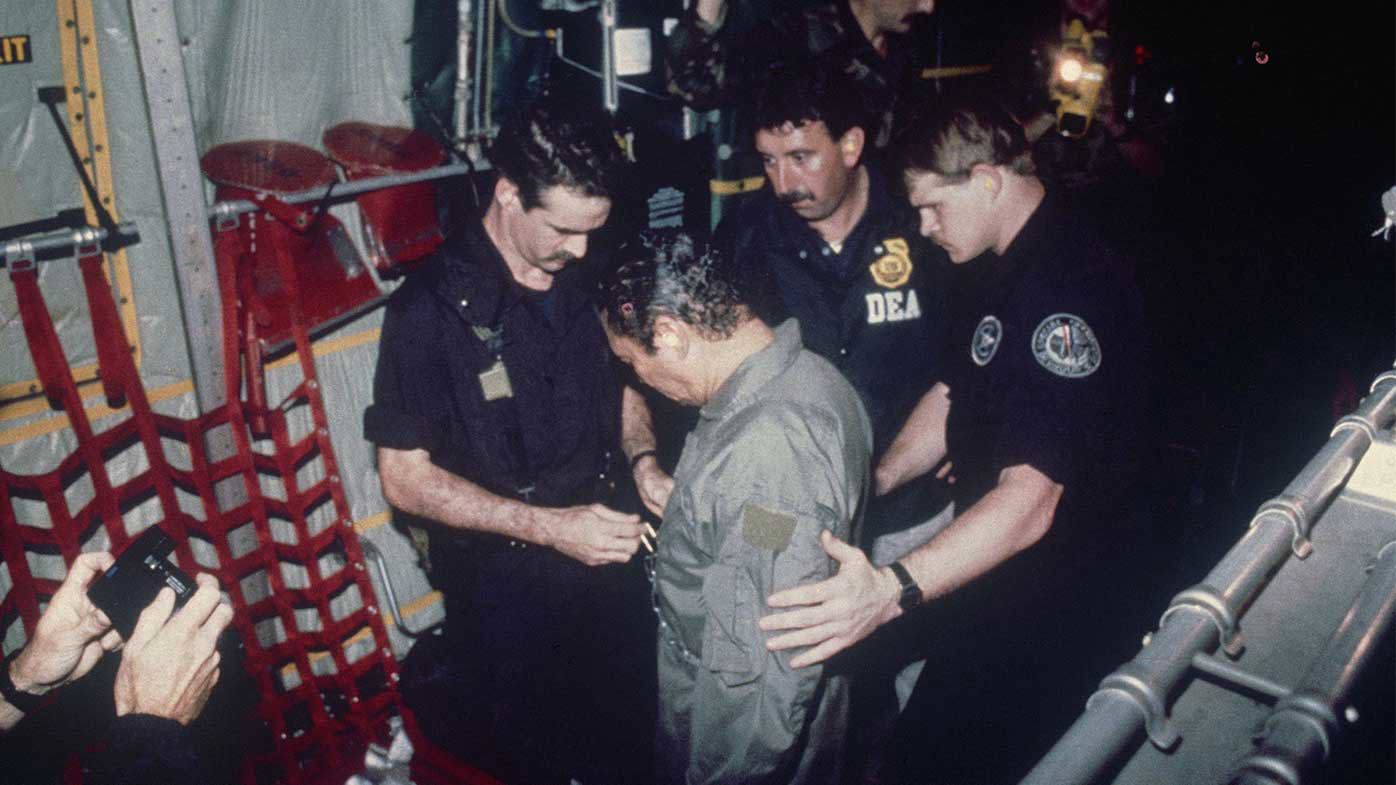
The humidity in Panama City during the final days of 1989 wasn’t just a weather pattern. It was a physical weight, a wet wool blanket that smelled of cordite, diesel, and the rot of a dying regime. Inside the Apostolic Nunciature—the Vatican’s diplomatic mission—General Manuel Noriega was beginning to realize that the walls weren't just made of stone and mortar. They were made of sound.
Noriega was a man who understood power through the lens of fear and mysticism. He was the "Maximum Leader," a CIA asset turned dictator, a man who allegedly used Santería rituals to ward off his enemies. But he had no ritual for what was happening outside the gates. The United States military had surrounded the embassy with a literal wall of speakers. They weren't there to give a speech. They were there to play "Panama." Discover more on a connected issue: this related article.
The Psychology of the Sonic Siege
War is usually defined by the absence of noise—the silence before the ambush—or the overwhelming cacophony of an explosion. This was different. This was a psychological marathon. The U.S. Fourth Psychological Operations Group didn't choose Van Halen, The Clash, and Jethro Tull by accident. They chose them because they were the antithesis of Noriega’s world.
Imagine being trapped in a room where the air itself vibrates with the opening riff of "Runnin' with the Devil." You are a man accustomed to the quiet deference of subordinates. You are a man who prizes control. Suddenly, you have no control over your own heartbeat, which begins to sync with the kick drum of Alex Van Halen. More analysis by BBC News highlights similar views on this issue.
Music, in its natural state, is an emotional bridge. It triggers dopamine. It heals. But when you strip away the listener's consent, music becomes a weapon. This is known as "acoustic bombardment." It exploits a glitch in the human brain: we cannot "shut" our ears. While we can look away from a gruesome sight or hold our breath to avoid a stench, our auditory system is always on, scanning for threats, processing data even in sleep.
The Playlist of the Damned
The soldiers on the ground treated the operation like a twisted radio request show. They took suggestions. They played "I Fought the Law" by The Clash. They played "Wanted Dead or Alive" by Bon Jovi. They even played "You Shook Me All Night Long" by AC/DC.
The absurdity of the situation masks the sheer horror of the experience. To the world watching on CNN, it looked like a high-stakes fraternity prank. To the Vatican diplomats inside, it was a living nightmare. They were the collateral damage of a rock-and-roll war. They tried to negotiate. They pleaded for the music to stop. The Americans, fueled by MREs and the adrenaline of the hunt, simply turned the volume knob to the right.
Consider the sensory deprivation—or rather, the sensory saturation—of those ten days. Noriega, a man who reportedly suffered from intense paranoia and skin conditions that made him sensitive to his environment, was being dismantled. The high-frequency synthesizers and David Lee Roth’s operatic screams weren't just loud; they were intrusive. They prevented the REM cycle. They shattered the ability to form coherent thoughts.
When the Ego Breaks
The real battle wasn't happening in the streets of Panama. It was happening inside Noriega’s skull. Every dictator relies on a cultivated image of invincibility. How do you maintain that image when you are being taunted by "Dancing in the Street"?
There is a specific kind of humiliation in being defeated by pop culture. It wasn't a silver bullet or a tactical strike that brought Noriega to his knees. It was the realization that he had become a joke in the eyes of his captors. The music was a constant reminder that the world he once ruled had moved on. The "Maximum Leader" was now just a man in a room, unable to sleep, haunted by the ghost of 1980s arena rock.
By the tenth day, the transition was complete. The man who once brandished a machete at his enemies walked out of the embassy gates. He didn't look like a general. He looked like a man who had been hollowed out. He was dressed in a tan uniform that seemed too big for him, blinking against the harsh sunlight, surrendered to the sheer, relentless energy of a culture he couldn't understand and a noise he couldn't stop.
The Invisible Stakes of Acoustic Warfare
We often think of surrender as a choice made after a logical assessment of the odds. We look at maps, troop counts, and ammunition supplies. But Noriega’s surrender reminds us that humans are biological machines with breaking points that have nothing to do with logic.
The use of music as a weapon in 1989 set a precedent that would echo through the decades, from the standoff at Waco to the "enhanced interrogation" rooms of the early 2000s. It raises a terrifying question about the nature of our own minds: If the right song, played at the right volume for the right amount of time, can break a dictator, what could it do to the rest of us?
The story of Noriega and Van Halen isn't just a quirk of history. It is a case study in the vulnerability of the human spirit. It shows that our most private space—our internal monologue—is not as secure as we think. It can be invaded. It can be colonised by a guitar solo.
As the Black Hawk helicopters carried him away toward a prison cell in Miami, the music finally stopped. The silence that followed must have been the loudest thing he had ever heard. It was the sound of a legacy ending, not with a bang, but with a fading, distorted echo of "Jump."
The speakers were packed away. The soldiers went home. But the air in Panama City remained changed. It was a reminder that sometimes, the most effective way to tear down a wall is to vibrate the molecules until they simply give up.
The image of the General walking toward the lights, defeated by a playlist, remains one of the strangest icons of the late 20th century. It serves as a testament to the idea that when brute force fails, the weird, the loud, and the persistent will always find a way through the gate.