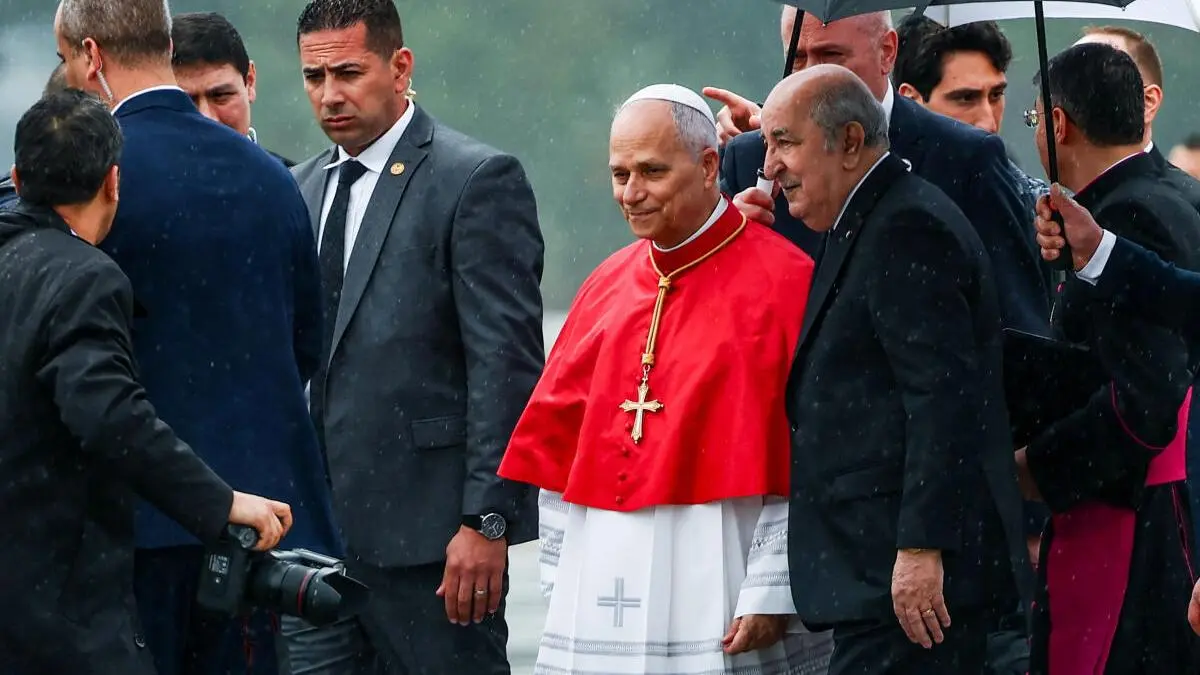
Pope Leo has drawn a line in the ancient dust of the Holy See, signaling a historic rupture with the Trump administration over the escalating threat of conflict with Iran. This is not merely a diplomatic disagreement or a routine call for peace from the balcony of St. Peter’s Basilica. It is a calculated, theological counter-offensive. By citing the Gospel as his primary shield, the Pope is attempting to strip away the moral cover that religious voters often provide for American military intervention in the Middle East.
The tension has reached a boiling point. While Washington frames a potential strike on Iranian nuclear or military infrastructure as a necessary preemptive measure for global security, the Vatican views it as a catastrophic violation of the "Just War" doctrine. Leo’s refusal to "fear" the political consequences of this pushback indicates a shift in Catholic geopolitics. He is no longer playing the role of the quiet mediator. He is acting as a disruptor. For another perspective, consider: this related article.
The Gospel as a Geopolitical Weapon
For decades, the relationship between the White House and the Vatican has been a delicate dance of shared interests and quiet friction. However, the current friction over Iran has transformed that dance into a confrontation. When Pope Leo invokes the Gospel in this context, he is doing more than quoting scripture. He is targeting the very base of the President's support.
The "Just War" theory, codified by St. Augustine and Thomas Aquinas, requires that a war must have a just cause, be a last resort, and possess a serious prospect of success without creating a greater evil than the one it seeks to eliminate. The Vatican's internal analysts have concluded that a war with Iran fails every one of these tests. They see a conflict that would destabilize the entire region, trigger a massive refugee crisis in Europe, and lead to the near-total eradication of ancient Christian communities in the East. Related coverage on this trend has been shared by The Guardian.
By leaning on the Gospel, Leo is effectively telling Catholic and Evangelical voters that supporting this specific war is an act of spiritual betrayal. This puts the administration in a difficult position. They can dismiss secular critics as being "soft on terror," but it is much harder to dismiss the Bishop of Rome when he uses the foundational text of the faith to dismantle the case for bombs.
The Collapse of the Middle Ground
The diplomatic channels between the State Department and the Secretariat of State in Vatican City are currently described by insiders as "frigid." In the past, even when the two powers disagreed—as they did during the 2003 invasion of Iraq—there was a sense of mutual respect for the different roles they played on the world stage. That respect has evaporated.
The Trump administration’s strategy relies on "maximum pressure," a combination of crushing economic sanctions and military posturing designed to force Tehran into submission. The Pope, however, views "maximum pressure" as a blunt instrument that primarily hurts the most vulnerable citizens rather than the ruling elite. He has seen the data from hospitals in Tehran and Shiraz. He knows that medicine shortages and soaring food prices are the reality on the ground.
The Vatican’s intelligence network is one of the oldest and most extensive in the world. It does not rely on satellite imagery or signals intelligence alone. It relies on the "boots on the ground" provided by thousands of priests, nuns, and lay workers living in the heart of the Islamic Republic. These reports suggest that an American strike would not lead to a popular uprising against the Ayatollahs. Instead, it would unify a fractured population against an external "Crusader" threat. This is the reality that Leo is trying to force the West to acknowledge.
The Shadow of the 2003 Iraq Failure
To understand why Pope Leo is being so aggressive now, one must look back at the Vatican’s failure to stop the Iraq War in 2003. Pope John Paul II was a vocal opponent of that conflict, but his pleas were largely ignored by the Bush administration and the American public. The resulting chaos, the rise of extremist groups, and the decimation of the Iraqi Christian population are seen by the current Curia as a permanent stain on Western foreign policy.
Leo is determined not to repeat that passivity. He is not just sending letters; he is mobilizing bishops across the United States to speak from the pulpit about the human cost of a war with Iran. He is building a coalition with other religious leaders, including Orthodox patriarchs and moderate Islamic scholars, to create a unified front against the march to war.
The administration’s counter-argument is straightforward: Iran is a state sponsor of terrorism and a nuclear threat that cannot be ignored. They argue that the Pope’s "Gospel-based" approach is naive and ignores the harsh realities of 21st-century security. They see his interference as a violation of the boundary between church and state, even though the Vatican is itself a sovereign state with a seat at the table of international diplomacy.
The Economic and Refugee Fallout
Beyond the moral arguments, the Vatican is deeply concerned with the practical consequences of a Persian Gulf conflagration. Their analysts predict that a full-scale war would send oil prices to unprecedented heights, potentially triggering a global recession that would hit developing nations the hardest. For a Pope who has made the "preferential option for the poor" the cornerstone of his papacy, this is an unacceptable outcome.
Then there is the matter of the refugees. Europe is still grappling with the political and social fallout of the Syrian civil war. A conflict in Iran, a country with nearly 90 million people, would dwarf the Syrian crisis. The Vatican knows that the resulting migration waves would empower hard-right nationalist movements across Europe—movements that often stand in direct opposition to the Pope’s teachings on migration and human dignity.
By opposing the war, Leo is also protecting the institutional future of the Church in Europe. He knows that another massive refugee crisis could break the European Union, the very structure that has provided a stable environment for the Church to operate since the end of World War II.
The Trump Strategy of Dismissal
The White House has responded to the Pope’s defiance with a mix of public dismissal and private irritation. The President’s advisors believe that the American Catholic vote is no longer a monolithic block controlled by the Vatican. They point to the deep divide between "social justice" Catholics and "traditionalist" Catholics who are more aligned with the administration’s nationalist platform.
They are betting that the average voter in Ohio or Pennsylvania cares more about national security and gas prices than the nuances of the "Just War" theory. However, this bet overlooks the power of the Pope’s platform. When the Pope speaks, the world listens, even if it doesn't always obey. His words provide a rallying point for the opposition and give political cover to lawmakers who are hesitant to support another open-ended conflict in the Middle East.
The administration has attempted to bypass the Pope by engaging with more hawkish elements within the American Catholic hierarchy. There is a growing movement of bishops who argue that the threat posed by Iran is so great that it supersedes the usual calls for peace. This internal schism is something the White House is actively encouraging, hoping to neutralize the Pope’s influence by making him look out of touch with his own flock in America.
Why the Gospel Matters in 2026
The use of the Gospel in this feud is a reminder that the papacy still wields a unique form of "soft power." In an era of high-tech warfare and cold realpolitik, the appeal to ancient moral principles can feel like an anachronism. But for Leo, it is the only power that matters. He is betting that the moral weight of his office can slow the momentum toward war.
This isn't about pacifism at any cost. The Vatican has supported military action in the past when it was deemed necessary to stop genocide or protect the innocent. But in the case of Iran, the Pope sees a war of choice, not a war of necessity. He sees a conflict driven by political ego and outdated strategic doctrines rather than a genuine pursuit of peace.
The refusal to "fear" the President is a signal to other world leaders that the Vatican will not be bullied into silence. It is an assertion of independence at a time when many international institutions are being sidelined or dismantled. Leo is positioning the Church as the "conscience of the world," whether the world wants one or not.
The Real Risk of Miscalculation
The greatest danger in this standoff is a total breakdown in communication. If the White House continues to ignore the Vatican's warnings, and if the Pope continues to escalate his rhetoric, the two powers will be locked in a cycle of mutual delegitimization. This would be a disaster for international diplomacy.
The Vatican remains one of the few entities that can communicate with all sides of the conflict. It has a presence in Washington, Tehran, Moscow, and Beijing. By turning the Iran issue into a public feud over the Gospel, Leo risks losing his ability to act as a back-channel mediator. If he is seen as a partisan actor rather than a neutral moral authority, his ability to influence the outcome of the crisis will be severely diminished.
Yet, from Leo’s perspective, the risk of silence is even greater. He believes that the path currently being taken by the West leads to a regional inferno that will burn for decades. He is willing to sacrifice his relationship with the White House if it means he can act as a speed bump on the road to war.
The Narrow Path to Peace
There is a small window for a diplomatic off-ramp, but it requires both sides to step back from their absolute positions. The Vatican has proposed a multilateral framework that would address Iran’s regional behavior and its nuclear program without resorting to military strikes. This involves a return to high-level negotiations, bolstered by the mediation of the Holy See and other neutral parties.
The administration, however, remains skeptical. They view any return to the negotiating table as a sign of weakness. They believe that only the credible threat of force will keep Tehran in check. This fundamental disagreement on the nature of power is what lies at the heart of the feud. One side believes in the power of the sword; the other believes in the power of the Word.
As the rhetoric intensifies, the world is watching to see who will blink first. Will the President risk alienating a significant portion of his base by ignoring the Pope? Or will Leo find that his moral authority has its limits in a world defined by raw power?
The standoff over the Iran war is more than a political dispute. It is a test of whether moral arguments still have a place in the halls of power. Pope Leo has made his move, grounding his defiance in the Gospel and challenging the leaders of the West to justify their actions not just to their voters, but to history and a higher authority.
The fallout of this confrontation will determine the shape of the Middle East for the next generation. If the Pope succeeds in halting the momentum toward war, he will have cemented his legacy as a global peacemaker. If he fails, he will be remembered as a lonely voice crying out in a wilderness of fire and steel. The next few months will reveal which of these paths the world is destined to follow.
The silence from the White House in response to the latest Vatican missive is deafening. It suggests that the administration is not looking for a compromise, but for a way to navigate around the moral obstacles the Pope has placed in their path. For Leo, the Gospel remains the ultimate standard, and he has made it clear that he will not move.
Stop looking for a middle ground where none exists. The choice is between a risky, complex diplomacy and the certain destruction of a regional war.