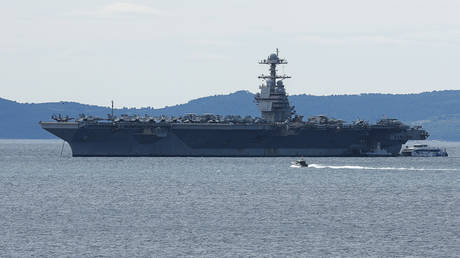
The most expensive warship ever built is about to become a very expensive floating parking lot. After a marathon 2025 deployment that saw the USS Gerald R. Ford (CVN 78) patrolling everywhere from the Mediterranean to the coast of Venezuela, the Navy’s $13 billion flagship is scheduled for a massive maintenance overhaul. We're talking about a stay in dry dock that could last anywhere from 12 to 17 months.
If you’re looking for a simple "it’s broken" narrative, you won't find it. The truth is more of a "death by a thousand cuts" scenario involving unproven tech, a brutal operational tempo, and a plumbing system that apparently can't handle a crew of 4,000. The Navy calls this a Planned Incremental Availability (PIA), but for a ship that was supposed to redefine naval warfare, spending a year behind a "Do Not Disturb" sign isn't a great look.
The $13 Billion Learning Curve
You can't talk about the Ford without talking about the tech. The Navy decided to cram 23 brand-new, unproven technologies onto a single hull. In the shipbuilding world, that’s basically asking for a headache. Most of the current downtime is dedicated to finally "un-fucking" (to use sailor parlance) systems that have been glitchy since the christening.
The biggest culprits are the Electromagnetic Aircraft Launch System (EMALS) and the Advanced Arresting Gear (AAG). Unlike the old steam catapults on the Nimitz class, which were reliable but violent, EMALS uses magnets to flick jets off the deck. It’s smoother, which saves the planes' airframes, but the reliability hasn't hit the mark. When one part of the EMALS fails, it can sometimes take down the whole deck. During this year-long maintenance, engineers are expected to perform deep-tissue surgery on these systems to bring them up to the reliability standards the Navy promised Congress back in 2017.
When the Toilets Quit Before the Sailors Do
Believe it or not, the most consistent threat to the Ford’s mission isn't an Iranian missile—it’s the toilets. The ship uses a commercial-style vacuum sewage system, similar to what you’d find on a Royal Caribbean cruise or a Boeing 787. It uses less fresh water, which is great in theory. In practice? The pipes are too narrow.
Recent reports from early 2026 show the crew has been battling a "sewage crisis." We’re talking about 205 breakdowns in a single four-day span. Sailors have been working 19-hour shifts just to keep the "heads" (bathrooms) functioning. The Navy has already spent millions on "acid flushes" to clear out calcium build-up in the pipes. Part of the upcoming year-long maintenance is a literal gutting of sections of the plumbing to install wider pipes and more resilient valves. It turns out that $13 billion doesn't buy you a flush you can trust.
A Victim of Its Own Schedule
The Ford didn't just sit in Norfolk; it’s been run ragged. While a standard carrier deployment is supposed to be six months, the Ford was pushed to 10 months during its recent stint in the Red Sea and Mediterranean.
Every day at sea is a day of wear on the nuclear reactors and the propulsion plant. When a ship of this complexity over-deploys, the maintenance debt doesn't just add up—it compounds. There are also rumors of a "toasted" laundry room and structural fatigue that can only be inspected once the ship is out of the water.
- The Propulsion Plant: Needs a deep inspection after high-speed maneuvers in contested waters.
- The Flight Deck: Requires resurfacing after thousands of launches and recoveries that exceeded the original testing parameters.
- The Crew: Needs a total reset. You can't run a crew at 110% for a year and expect them to maintain a peak warfighting edge.
Is the Ford a Lemon?
It's tempting to call the Ford a failure, but that's a bit shortsighted. Every "lead ship" in a new class has a rough start. The Nimitz class had its own nightmares in the 70s. The real issue is that the Ford is a Software-Defined Warship.
In the old days, if a catapult broke, you hit it with a wrench. On the Ford, if a catapult breaks, you might need a software patch and a specialized contractor from General Atomics. This year in the shipyard is essentially a massive "Version 2.0" update. The goal is to move the ship from "experimental powerhouse" to "reliable workhorse."
What Happens Next
If you're tracking the Ford, don't expect to see it on the evening news anytime soon. Here is what the next 12 months look like for the Navy’s prize ship:
- Dry Docking: The ship will be lifted out of the water in Virginia to check the hull and propulsion shafts.
- System Gutting: Expect a massive overhaul of the VCHT (sewage) and AWE (weapons elevators) systems.
- Software Integration: New code will be pushed to the EMALS to prevent the "cascading failures" that have plagued previous deployments.
- Sea Trials: Sometime in 2027, the ship will have to prove it can actually hit the 160-sorties-per-day target it was designed for.
The Navy is betting the farm on the Ford class. With three more ships—the Kennedy, Enterprise, and Doris Miller—already in various stages of construction, they don't have a choice. They have to make this one work, even if it means keeping the world's most advanced carrier in the shop for a year to fix the toilets and the magnets. Honestly, it's a sobering reminder that even in 2026, the most high-tech gear is still at the mercy of basic physics and plumbing.
Watch the Norfolk shipyard schedules; when the Ford finally floats out again, we'll know if the Navy actually fixed the problems or just put a $13 billion Band-Aid on them.