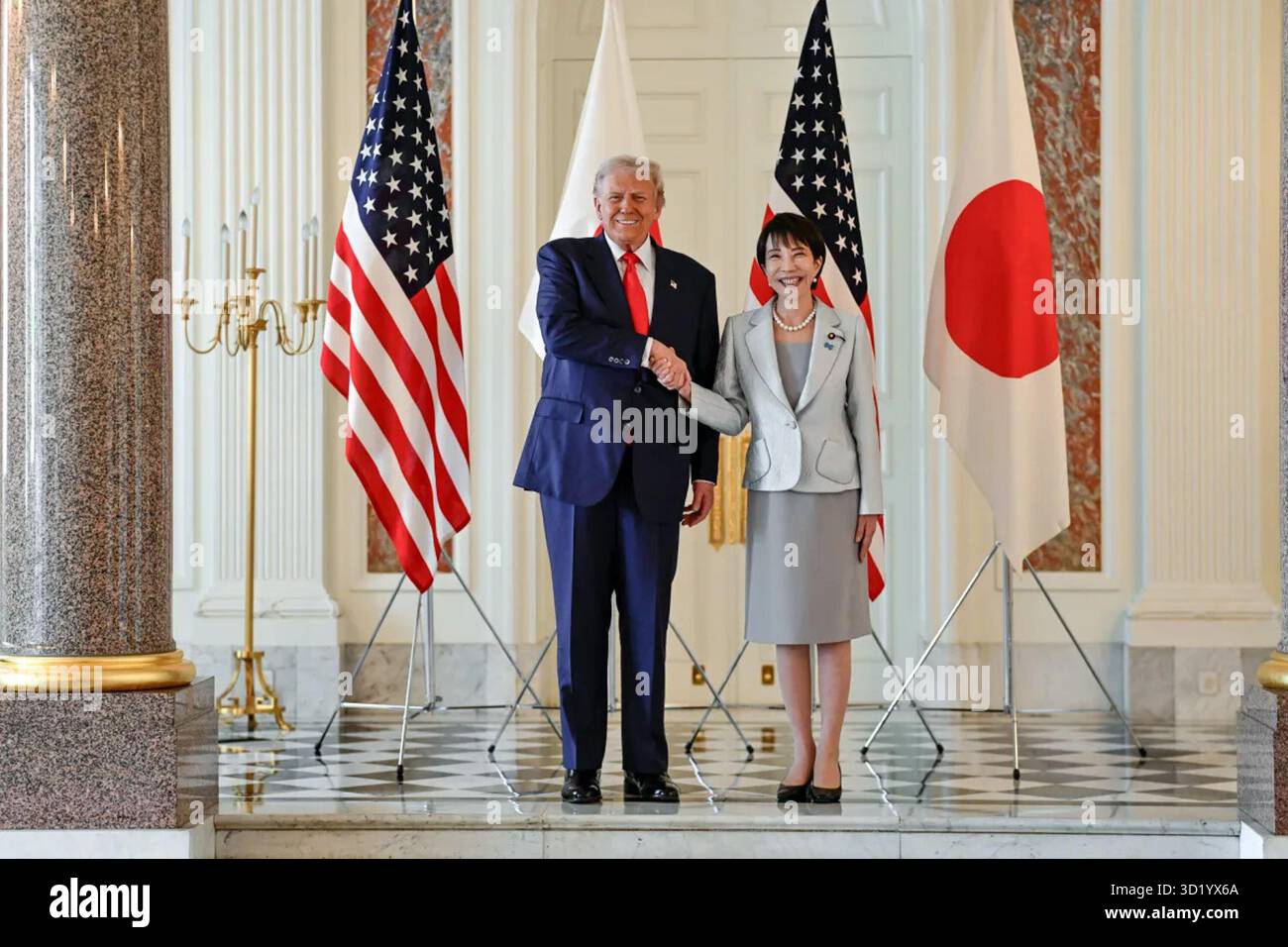
Political commentators love a good echo chamber. When Xi Jinping mutters his well-worn script about the "decline of the West" and Donald Trump immediately echoes it with a "100% correct" stamp, the media machine goes into overdrive. The standard narrative is served on a silver platter: Washington is crumbling, Beijing is inevitable, and the current administration is asleep at the wheel.
It is a comforting, dramatic story. It is also entirely wrong.
The lazy consensus across the political spectrum assumes that when adversarial superpowers agree on a trend, that trend must be reality. In truth, the narrative of American decline is the most valuable piece of geopolitical fiction in the world today. It is not a diagnosis; it is a tool. Both Washington and Beijing weaponize this exact panic to mask deep structural realities that tell a completely different story.
If you are allocating capital, plotting corporate strategy, or trying to understand where global power actually sits, you need to stop reading the headlines. You need to look at the mechanics of structural power.
The Manufacturing of a Useful Panic
Xi Jinping hypes the "East is rising, the West is declining" thesis for a very simple, inward-facing reason: domestic stabilization.
I have spent years analyzing capital flows and regulatory shifts in East Asia. When a regime faces massive structural headwinds—a historic real estate contraction, a demographic cliff, and local government debt mountains—it does not preach vulnerability. It preaches inevitability. By convincing the domestic population that the external rival is decaying, Beijing buys time and manufactures patience for its own internal economic adjustments.
Trump and the American populist right use the exact same script for a different flavor of domestic consumption. To sell a radical restructuring of trade policy, tariffs, and immigration, you must first convince the electorate that the patient is dying. If the US economy is actually doing fine, the urgency for drastic, disruptive policy shifts evaporates. Panic is a potent political currency.
When both sides of a rivalry find the exact same narrative useful, you are not watching a geopolitical shift. You are watching a coordinated marketing campaign.
The Hard Numbers the Declinist Narrative Ignores
Let's strip away the rhetoric and look at the actual metrics of global dominance. The idea that the US is economically losing ground to China collapses under the weight of verifiable data.
Consider the raw size of the economies. In 2010, many economists predicted China’s GDP would comfortably surpass the US by 2020 or 2025. Instead, the gap has recently widened in America's favor. The US economy grew at an annualized rate of nearly 3% in late 2023 and maintained strong momentum through recent quarters, drastically outperforming its peer group in the developed world.
Look at capital concentration. The standard metric of global economic health is where smart money hides when things get ugly.
- Global Reserve Currency Status: The US dollar still sits at the center of roughly 85% to 90% of all foreign exchange transactions. Despite endless talk of BRICS de-dollarization, the Chinese yuan accounts for a fraction of global payments, mostly restricted to state-managed bilateral trade.
- Capital Markets: The market capitalization of the US stock market represents nearly 50% of the global total. Investors do not pour trillions into a "declining" empire; they pour it into the deepest, most liquid, and most legally secure markets on earth.
- Energy Sovereignty: The old vulnerability of the 1970s is gone. The US is now the world’s largest producer of crude oil and natural gas, producing more oil per day than Saudi Arabia or Russia. China, conversely, remains the world's largest importer of crude, leaving its industrial base permanently exposed to maritime choke points.
Imagine a scenario where a company with total energy independence, the world's preferred currency, and a monopoly on advanced technological architecture is labeled as "failing" by its chief competitor. You would call that competitor's marketing department brilliant, or the analysts incredibly gullible.
The Innovation Trap: Scale vs. Control
The media frequently panics over China’s massive manufacturing output. They look at electric vehicles, solar panels, and steel production, declaring that the industrial crown has moved east.
This view misunderstands how modern economic value is captured.
Manufacturing physical goods at scale is low-margin grunt work. The real power—and the real profit—remains firmly entrenched in the design, intellectual property, and foundational software ecosystems. Apple captures the vast majority of global smartphone profits while outsourcing the assembly. The same dynamic plays out across aerospace, biotechnology, and advanced computation.
Furthermore, Beijing's recent regulatory crackdowns on its own tech sector proved that the regime values political control far more than raw innovation. When you disappear your top tech founders and force algorithms to align with party orthodoxy, you do not build the next generation of world-changing platforms. You build compliant utilities.
The US system is chaotic, loud, and frequently dysfunctional. But that exact chaos is a feature, not a bug. It allows for creative destruction. It allows capital to abandon dead ideas and fund insane, high-risk breakthroughs. That is why the foundational shifts in artificial intelligence, quantum computing, and commercial space exploration are still anchored in American hubs, funded by American venture capital.
Dismantling the "People Also Ask" Illusions
The public debate around this topic is warped by flawed premises. Let's answer the most common questions with brutal honesty.
Is China's economy going to surpass the US?
No, not in any meaningful, sustainable way. While China’s nominal GDP might occasionally fluctuate closer to the US depending on currency valuations, its per capita wealth remains stuck at a developing-nation level. More importantly, China is hitting the "Middle Income Trap" at the exact moment its population is shrinking. A nation that will lose hundreds of millions of working-age citizens over the next few decades cannot sustain the growth rates required to permanently displace a structurally growing US economy.
Why do American politicians say the country is in decline?
Because fear sells. In modern politics, optimism gets you ignored; catastrophism gets you votes and donations. Telling the public that the nation is a "failing third-world country" creates an artificial crisis that only the candidate claims they can fix. It is a classic sales pitch, not an objective macroeconomic assessment.
Does the rise of alternative trade blocs threaten US dominance?
Groups like BRICS make for great press releases, but they lack internal cohesion. India and China are literal border rivals who regularly skirmish in the Himalayas. Brazil and South Africa face massive internal structural crises. These nations cannot agree on a unified currency or a shared security framework because their core national interests are fundamentally misaligned. A coalition built entirely on "not being the US" is not an alternative global superpower; it is a grievance committee.
The Vulnerability in the Contrarian View
To maintain absolute credibility, we must acknowledge where this contrarian view faces its greatest risk. The threat to American preeminence is not external. It cannot be engineered by Beijing, Moscow, or Riyadh.
The single point of failure for the United States is internal institutional decay.
The weaponization of the debt ceiling, the polarization of basic governance, and the erosion of trust in foundational legal institutions are self-inflicted wounds. If Washington chooses to default on its obligations or descends into genuine domestic instability, the structural advantages outlined above will eventually evaporate. The system relies on predictability and the rule of law. If the US destroys its own credibility, it won't matter how weak its rivals are.
But today, that decay is still a political theater production rather than a structural reality. The underlying economic engine continues to hum, unaffected by the shouting matches on cable news.
Stop Buying the Narrative
The next time you see a headline where an American politician agrees with an authoritarian dictator about the "collapse of America," check your pockets. Someone is trying to sell you something.
Xi Jinping wants his people to believe the West is dying so they don't look too closely at their frozen bank accounts and empty apartment towers. Donald Trump wants his base to believe the country is ruined so they view him as the sole savior.
The data tells a radically different story. The US retains the world's reserve currency, the world's deepest capital markets, absolute energy independence, and a functional monopoly on the high-margin intellectual property driving the future global economy.
Stop managing your business, your investments, and your worldview based on a shared marketing gimmick. The era of American dominance isn't over; it is just being managed by people who profit off your fear. Use the panic of others to buy the reality they are ignoring.