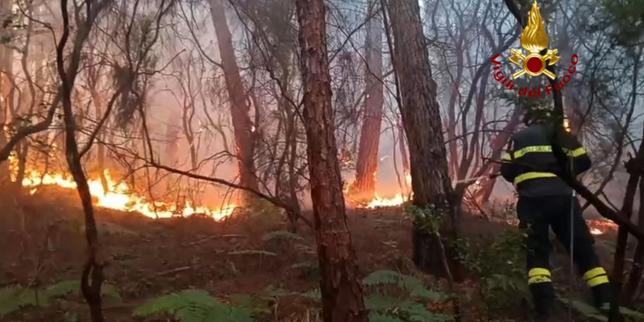
The evacuation of 3,500 people from the Tuscan countryside is not a statistical anomaly. It is the predictable outcome of decades of neglect, misplaced priorities, and a fundamental misunderstanding of the fire ecology that defines the Italian interior. When smoke choked the valleys and residents fled their homes, the global media treated the event as a tragic misfortune of climate change. This reading is insufficient. The fire that uprooted thousands of lives was not merely an act of nature but a consequence of structural, administrative, and economic decisions that have allowed the fuel load in the region to reach critical mass.
We have spent years romanticizing the Italian countryside, painting a vision of pristine vineyards and untouched forests that ignores the biological reality of these areas. The truth is far grittier. When we look at the hills of Tuscany, we are looking at an ecosystem that has been fundamentally altered by the abandonment of traditional agricultural practices. For centuries, the small-scale farmer served as the primary agent of fire prevention. Grazing livestock, systematic wood clearing, and the maintenance of firebreaks were ingrained in the daily routine of the rural population. That version of Italy is dying, and as the agricultural population declines, the forest moves back in to claim the territory.
This creates a dangerous accumulation of biomass. A forest that is not managed becomes a storehouse for combustible material. Dead wood, dry undergrowth, and a lack of access roads turn a scenic hillside into a tinderbox. When a spark occurs, whether from human activity or lightning, the fire does not just burn; it explodes. The emergency services are then forced into a reactive cycle, chasing infernos through terrain that is often inaccessible to heavy equipment. The 3,500 people displaced this week are the primary victims of a failure to recognize that preservation requires active intervention.
The Flawed Logic of Modern Conservation
We have trapped ourselves in a rigid policy cycle that prioritizes the visual aesthetic of the environment over its biological health. Strict environmental protections often prohibit the clearing of brush or the thinning of forest canopy, under the guise of ecological conservation. While well-intentioned, these policies ignore the reality of a warming climate. Drier summers and unpredictable wind patterns mean that the natural forest cycles of the past are no longer safe. By preventing the necessary maintenance of the forest, we have ensured that when fire does arrive, it will be intense and unstoppable.
This is a failure of governance that spans multiple levels. The division of responsibility between regional, national, and local forestry departments creates a friction-heavy system. When a fire breaks out, the immediate priority is firefighting, but the real work of prevention is stifled by bureaucratic inertia. Permits for controlled burns are difficult to secure, and funding for forest maintenance is perpetually insufficient, diverted instead to reactive suppression. We have effectively spent millions of euros to fight fires after they start, while refusing to spend the fraction of that amount required to manage the fuel load before the first flame appears.
The economic reality is equally stark. The tourism industry relies on the image of a verdant, lush Tuscany. A managed, thinned, and fire-resistant forest may look less "natural" to the casual observer, but it is the only way to ensure the long-term survival of the region. Stakeholders must accept that a wilder, more overgrown environment is not safer. It is more dangerous. The trade-off is clear, yet the political will to communicate this to the public remains absent. It is far easier to promise protection of the wild than to explain the necessity of active, industrial-grade forest management.
The Economic Mirage of Luxury Tourism
There is a dissonance between the way we value the land and the way we use it. The rise of luxury agritourism has brought capital into the region, which is a positive development for local economies. However, it has also created a new set of risks. Many of these properties are nestled deep within the very forest zones that are most susceptible to fire. Their presence increases the human footprint in vulnerable areas, adding to the number of potential ignition points.
These estates often operate in a bubble of safety, expecting the state to provide protection that the local infrastructure cannot support. During the recent evacuations, the strain on local roads became apparent. Many of the historic access routes were never designed for the rapid evacuation of thousands of residents and tourists simultaneously. When the order to leave comes, the traffic patterns collapse, leaving people stranded in lanes that were narrow even in the Middle Ages. The infrastructure is not built for the modern population density.
We must scrutinize the planning permits that allow for high-density development in high-risk zones. The desire to provide a tranquil getaway often leads planners to ignore the wildfire risk assessments that warn against such expansion. This creates a moral hazard. Developers reap the profits of the location, while the state and the local taxpayer bear the burden of emergency evacuation and disaster recovery. The cycle is unsustainable.
Administrative Fragmentation as a Barrier to Safety
The Italian approach to forest fire management is characterized by a high degree of fragmentation. Responsibility is spread thin across various agencies, each with its own protocols and turf. This creates a lack of accountability when the system fails. When the evacuation of 3,500 people becomes necessary, it is the end result of a failure that began months, or even years, earlier.
Effective fire management requires a unified command structure that can coordinate across municipal boundaries. Fire does not respect the borders of a commune or a province. It spreads across the entirety of the terrain. Yet, our response mechanisms remain largely local, hamstrung by the limitations of regional budgets and the lack of integrated data sharing. A unified, real-time tracking system for forest health, fuel moisture levels, and ignition risk should be the standard. Instead, we have a patchwork of monitoring efforts that fail to provide a cohesive picture of the threat level.
The frustration among local emergency responders is palpable. They are tasked with the impossible: containing a fire that has been fueled by years of government inaction. They are the ones who must tell a family that their home cannot be saved, not because the firefighting equipment failed, but because the forest around the house was allowed to grow until it became a lethal weapon. These individuals deserve better than to be placed in an impossible position by policies written by people who rarely visit the ground level.
A Trajectory of Increasing Risk
The meteorological data points in one direction. Higher average temperatures and longer, more severe droughts are becoming the norm for the Mediterranean basin. The fire season is no longer a distinct three-month period; it is expanding into the spring and autumn. This means the window for safe, controlled prevention activity is shrinking. We are running out of time to adjust our methods.
Continuing on the current path will result in more frequent evacuations, more loss of property, and a steady degradation of the environment. The damage caused by intense fire, particularly when it burns the soil to its mineral layer, takes decades to recover. It leaves the hillsides prone to landslides and erosion, further endangering the infrastructure that remains. We are not just losing the current season; we are damaging the resilience of the region for future generations.
There is a tendency to look for a technological fix, some new drone technology or satellite monitoring system that will detect fires early. While these are useful tools, they are not a substitute for ground-level action. Technology can tell us that the house is on fire, but it cannot stop the fire from burning. Only the physical removal of fuel and the maintenance of the environment can do that.
The path forward requires a difficult shift in public perception. It requires accepting that the pristine, overgrown hillsides we admire are not a sign of a healthy environment, but a sign of a dying one. It requires funding, rigorous planning, and the courage to make decisions that prioritize long-term safety over short-term aesthetics.
The smoke will eventually clear from the Tuscan sky, and the 3,500 people will return to their homes, or to the shells that remain. The memory of the terror will fade. But the dry wood will remain on the slopes, waiting for the next spark. The cycle of the fire will not end because we wish it to. It will only end when we stop treating the environment as a static painting and start treating it as the dynamic, dangerous, and demanding system that it is. The work of changing that reality must begin before the next evacuation order is issued. We have the data. We have the history. We have the warning. The only thing missing is the resolve to act before the next fire takes hold.