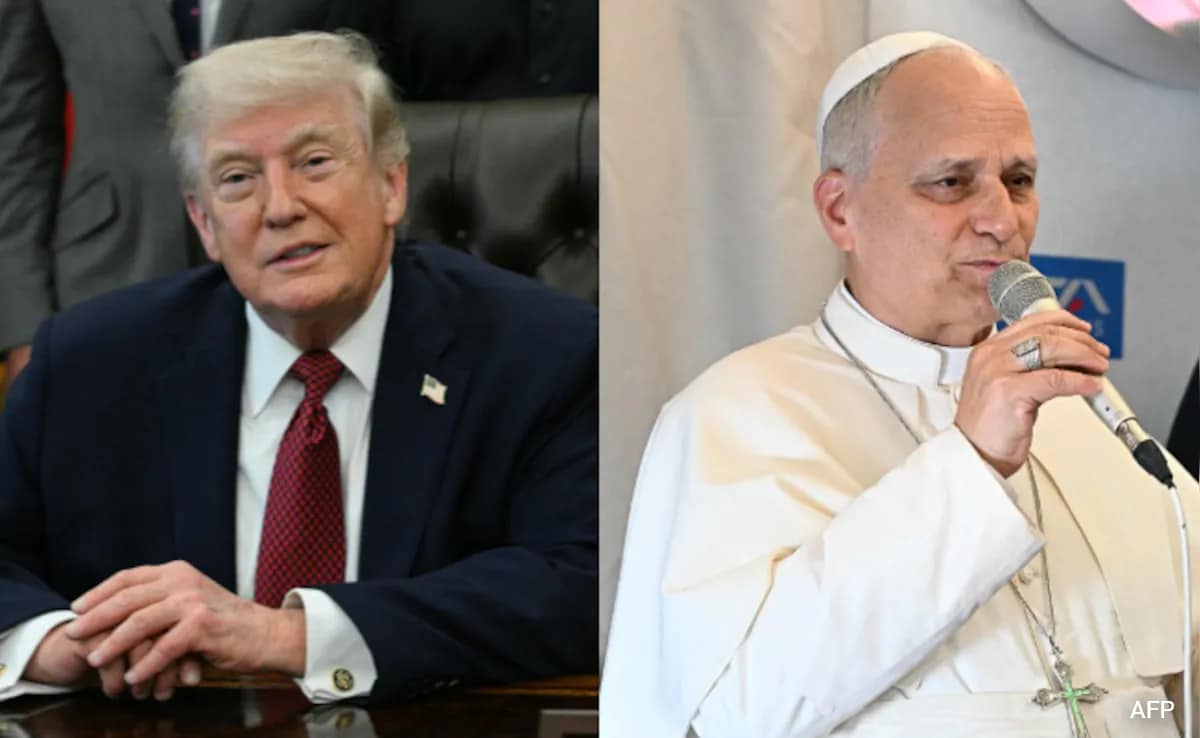
The headlines are predictable. They treat the recent friction between the Oval Office and Pope Leo as a diplomatic "clash" or a "feud" between two stubborn men. They frame the President’s decision to recite a Bible verse from the resolute desk as a defensive posture or a cynical grab for the evangelical base. They are wrong.
This isn’t a spat. It is a fundamental collision between two competing versions of Western sovereignty.
The media focuses on the optics. I’ve sat in rooms where these types of strategic communications are mapped out, and I can tell you: if you’re looking at the optics, you’re the mark. This isn't about whether the President is "pious" or whether the Pope is "political." Those are binary traps for the low-information voter. This is about the reclamation of national theology.
The Myth of the Secular State
The "lazy consensus" dictates that modern states are secular and that religious interference is an anomaly. That is a fantasy. Every state is a theological project. Every law is a moral claim. When Pope Leo critiques the administration, he isn't just offering a "human rights" perspective; he is asserting a supra-national authority that claims jurisdiction over the moral soul of the country.
When the President stands in the Oval Office to recite scripture, he isn’t just quoting a book. He is asserting that the American executive does not need a Roman intermediary to interpret the divine or the moral direction of the republic. It is a direct challenge to the Pope’s "plenitudo potestatis"—the fullness of power.
We are witnessing a revival of Gallicanism—the idea that the national monarch (or executive) has a direct line to the divine that bypasses the centralized authority of the Vatican.
Why Reciting Verse is a Power Move, Not a Prayer
If you think this is about "pandering," you’re missing the historical weight of the gesture. Throughout history, the recitation of scripture by a head of state in the face of ecclesiastical pressure has been a sign of defiance, not submission.
Think of it as a jurisdictional dispute.
- The Pope’s Claim: Morality is universal and managed by the Church.
- The President’s Claim: Morality is national and managed by the elected representative.
By using the Bible as a backdrop, the administration is effectively saying, "We have the same source material you do, and we don't need your permission to use it." This is a disruption of the religious supply chain. It cuts out the middleman.
The Intelligence Failure of the Pundit Class
Most political analysts are religiously illiterate. They view "religion" as a demographic category—a set of boxes to be checked in an exit poll. They don't understand that for a significant portion of the global population, these symbolic gestures are more "real" than a policy white paper on trade tariffs.
I’ve seen campaigns spend $50 million on digital ads only to be derailed by a single, poorly handled symbolic conflict with a religious leader. Why? Because symbols are the shorthand of sovereignty.
The media asks, "Will this alienate Catholic voters?"
The better question is, "Which Catholics?"
The "clash" isn't with the pews; it's with the bureaucracy. Modern Catholicism is a fractured entity. There is a massive, silent contingent of the laity that is more aligned with the nationalistic populism of the President than with the globalist, Jesuit-inflected rhetoric of the current papacy. By leaning into the scripture, the President isn't alienating these people—he’s giving them a reason to choose their country over their clergy.
The Mechanics of the "Clash"
Let’s talk about the specific friction point. Pope Leo has been vocal about the ethics of border security and nationalist economics. The mainstream press frames this as "The Pope vs. The President."
In reality, it is Vertical Authority vs. Horizontal Sovereignty.
Vertical Authority (The Vatican) argues that because we are all humans under God, borders are a secondary, perhaps even an immoral, concern.
Horizontal Sovereignty (The State) argues that without a border, there is no state, and without a state, there is no protector of the people’s rights.
The President’s Bible recitation isn’t a rebuttal of the Pope’s theology; it is an assertion that the Pope’s theology is irrelevant to the function of the State. It is a "Keep off the grass" sign directed at the Holy See.
The Risk of the Play
Don't mistake my analysis for endorsement. This strategy is high-risk. When you invite the divine into the Oval Office, you are playing with a flame you cannot control.
The danger isn't that it won't work—it's that it works too well. By claiming the mantle of a "national theologian," the President risks alienating the very secularists who support his economic policies. You can only lean on the "Will of God" for so long before people start asking for the receipts.
Furthermore, using the Bible as a political shield devalues the currency of the text itself. It’s a classic case of Hyper-Symbolism. When everything becomes a symbol of power, nothing remains sacred.
Dismantling the "People Also Ask" Nonsense
People are asking: "Is this a violation of the separation of church and state?"
No. That is a shallow, 10th-grade civics understanding of the concept. The First Amendment prevents the establishment of a religion. It does not mandate the excision of religious language from the executive branch. A President quoting a Psalm is no more a violation of the Constitution than a President wishing someone a "Merry Christmas."
People are asking: "Why now?"
Because the administration is entering a phase where "logical" arguments about policy have reached a point of diminishing returns. To move the needle further, you have to move into the realm of the mythic. You have to appeal to the "Deep Story" of the nation.
The Inversion of Authority
The real story here is the inversion. Historically, the Pope gave legitimacy to the King. In 2026, we are seeing a President who believes his legitimacy is so absolute that he can provide a corrective to the Pope.
This isn't a "clash." It's a hostile takeover of the moral high ground.
Stop looking at the Bible verse. Look at the chair it's being read from. The President isn't asking for a blessing. He’s issuing an edict.
The Vatican has legions of diplomats and centuries of tradition. The Oval Office has a microphone and a direct line to the lizard brain of the electorate. In a fight between ancient tradition and modern media dominance, the tradition usually loses—unless it learns to fight dirty.
Pope Leo is playing a game of chess. The President is playing a game of capture the flag.
If you're still waiting for a "joint statement of reconciliation," you're going to be waiting for a long time. This is the new normal: the nationalization of God. Whether that leads to a more principled republic or a more dangerous form of messianic politics is a question the pundits aren't equipped to answer.
They're too busy checking the teleprompter for typos.
Go back and read the verse he chose. He didn't pick a verse about peace. He picked a verse about the sword.
The message wasn't for God. It was for Rome.