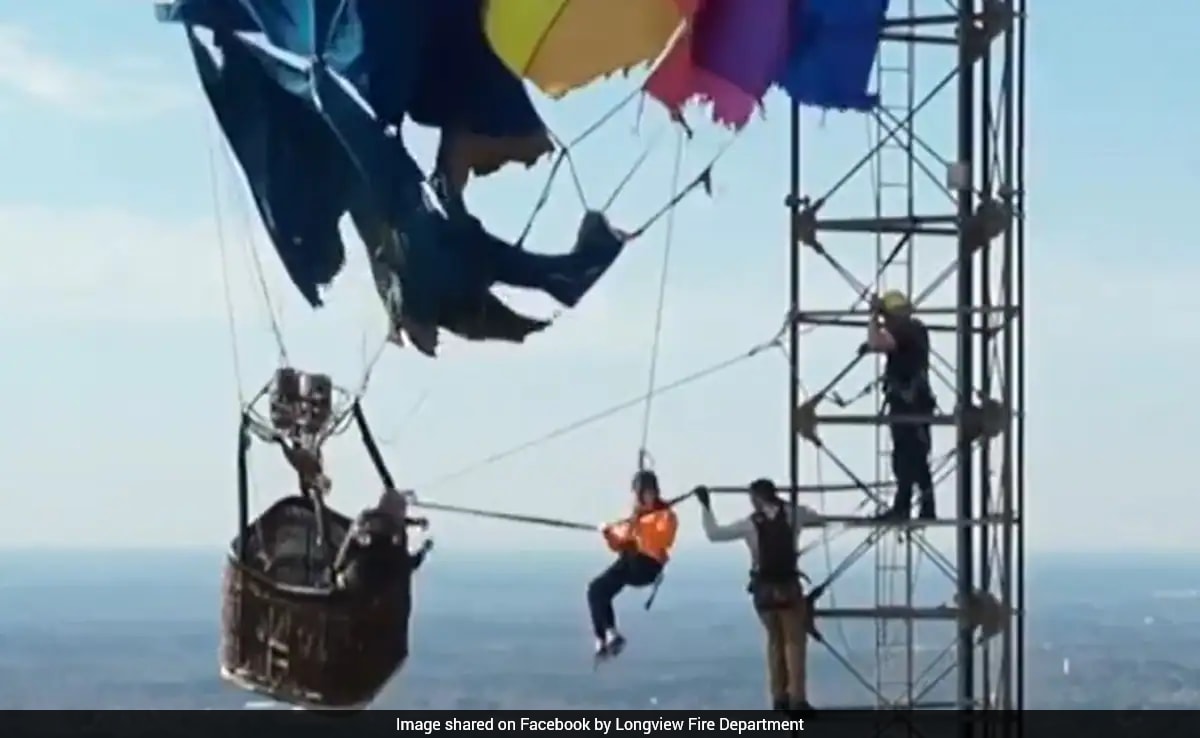
Imagine hanging from a metal lattice 100 stories above the ground with nothing but a wire and a prayer. That’s not a movie plot. It’s exactly what happened in Albuquerque, New Mexico, when a hot air balloon collided with a radio tower, leaving two people dangling in a high-altitude nightmare. This wasn't just a "mishap." It was a catastrophic mechanical and structural failure that tested the limits of search and rescue operations.
When you think of hot air balloons, you think of serenity. You think of drifting over the desert at sunrise. You don’t think about $1,000$-foot radio towers slicing through a nylon envelope like a razor. But in the world of aviation, "low and slow" doesn't always mean safe. Towers are the natural enemy of the balloonist. They’re hard to see against a cluttered horizon, and once you’re caught, the physics of the situation turn against you instantly. If you found value in this piece, you should read: this related article.
Why Radio Towers are Death Traps for Pilots
Most people don't realize how invisible these structures can be. A radio tower isn't a solid skyscraper. It’s a skeleton of grey steel held up by guy wires that are almost impossible to spot in certain lighting. When this balloon hit the tower, it didn't just bump into it. The force of the impact and the heat of the burners created a tangled mess of melted fabric and high-tension cables.
The basket became wedged. That’s the only reason those two people didn't plummet to the ground immediately. It was a fluke of physics. If the basket had slipped six inches in either direction, we’d be talking about a recovery mission instead of a rescue. For another perspective on this event, refer to the latest coverage from BBC News.
The height is the real kicker here. At $1,000$ feet, you aren't just high up. You’re in a different weather system. The wind speeds at the top of a tower are significantly higher than at the base. This creates a "sway" in the structure. Imagine being trapped in a small wicker basket, pinned against a vibrating metal needle, while the wind tries to shake you off. It’s a miracle the tower itself didn't collapse under the lateral pressure of the balloon's remaining lift.
The High Stakes Rescue Operation
You can't just fly a helicopter up there and pluck someone off a radio tower. The rotor wash from a heavy-lift helicopter would have likely pushed the balloon off its precarious perch, sending the occupants into a freefall. This required a level of precision that most municipal fire departments simply aren't equipped for.
Rescuers had to climb.
Think about that for a second. While the world watched from below, elite specialized teams had to scale the interior of the tower. They were carrying heavy gear, dealing with potential electrical hazards from the radio transmitters, and moving toward a "load" that was fundamentally unstable. Every step a rescuer took vibrated through the steel. Every vibration risked dislodging the basket.
The technical hurdles of a tower save
- RF Radiation Risks: Radio towers aren't just tall; they're "hot." The electromagnetic radiation emitted by high-power transmitters can literally cook human tissue or interfere with cardiac pacemakers. Rescuers often have to coordinate with station owners to powered down the arrays before they can even begin the ascent.
- Structural Integrity: A tower is designed to hold its own weight and wind load. It isn't necessarily designed to have a several-hundred-pound balloon and basket snagged at the top.
- The Snag Factor: Nylon melts. When the balloon hit, the heat from the burners likely fused parts of the envelope to the tower's cross-members. This created a sticky, unpredictable anchor point.
What Pilots Aren't Telling You About Balloon Safety
Hot air ballooning is statistically safe, but when things go wrong, they go wrong in spectacular fashion. The biggest misconception is that the pilot has total control. You don't. You have vertical control. You can go up by blasting the burners, and you can go down by venting air. But where you go horizontally is entirely up to the wind.
If a gust of wind pushes you toward a tower line, you can't just "turn" the balloon. You have to climb over it or drop under it. In the Albuquerque incident, it's likely a combination of "box winds"—a phenomenon where winds at different altitudes blow in different directions—and a sudden loss of buoyancy or a late sighting of the tower led to the impact.
Local pilots in New Mexico know the "Albuquerque Box" well. It’s what makes the International Balloon Fiesta possible, but it’s also what makes the terrain treacherous. You’re playing a game of chess with an invisible opponent.
Lessons from the Albuquerque Tower Incident
This wasn't the first time a balloon hit a tower, and honestly, it won't be the last. But it serves as a grim reminder of the necessity for better obstacle lighting and pilot situational awareness. Some critics argue that older radio towers need better marking, while others say pilots are becoming too reliant on GPS and not spending enough time looking out of the basket.
If you’re planning on taking a flight, don't just look at the price. Look at the pilot's hours. Ask about their experience with local terrain.
Safety isn't just about a pre-flight checklist. It's about knowing how to read the shadows on the ground to spot the guy wires you can't see in the air. Those two people who survived the $1,000$-foot dangle are the luckiest individuals in the history of aviation. They survived a scenario that is, by all accounts, unsurvivable.
Check the FAA's incident database if you're curious about the safety record of commercial balloon operators in your area. Look for "obstruction strikes" in the search filters. It’s a sobering way to realize that the sky isn't as empty as it looks. Don't take a flight during high-wind advisories, even if the operator says it's "probably fine." It’s your life on the line, not theirs.