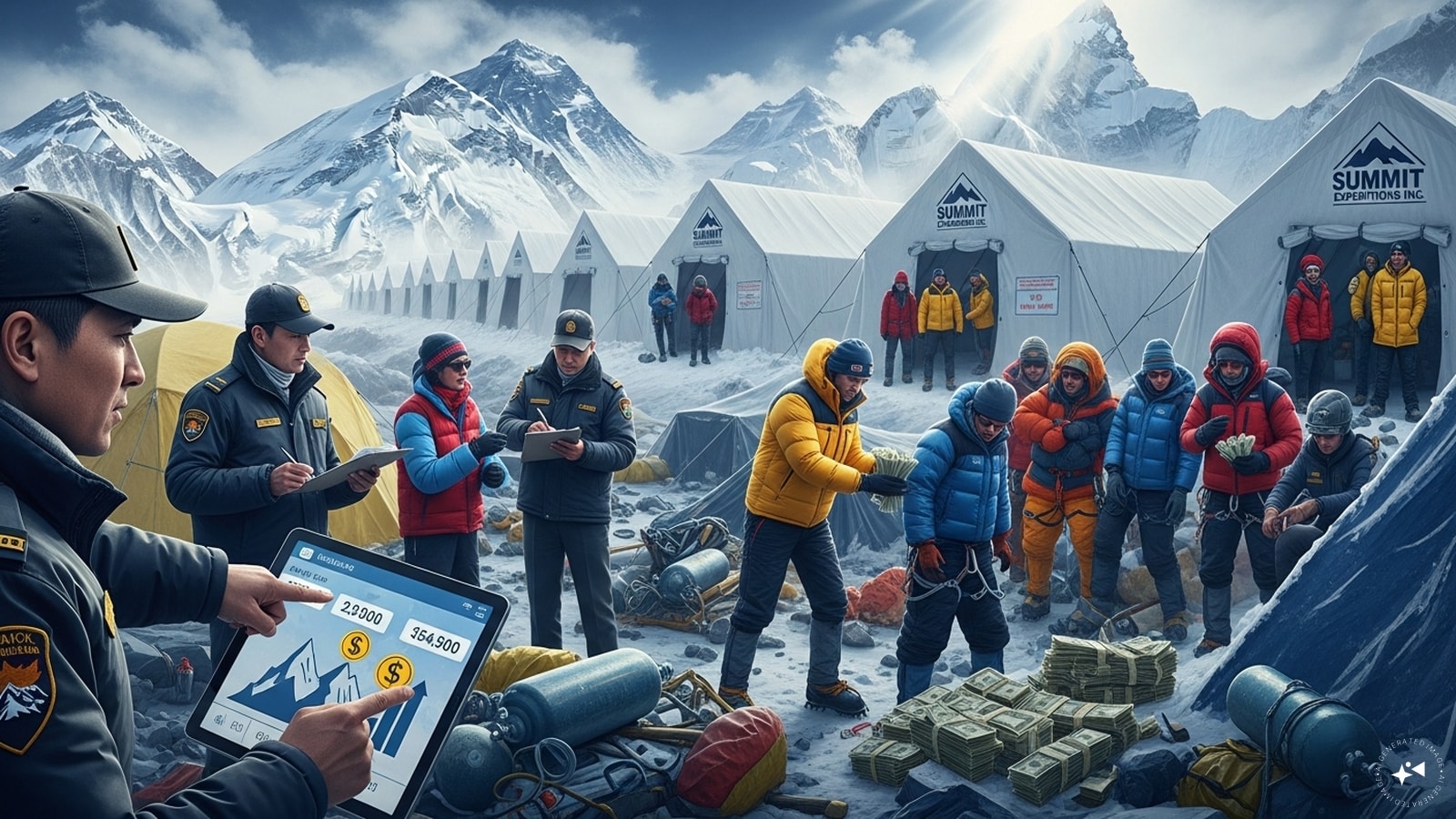
The alpine rescue industry in Nepal operates within a distorted incentive structure where the cost of a medical evacuation—often exceeding $15,000 per flight—is decoupled from the patient’s clinical need and redirected toward profit-sharing agreements between trekking agencies, helicopter operators, and private hospitals. Recent criminal charges filed against 32 individuals, including trekking guides and agency owners, reveal a coordinated effort to induce symptoms of Acute Mountain Sickness (AMS) in tourists to trigger lucrative insurance payouts. This systemic corruption is not a collection of isolated incidents but a logical outcome of a high-margin, low-oversight ecosystem where the patient is treated as a financial asset rather than a client.
The Economic Architecture of Search and Rescue Fraud
To understand why a guide would intentionally compromise a client's health, one must analyze the revenue distribution of a standard Himalayan rescue. A typical helicopter evacuation from the Everest region is priced at a premium, frequently inflated by 200% or 300% when billed to international insurance providers. For a more detailed analysis into this area, we suggest: this related article.
The flow of capital follows a distinct hierarchy:
- The Lead Guide: Serves as the point of origin for the "rescue" decision.
- The Trekking Agency: Acts as the coordinator, selecting the helicopter provider.
- The Helicopter Operator: Executes the flight and pays a kickback to the agency.
- The Receiving Hospital: Admits the patient for unnecessary diagnostic tests and prolonged stays to maximize billing.
In this model, the insurance company is the ultimate payer, while the "patient" is the mechanism of extraction. The profit margins on a standard trek are slim, often squeezed by fierce price competition. Conversely, the commission from a single fraudulent helicopter evacuation can exceed the total profit from a 14-day trekking package for an entire group. This creates a powerful financial incentive to prioritize medical emergencies over successful summits. For further information on this issue, detailed analysis can also be found at AFAR.
Mechanisms of Induced Sickness and Symptom Mimicry
The core of the criminal allegations involves the deliberate induction of illness, primarily through the contamination of food or water. By introducing substances that cause gastrointestinal distress or mimic the symptoms of AMS, guides create a pretext for evacuation that appears legitimate on paper.
The Pharmacological and Environmental Triggers
The primary method reported involves the covert administration of laxatives or baking soda into the hikers' meals.
- Laxative-induced Dehydration: Severe diarrhea leads to rapid electrolyte imbalance and dehydration. At high altitudes, dehydration significantly impairs the body's ability to acclimatize, directly increasing the risk of actual AMS while simultaneously presenting symptoms (fatigue, headache, dizziness) that are indistinguishable from it.
- Respiratory Interference: High-altitude environments require precise blood pH regulation. Introducing substances that alter metabolic chemistry can confuse a trekker's perception of their own fitness, leading to panic—a state easily exploited by a guide advocating for immediate descent via helicopter.
The Asymmetry of Information
The guide holds absolute authority over the trekker’s safety. When a hiker feels slightly unwell at 4,000 meters, they lack the diagnostic tools to differentiate between normal acclimatization stress and life-threatening High Altitude Cerebral Edema (HACE). The guide exploits this information gap. By exaggerating the severity of symptoms and warning of imminent death, the guide coerces the client into consenting to an evacuation they do not need. This consent protects the agency from immediate legal liability, as the rescue is framed as a "precautionary measure" requested by the client.
Structural Failures in Oversight and Regulation
The persistence of these fraudulent practices stems from a lack of centralized medical vetting and a fragmented regulatory environment in Nepal. Unlike European alpine regions, where mountain rescue is often state-subsidized or strictly regulated by non-profit alpine clubs, the Nepalese model is almost entirely privatized.
The Conflict of Interest in Triage
In a functioning medical system, triage is performed by a disinterested third party. In the Everest region, the guide—who stands to gain from the evacuation—is the person performing the initial triage. There is no requirement for a remote medical consultation with a certified physician before a helicopter is dispatched. This lack of a gatekeeper allows for the "blind dispatch" of aircraft based solely on the word of an interested party.
Insurance Company Complicity and Fatigue
For years, international insurance companies paid these claims with minimal scrutiny, viewing the high costs as an inherent risk of high-altitude travel. This "soft" target status encouraged agencies to scale their fraudulent operations. It was only when the volume of claims reached a statistical anomaly—where a disproportionate percentage of trekkers from specific agencies required "emergency" rescues—that insurers began to investigate. The current legal crackdown is a direct result of insurance consortiums threatening to blackball Nepalese trekking operators entirely if the government failed to intervene.
The Cost Function of Reputational Decay
The long-term impact of this fraud extends beyond the immediate financial theft. It alters the risk profile of the entire region, leading to higher premiums for travelers and a general degradation of trust in the Nepalese tourism industry.
- Insurance Premium Inflation: As the probability of a claim ($P$) and the severity of the loss ($L$) both increase due to fraud, the expected loss ($E = P \times L$) rises. Insurance providers respond by raising premiums or adding "high-altitude exclusions" that make trekking unaffordable or excessively risky for legitimate climbers.
- Erosion of Medical Integrity: When hospitals prioritize billing over patient care, the quality of actual emergency medicine suffers. Resources—helicopters and medical staff—are diverted from real life-threatening situations to attend to "profitable" patients, creating a systemic bottleneck that can lead to actual fatalities in true emergencies.
Quantitative Analysis of the Rescue-to-Trekker Ratio
Data analysis of trekking seasons reveals a correlation between "low-budget" trekking packages and high rescue rates. Agencies that undercut the market price on the front end typically recover their margins through backend rescue commissions.
The "Rescue-to-Trekker Ratio" (RTR) serves as a primary indicator of fraud. A standard, safe operation might see an RTR of less than 1% for serious medical issues. Fraudulent operations have been observed with RTRs exceeding 10-15%. This statistical outlier suggests that the environment is not the primary cause of the illness; rather, the business model is.
Defensive Strategies for the Sovereign Traveler
To mitigate the risk of being targeted by an induced-sickness scheme, trekkers must shift their operational security and medical autonomy.
- Decouple the Guide from the Medical Decision: Use a third-party satellite communication device (e.g., Garmin inReach) to consult with a remote medical service or your insurance provider's dedicated physician before agreeing to any evacuation.
- Standardize Food and Water Intake: Minimize consumption of "open" foods (soups, stews) where additives can be easily hidden. Prioritize sealed or self-prepared meals in high-risk areas.
- Verify Hospital Affiliations: Before starting a trek, identify which hospitals are on your insurer’s "approved" list. Be wary of guides who insist on a specific private clinic that is not recognized by international medical bodies.
- Audit the Agency's RTR: Request data on how many rescues an agency performed in the previous season. High numbers are not a sign of "safety" but a red flag for predatory practices.
Tactical Realignment for the Nepal Tourism Board
The government’s decision to book 32 individuals is a necessary first step, but it does not address the underlying incentives. A structural fix requires:
- Mandatory Telemedicine: No insurance claim should be valid without a timestamped, recorded video consultation between the patient and a certified doctor at the point of rescue.
- Price Capping: Implementing a fixed, transparent fee structure for helicopter charters to remove the "middleman" commission.
- Blacklisting: Permanent revocation of licenses for any agency or individual involved in inducing illness, coupled with a public database of sanctioned operators.
The current model is a parasitic relationship where the short-term greed of a few operators threatens the viability of a multi-million dollar industry. The investigation into the 32 accused individuals marks the transition from a period of unregulated exploitation to one of necessary, albeit forced, transparency. For the trekker, the primary defense remains a clinical skepticism of any medical advice provided by a party with a financial stake in the diagnosis.