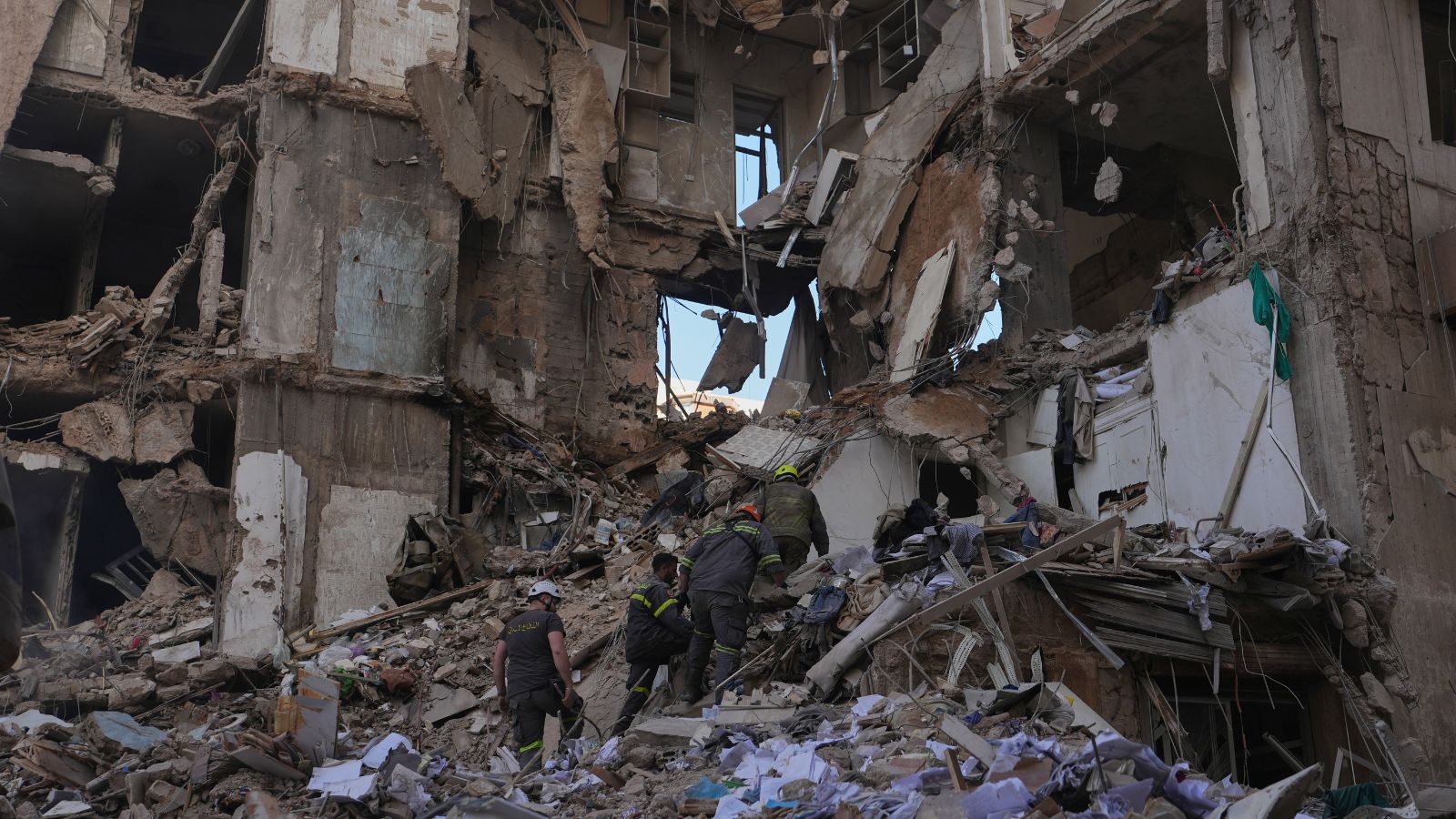
The Israeli military’s targeted elimination of a high-ranking Hezbollah official—identified by intelligence sources as the nephew of the group’s current Secretary-General, Naim Qassem—marks a definitive shift in the mechanics of the Lebanon conflict. This strike was not a random act of attrition. It was a precise removal of a figure who sat at the intersection of bloodline and bureaucracy. By neutralizing a relative of the top leadership, Israel has sent a message that exceeds the tactical value of the individual killed. They are dismantling the psychological safety net that once protected the families of the Hezbollah elite.
For decades, the upper echelon of the Shia militant group operated under a silent assumption that their immediate kin occupied a protected sphere, often insulated from the front lines while managing the vast financial and logistical networks that keep the organization breathing. That era is over. The death of Qassem’s nephew in a targeted bombing within Lebanon demonstrates that the Israeli Defense Forces (IDF) have mapped the organizational chart down to the last branch of the family tree.
The Strategy of Intimate Pressure
Targeting the inner circle of a leader like Naim Qassem is a classic move in high-stakes psychological warfare. It forces a commander to weigh their political and military objectives against the very real, very personal cost of their family’s survival. This is not just about reducing the number of fighters on a battlefield. It is about creating a sense of total exposure.
When a nephew is killed, the message to the uncle is clear: we know where you eat, we know who you trust, and we can reach through your most private defenses. This specific operation highlights a massive intelligence breach within Hezbollah’s internal security apparatus. For a strike of this nature to succeed, the IDF required real-time human intelligence or signals intercepts that tracked a specific individual who likely moved with a high degree of discretion.
The Failure of Hezbollah Internal Security
The group is currently reeling from a series of security catastrophes. From the exploding pagers to the assassination of Hassan Nasrallah, the myth of Hezbollah’s invincibility has been shredded. The death of Qassem’s relative suggests that the leak is not just a single hole in the boat, but a systemic rot.
Security experts suggest that the group’s rapid expansion over the last decade—driven by its involvement in the Syrian civil war—forced it to lower its vetting standards. This allowed Israeli intelligence to plant assets and monitoring devices deep within the structure. When you grow too fast, you lose the ability to verify the loyalty of every link in the chain. Israel is now pulling those chains until they snap.
Breaking the Logistic Backbone
The individual killed was not merely a symbolic figure. In organizations like Hezbollah, family members are often entrusted with the most sensitive tasks, particularly the management of "black" budgets and the procurement of advanced weaponry from Iran. Trust is the rarest commodity in a clandestine organization, and blood is the only proxy for it.
By removing these individuals, Israel disrupts the informal networks that bypass official channels. These are the people who arrange the safe houses, move the cash, and coordinate with Revolutionary Guard handlers. When a "nephew" or a "son" is removed, the leader loses more than a relative; he loses a fixer who didn't need to be watched.
The Iranian Connection
We cannot view this strike in isolation from the broader regional shadow war. Every Hezbollah official killed is a blow to Tehran’s investment. Iran has spent billions of dollars and decades of training to build Hezbollah into a "fire insurance policy" against an Israeli attack on Iranian soil.
Now, that policy is being cashed in early. The degradation of the leadership, from the very top down to the mid-level family associates, means that if a full-scale regional war erupts, Hezbollah’s ability to coordinate a multi-front response is severely compromised. They are moving from a structured army back into a fragmented collection of local militias.
The Geography of the Lebanon Bombings
The air campaign in Lebanon has evolved. It is no longer restricted to the southern border or the well-known strongholds in the Dahiyeh suburb of Beirut. The IDF is now striking with impunity across the Bekaa Valley and into the heart of northern Lebanon.
This geographical expansion serves two purposes. First, it flushes out officials who thought they could find sanctuary in non-traditional areas. Second, it creates a massive internal displacement crisis that puts political pressure on Hezbollah from the Lebanese population. When the bombings follow Hezbollah officials into Christian or Sunni neighborhoods, the sectarian tension within Lebanon reaches a breaking point.
Assessing the Military Impact
While the death of a single official, even a well-connected one, rarely ends a movement, the cumulative effect is undeniable. Modern warfare relies heavily on "Command and Control." When you kill the commanders, the control evaporates.
The IDF is currently utilizing a cycle of "Strike and Re-evaluate." They hit a target, wait for the communications chatter that follows the funeral or the succession, and then hit the next person who steps up to the microphone. It is a meat grinder for the mid-to-high level operative.
The Naim Qassem Factor
Naim Qassem was always seen as the "intellectual" or the "bureaucrat" of Hezbollah, standing in the shadow of Nasrallah’s charismatic authority. His elevation to the top spot was a move of necessity, not preference. By targeting his family so early in his tenure, Israel is testing his resolve and his ability to maintain order.
If Qassem cannot protect his own kin, the rank-and-file fighters will begin to wonder who is looking out for them. In the brutal logic of Middle Eastern proxy wars, perception is often more important than reality. The perception now is that Hezbollah is a sinking ship, and the captain’s family is already overboard.
Redefining the Rules of Engagement
This strike signals that the "red lines" of previous decades have been erased. There was a time when both sides avoided targeting the families of political leaders to prevent an endless cycle of revenge killings that could spiral out of control. Those days are gone.
Israel has shifted to a strategy of total pressure. They are betting that by inflicting maximum pain on the leadership, they can force a diplomatic settlement on their terms—specifically, the push of Hezbollah forces back beyond the Litani River, as mandated by UN Resolution 1701.
The Risk of Escalation
The danger in this approach is the "cornered rat" syndrome. With their leadership decimated and their family members targeted, the remaining Hezbollah commanders may feel they have nothing left to lose. This could lead to more frequent and less discriminate rocket attacks on Israeli civilian centers, or attempts at international terrorism against Israeli targets abroad.
However, the current data suggests Hezbollah’s capabilities are too degraded for a sustained, high-intensity response. Their long-range missile sites are being systematically destroyed, and their communication lines are compromised. They are fighting a 21st-century war with a 20th-century mindset, and the gap is showing.
The Long-Term Consequences for Lebanon
Lebanon stands at a crossroads. As Hezbollah’s grip on the country weakens due to military losses, a power vacuum is forming. The Lebanese Armed Forces (LAF) and the central government are under immense pressure to assert control, but they lack the resources and, frankly, the courage to challenge the remaining Hezbollah infrastructure.
The elimination of the Qassem nephew is a milestone in the erosion of the "State within a State." If the leadership continues to be picked off at this rate, the group’s ability to provide social services and maintain its parallel economy will collapse. This would leave millions of people who depend on Hezbollah’s patronage in a state of total desperation.
Precision as a Political Tool
The use of high-precision munitions in these bombings is a deliberate choice. By minimizing collateral damage in some instances while being devastatingly accurate in others, Israel is showing the Lebanese public that they are not the target—Hezbollah is. It is an attempt to drive a wedge between the militant group and the civilian population that has historically provided its cover.
This "surgical" approach is designed to make the presence of a Hezbollah official a liability for any neighborhood. If having a "nephew" or a commander next door means a missile is coming through the roof, people will eventually stop opening their doors.
The Intelligence Supremacy
The most significant takeaway from this event is the sheer dominance of Israeli intelligence. To identify, track, and kill a specific relative of the Secretary-General requires a level of penetration that most intelligence agencies can only dream of. It suggests that every phone call, every encrypted message, and every vehicle movement is being logged and analyzed by AI-driven systems in Tel Aviv.
Hezbollah is no longer fighting a war against an army; they are fighting a war against an algorithm that knows their next move before they do. The death of Qassem’s nephew is a data point in a much larger trend of technological overmatch.
The organization is being dismantled piece by piece, family member by family member. The hierarchy is collapsing into a mess of paranoia and failed security protocols. While the group will undoubtedly attempt to project strength through propaganda and sporadic rocket fire, the reality on the ground is one of terminal decline. The protective shield of the dynasty has been shattered, and those who remain are left wondering not if they will be hit, but when.