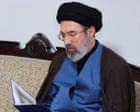
The headlines are screaming about a "seismic shift" in Tehran. Mojtaba Khamenei is reportedly taking the mantle. Brent is breaching $100. The consensus is panicking because it thinks we are staring at the end of regional stability and a global energy shock.
They are wrong.
The media loves a dynasty story. It’s easy to sell. But the assumption that a leadership change in the Islamic Republic, coupled with a temporary price spike, equates to a geopolitical "game over" is a fundamental misunderstanding of how power and petroleum actually function in 2026. If you are selling your positions or bunkering down for a global depression, you are falling for the noise.
The Institutional Inertia of the Deep State
The prevailing narrative suggests that Mojtaba Khamenei’s ascent marks a radical departure or a volatile new era. This ignores the reality of the Office of the Supreme Leader. The person at the top is not a rogue actor; they are the custodian of a massive, bureaucratic, and deeply entrenched military-industrial complex.
The Islamic Revolutionary Guard Corps (IRGC) does not care about the name on the door as much as it cares about the survival of the system. I have spent years tracking the financial flows of sanctioned entities. The "revolutionary" rhetoric is the product. The "stability of the status quo" is the business model.
Mojtaba isn't coming in to burn the house down. He is coming in to ensure the plumbing keeps working. Transition in Tehran is less about a change in direction and more about a consolidation of existing interests. Expecting a radical shift in foreign policy because of a new face is like expecting a bank to stop charging interest because they hired a new CEO.
Why $100 Oil is a Paper Tiger
Everyone is staring at the ticker, watching the price of crude climb past $100. They call it a crisis. I call it a market rebalancing that the world is more than prepared to handle.
The 1970s called, and they want their panic back. In 2026, the global economy is significantly less energy-intensive than it was during the last great shocks. We have spent the last decade building redundancy into the system.
- The US Shale Buffer: Domestic production is at historic highs. Every time the price creeps up, the economics for "marginal" wells in the Permian Basin become irresistible. The supply response is faster than it has ever been.
- The Strategic Reserve Paradox: Governments talk about "releasing" reserves to lower prices. That’s a rounding error. The real pressure comes from the fact that at $110, demand destruction kicks in almost instantly in emerging markets, forcing a price correction regardless of what happens in the Strait of Hormuz.
- The Diversification Reality: We aren't just talking about renewables. We are talking about the massive shift in how heavy industry and logistics have optimized fuel consumption.
A $100 barrel is a psychological barrier, not a structural one. The "pain at the pump" is a political talking point, not a precursor to a systemic collapse.
The Misconception of Total War
The "Middle East Crisis" live blogs want you to believe we are one drone strike away from a total regional conflagration. This "all or nothing" view of conflict is amateur hour.
What we are seeing is a sophisticated, high-stakes negotiation through kinetic means. Neither Iran nor its neighbors can afford a full-scale war. Iran’s economy, despite its resilience, cannot sustain a total mobilization. Saudi Arabia and the UAE are balls-deep in massive infrastructure projects—Vision 2030 doesn't happen if the skies are filled with missiles.
The conflict is a series of controlled burns. They are meant to signal strength, not to destroy the neighbor’s house. If you interpret every skirmish as the start of World War III, you will consistently miss the actual investment opportunities hidden in the volatility.
Stop Asking if it’s Stable
The most common question I get is: "When will the Middle East be stable?"
It’s the wrong question. It’s a flawed premise.
Instability is the feature, not the bug. The region thrives on the management of tension. For the defense sector, the energy giants, and the regional power brokers, a certain level of friction is profitable. It justifies military spending. It keeps oil prices at a premium. It consolidates domestic power.
If you are waiting for a "peaceful" Middle East to make your next move, you will be waiting forever. The smart money isn't betting on peace; it’s betting on the fact that the tension will always be managed just short of the breaking point.
The Brutal Reality of Succession
Let’s look at Mojtaba. The critique is that his lack of "elected" legitimacy will lead to an internal uprising.
History says otherwise. When the stakes are this high—when the survival of the elite class is tied to the survival of the leader—the inner circle tends to close ranks, not splinter. The IRGC has too much to lose to allow a messy succession. They aren't looking for a charismatic visionary. They are looking for a manager who won't mess with their ports, their black-market trade routes, and their regional influence.
The "unrest" that analysts predict is usually confined to the streets, which the state has proven it can suppress with chilling efficiency. To bet on a collapse of the Iranian state during this transition is to bet against one of the most durable authoritarian structures in modern history.
The Actionable Pivot
If you want to actually survive this "crisis," stop reading the play-by-play of who is meeting whom in Tehran.
- Ignore the Oil Hysteria: Look at the energy services sector instead. High prices mean more Capex. The companies that provide the hardware to drill are the real winners, not the people hoarding gas cans in their garage.
- Short the Doomsday Narratives: When the media consensus reaches a fever pitch about "imminent collapse," that is usually the peak of the volatility risk. The market has a way of pricing in the end of the world long before it happens.
- Watch the Money, Not the Mouths: Follow the trade agreements between the Gulf states and Asia. If China isn't pulling its people out of the region, there is no real war coming.
The headlines are designed to provoke an emotional response. A leadership change in Iran is a Tuesday. $100 oil is a market cycle. The "crisis" is just business as usual for those who actually understand the mechanics of power.
Stop looking for the explosion. Watch the hands that are moving the pieces. They aren't shaking; they're counting.