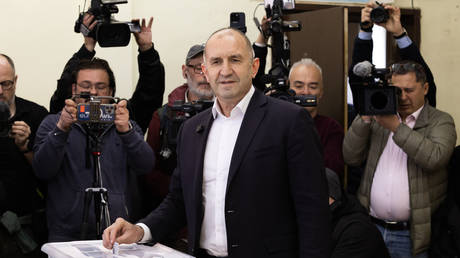
Bulgaria’s seventh general election in three and a half years confirms a state of systemic equilibrium where no political actor possesses the kinetic energy to overcome institutional friction. The fundamental crisis is not a lack of democratic participation, but a breakdown in the Coalition Formation Function. When the cost of compromise exceeds the benefit of incumbency, the default state of the political system reverts to caretaker administration, effectively freezing national strategy.
The current deadlock is the result of three specific structural barriers: the Sanctioned Actor Paradox, the Fragmented Protest Vote, and the Erosion of Institutional Legitimacy. Understanding the trajectory of the Bulgarian state requires moving beyond "corruption" as a vague catch-all and instead analyzing the specific mechanisms preventing a stable executive branch from taking root.
The Sanctioned Actor Paradox and the GERB-SDS Bottleneck
The GERB-SDS coalition, led by Boyko Borisov, remains the dominant plurality, yet it functions as a blocked asset. The paradox lies in the delta between electoral victory and governing viability. GERB maintains a loyal base centered on municipal patronage networks and a reputation for "predictability," but it cannot find a coalition partner without triggering a legitimacy crisis for that partner.
This bottleneck is tightened by the presence of Delyan Peevski and the split within the Movement for Rights and Freedoms (DPS). The emergence of DPS – A New Beginning versus the Alliance for Rights and Freedoms (APS) has fragmented the traditional Turkish minority vote, which previously acted as the "kingmaker" in Bulgarian politics.
Peevski’s inclusion in any formal or informal governance structure creates an immediate ceiling for reformist parties like We Continue the Change–Democratic Bulgaria (PP-DB). The "Sanctioned Actor" variable operates as a hard constraint:
- International Pressure: Adherence to Western standards (including the Magnitsky Act) makes formal cooperation with sanctioned individuals a liability for any party seeking Eurozone or Schengen integration.
- Domestic Veto: The protest movement’s primary objective remains the "de-corruptization" of the judiciary, a goal viewed as diametrically opposed to the survival of the current GERB and DPS leadership structures.
The Cost Function of Coalition Building
In a healthy parliamentary system, the goal of a political party is to maximize its influence within a government. In Bulgaria, the goal has shifted to Brand Preservation. Parties are currently calculating their moves based on a risk-avoidance model rather than a power-maximization model.
The "Cost of Governance" for a party like PP-DB is currently higher than the "Cost of Opposition." Entering a grand coalition with GERB would likely result in the alienation of their core urban, pro-reform constituency. This creates a Negative Sum Game where the most rational move for individual party survival—refusing to compromise—results in the irrational outcome for the state: perpetual instability.
The rise of the "Greatness" (Velichie) and "Sword" (MECH) parties further complicates this calculation. These fringe elements capture the "angry" vote, draining percentage points from mainstream parties and raising the threshold for a stable majority. Every new micro-party that enters the 240-seat Parliament increases the complexity of the coalition matrix exponentially.
The Geopolitical Drift and Institutional Decay
The primary casualty of this political stalemate is Bulgaria’s long-term strategic alignment. While the country is nominally a member of NATO and the EU, the lack of a stable, empowered parliament creates a vacuum filled by pro-Russian rhetoric and populist movements like Vazrazhdane (Revival).
Vazrazhdane’s growth is a direct function of the Stability Gap. When mainstream parties fail to deliver a functioning government, the electorate begins to view "systemic" politics as a failed experiment. This leads to:
- Eurozone Integration Delays: Bulgaria’s target for adopting the Euro is consistently pushed back due to the inability to pass necessary fiscal and regulatory legislation.
- Energy Sovereignty Stagnation: Major decisions regarding nuclear expansion and the diversification of gas supplies require multi-year commitments that caretaker governments are unauthorized to make.
- Judicial Reform Paralysis: The Supreme Judicial Council remains in a state of suspended animation, preventing the systemic changes needed to address high-level corruption.
The Bulgarian Presidency, led by Rumen Radev, has emerged as the de facto center of power. However, this is a constitutional distortion. The presidency was designed to be a ceremonial and unifying office, not a permanent executive branch. The reliance on caretaker cabinets creates a "Shadow Executive" that lacks the democratic mandate to enact sweeping reforms but possesses enough power to maintain the status quo.
The Mathematical Impossibility of the 51st Assembly
The seat distribution in the 51st National Assembly suggests that any viable government would require at least three, and likely four, distinct political entities to agree on a common program. The ideological distance between these entities is too great to be bridged by traditional horse-trading.
Consider the Incompatibility Matrix:
- PP-DB demands the total overhaul of the prosecution service and the isolation of Peevski.
- GERB refuses to sacrifice its leadership or its historical alliances for a junior role in a reformist-led government.
- Vazrazhdane remains ideologically committed to the reversal of Bulgaria's Western orientation, making them an "untouchable" for the pro-EU center-right.
- The DPS Schism prevents the traditional "balancing act" that used to provide parliamentary stability.
The result is a legislative body that is technically operational but strategically dead.
Strategic Forecast: The Pivot to Constitutional Crisis
Bulgaria is approaching the limits of its current constitutional framework. The cycle of "Election -> Deadlock -> Caretaker Government -> Election" has reached a point of diminishing returns. Voter turnout is at record lows, which increases the proportional power of "controlled votes" and fringe extremists.
The next phase of this crisis will likely involve a push for a Presidential Republic. Proponents argue that the parliamentary system is inherently unsuited for Bulgaria's current political culture and that a strong executive model would provide the stability the country lacks. However, this transition carries significant risks:
- Concentration of Power: A shift to a presidential system could lead to an erosion of checks and balances, particularly if the presidency is captured by populist or pro-Russian interests.
- Social Polarization: The debate over constitutional change would likely split the country even further, pitting those who value parliamentary democracy against those who prioritize administrative efficiency.
The only mechanism to break the current cycle without a constitutional rewrite is the emergence of a "Shock to the System." This could take the form of an external economic crisis or a fundamental realignment of the Bulgarian center-right. Until the cost of political stalemate becomes higher than the cost of a painful compromise, the Bulgarian state will remain in a condition of managed decline.
The strategic priority for international observers and domestic stakeholders must be the protection of the Technical State. In the absence of a political executive, the focus must shift to maintaining the integrity of the Bulgarian National Bank, the energy grid, and the security services. These institutions must be shielded from the political fray to prevent the paralysis of the parliament from cascading into a total systemic collapse. The immediate play for any reformist actor is not the pursuit of a majority they cannot achieve, but the hardening of these non-political institutions against the inevitable period of prolonged instability ahead.