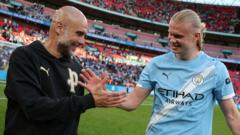
The pursuit of a "Treble"—the simultaneous acquisition of a domestic league title, the primary domestic cup, and the continental championship—is not an exercise in sporting luck, but the result of a precise optimization of three distinct variables: tactical flexibility, squad depth as a risk mitigation tool, and the management of physiological fatigue cycles. Manchester City’s transition from a period of domestic dominance to a legitimate contender for repeated historic clean sweeps is predicated on a structural evolution from a possession-oriented system to a high-threshold efficiency machine. To understand this trajectory, one must move beyond the emotional narrative of "destiny" and examine the cold operational realities of Pep Guardiola’s tactical architecture and the club's capital allocation.
The Triad of Sustained Dominance
Success in elite European football is governed by a diminishing returns curve. As the volume of matches increases, the probability of injury and tactical "solve-ability" scales exponentially. City’s model combats this through three pillars of systemic resilience.
1. Tactical Hybridization and the Box Midfield
Early Guardiola iterations relied on wide wingers stretching the pitch to create interior pockets. Modern City operates through a 3-2-2-3 or 3-2-4-1 structure. By moving a nominal defender into the midfield pivot—most notably John Stones—City creates a numerical superiority in the central "Phase 2" of build-up. This "Box Midfield" forces opponents into a defensive dilemma: press the extra man and leave the half-spaces vulnerable, or drop deep and concede total territorial control. This isn't just about possession; it is about energy preservation. By controlling the center, City reduces the need for high-intensity recovery sprints, thereby lowering the cumulative metabolic load on their primary creators.
2. Positional Versatility as a Hedge Against Attrition
The squad is intentionally kept lean but highly versatile. Unlike competitors who stockpile specialized backups, City prioritizes players who can operate in at least three distinct zones. Bernardo Silva’s ability to function as a traditional winger, an interior "8," or a deep-lying "6" allows the manager to rotate the squad without degrading the systemic integrity. This creates a "redundancy without bloat" model. When a key component like Kevin De Bruyne is unavailable, the system does not break; it recalibrates.
3. The Erling Haaland Deviation: Structural Efficiency
The introduction of a traditional, high-volume striker shifted City’s "Expected Goals" (xG) distribution. Previously, City relied on "False 9" movements that prioritized ball retention over verticality. Haaland’s presence allows for a lower volume of passes per goal, which is a critical efficiency metric during the high-density fixture lists of April and May. If a team can score via 10 passes rather than 40, they preserve the cognitive and physical resources required for the subsequent mid-week fixture.
The Economics of the Treble: Probability and Variance
Winning three trophies requires navigating approximately 60 matches across 10 months. Statistically, the "Treble" is an outlier because it requires a near-perfect alignment of low-probability events in knockout competitions.
The Variance of Cup Competitions
The Premier League is a high-sample-size environment (38 games). In such an environment, the team with the highest structural quality almost always wins because variance (luck) regresses to the mean. The Champions League and FA Cup, however, are low-sample-size environments. A single refereeing error, a deflected shot, or a 10-minute lapse in concentration can result in elimination. City’s strategy involves inflating their "baseline dominance" so significantly that even with negative variance, they remain the statistical favorite. They don't aim to "win" a cup final; they aim to make the match so lopsided in terms of territory and chance creation that the opponent's path to victory requires a three-standard-deviation event.
The Physiological Bottleneck: Periodization of Performance
The primary threat to a treble is not the opponent, but the "red zone" of player fatigue. Tactical systems are only as effective as the physical capacity of the players to execute them.
Macro-Cycle Management
City’s performance staff employs a periodization model that intentionally "undercooks" the squad in the early months (August–October). You will often see City drop points or look sluggish in early autumn. This is a calculated risk. By delaying peak physical condition, they ensure that the squad reaches its maximum power-to-weight ratio and cognitive sharpness in April. Most teams peak too early and experience a physiological "cliff" during the quarter-final and semi-final stages of knockout competitions.
Cognitive Load and Decision-Making
Fatigue manifests first in the central nervous system, leading to slower decision-making and poor positioning. In a system as complex as Guardiola’s—which requires players to constantly monitor the positions of 21 other actors—a 5% drop in cognitive processing leads to a systemic failure. The use of "controlled possession" is City's primary defensive tool. By keeping the ball, they force the opponent to do the cognitive and physical work of chasing, effectively "resting with the ball."
The Psychological Burden of "The Quest"
While data governs the physical and tactical realms, the psychological pressure of a treble pursuit introduces a unique variable: risk aversion. As the stakes increase, players naturally tend to favor "safe" actions over high-reward/high-risk actions. This can stifle the very creativity required to break down low-block defenses.
Guardiola counteracts this through "hyper-instruction." By providing players with a rigid set of instructions for every possible scenario on the pitch, he reduces the "choice architecture" load on the players. They don't have to "think" under pressure; they only have to "execute" the pre-programmed response. This transforms a high-pressure sporting event into a series of technical drills, which are far easier to manage mentally.
The Inevitability of Financial Scrutiny
It is impossible to analyze City's quest for history without addressing the capital efficiency of the project. The club has been accused of "buying success," but the data suggests a more nuanced reality of "efficient capital deployment." While their spend is high, their "hit rate" on transfers is significantly higher than that of their direct rivals (Manchester United, Chelsea, PSG).
City’s recruitment focuses on "system-fit" rather than "market-value." They rarely buy established superstars at the peak of their commercial value; they buy 22-to-24-year-olds with specific technical profiles that can be molded into the system. This creates a sustainable value chain. The cost-per-trophy metric for City, while high in absolute terms, is highly optimized when compared to the inefficiency of their peers.
The Strategic Forecast for Multi-Trophy Success
To secure a treble or a "quadruple," a club must transition from being a "football team" to a "high-performance system." This requires:
- Fixed Tactical Principles: The system must be the constant, the players the variables.
- Data-Driven Rotation: Resting players based on GPS and blood-marker data, not on "feeling."
- Depth Neutrality: The gap between the best player and the 18th player must be less than 15% in terms of technical output.
The current Manchester City iteration has achieved these metrics. The primary threat to their continued dominance is not a rival team, but "tactical stagnation"—the point at which the rest of the league develops a standardized defensive blueprint to neutralize the box midfield. Until that evolution occurs, City’s pursuit of history is not a matter of "if," but a matter of how many trophies the variance of knockout football allows them to collect.
The strategic play for any competitor is to disrupt the "Phase 1" build-up through a high-risk man-marking press, forcing City into long-ball situations where their numerical advantages are negated. However, few teams possess the physical profile or the bravery to execute this over 90 minutes. Consequently, City remains the benchmark for operational excellence in global sport.