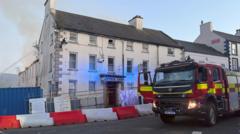
The ignition of a derelict hotel represents more than a localized fire department response; it is the inevitable conclusion of a failed asset lifecycle. When a large-scale hospitality structure transitions from operational to "derelict," it exits the regulated safety ecosystem of active fire suppression and enters a state of unmitigated risk. The primary challenge for emergency services in these scenarios is not merely the suppression of flames, but the management of a rapidly collapsing structural environment where the fuel load is high, the fire-stopping measures are compromised, and the risk-to-benefit ratio for internal entry is almost universally negative.
The Triad of Accelerated Combustion in Abandoned Structures
The severity of a blaze in a derelict hotel is dictated by three compounding variables that distinguish it from residential or active commercial fires.
1. Compromised Passive Fire Protection
In an active hotel, fire doors, intumescent seals, and compartmentalized ceiling voids act as barriers to limit the rate of heat release. Once a building is abandoned, these systems are the first to fail. Vandalism, the stripping of copper piping, and the removal of architectural salvage often involve the breaching of firewalls and the propping open of stairwell doors. This creates a "chimney effect," where vertical shafts allow heat and toxic gases to bypass floors, leading to simultaneous multi-story involvement that outpaces traditional hose-line deployment.
2. High-Density Synthetic Fuel Loads
Despite the removal of high-value electronics, derelict hotels often retain massive quantities of legacy furnishings. Polyurethane foam in mattresses and sofas, treated timber framing, and synthetic carpeting provide a dense thermal energy source. Upon ignition, these materials undergo pyrolysis, releasing flammable gases that accumulate in unventilated rooms. This leads to backdraft or flashover conditions—where the entire environment ignites simultaneously—far earlier in the incident timeline than in maintained properties.
3. Structural Porosity and Ventilation
Broken windows and forced entry points create unpredictable airflow. In a controlled environment, ventilation is managed by the HVAC system or tactical venting by firefighters. In a derelict hotel, the building is "leaky." Wind-driven fire conditions can push a localized room fire into a conflagration within minutes, as the broken exterior envelope provides a constant supply of oxygen while the internal layout acts as a complex labyrinth of heat traps.
The Economics of Arson and Negligence
The transition of a property from a liability to a loss event often follows a predictable economic curve. The cost of securing a large-scale derelict asset—covering 24/7 security, boarding, and insurance premiums—often exceeds the projected appreciation of the land. This creates a "security vacuum."
- Vulnerability Phase: The building is closed but intact. Risk is low.
- Decay Phase: External barriers are breached. Copper and lead theft occurs. Risk of accidental ignition by squatters increases by 400%.
- Terminal Phase: The structure is a known hazard. The "broken windows theory" manifests, and the asset becomes a target for deliberate fire-setting.
From a consultant’s perspective, the "blaze at a derelict hotel" is rarely a surprise. It is the terminal point of a neglected maintenance function. The cost of the emergency response—utilizing multiple pumping appliances, aerial ladder platforms, and high-volume pumps—is a public subsidy of a private failure in asset management.
Operational Tactical Constraints: Defensive vs. Offensive Modes
Fire crews arriving at a derelict hotel must immediately execute a risk-benefit analysis that favors "Defensive Mode." In active buildings, the "Life Safety" priority justifies high-risk internal searches. In a derelict property, where the presence of occupants is speculative and the structural integrity is unverified, the protocol shifts toward containment.
The Problem of Void Spaces
Hotel architecture is notoriously complex, characterized by dropped ceilings for ductwork and plumbing. In a derelict state, fire can travel through these voids undetected by crews on the floor. A fire that appears to be on the third floor may actually be anchored in the structural timber of the fourth, leading to a floor collapse that traps firefighters.
Water Supply Logistical Bottlenecks
Large-scale fires require flow rates often exceeding 2,000 liters per minute. In many cases, the hydrants surrounding an abandoned property have not been tested or have suffered from reduced pressure due to local infrastructure decay. This necessitates the deployment of high-volume pumps (HVPs) to draw water from open sources or the establishment of a "shuttle" system using water carriers, significantly delaying the time to "knock down" the main body of fire.
Measuring the Environmental and Public Health Externalities
The impact of a derelict hotel fire extends beyond the property line. Because these structures often date back several decades, they contain materials that are hazardous when aerosolized.
- Asbestos Mobilization: Older hotels used asbestos for pipe insulation and ceiling tiles. Intense heat fractures these materials, and the resulting thermal plume can carry fibers across a wide radius.
- Particulate Matter (PM2.5): The combustion of synthetic materials produces high concentrations of fine particulate matter and hydrogen cyanide. Unlike modern residential fires, the volume of material in a hotel means the smoke log can persist for days, requiring long-term "shelter in place" orders for local residents.
- Runoff Contamination: The thousands of tons of water used to suppress the fire mix with charred debris and chemical residues. Without active drainage management, this toxic runoff enters the local water table or sewage system, creating a secondary environmental incident.
Tactical Recommendation for Municipal Oversight
To mitigate the recurrence of these incidents, a shift from reactive firefighting to proactive asset enforcement is required. The following framework should be applied to all high-volume derelict assets:
- Mandatory Structural Fire Audits: Municipalities must require owners of derelict properties to provide quarterly structural integrity reports. If the property is deemed a "fire trap," the city should have the legal mechanism to perform a controlled demolition at the owner’s expense.
- Remote Sensor Deployment: Low-power wide-area network (LPWAN) heat and motion sensors can be deployed in "empty" buildings to provide early warning of intrusion or ignition. The cost of a $500 sensor suite is negligible compared to the $100,000+ cost of a multi-agency fire response.
- Hazard Mapping for First Responders: Fire services must maintain digital floor plans of high-risk derelict assets, pre-identifying "no-go zones" where floor loading is compromised or where hazardous materials are stored.
The incident at the derelict hotel is a symptom of a systemic gap in urban property management. Until the cost of maintaining a dangerous ruin exceeds the cost of demolition or redevelopment, these structures will continue to serve as high-energy fuel cells waiting for a spark. The strategy must move toward aggressive site clearance and the legal penalization of "land-banking" through negligence.
Owners must be compelled to move assets into a "Safe State" or face immediate forfeiture. Failure to act results in the inevitable: a catastrophic thermal event that endangers crews, destroys environmental quality, and leaves the community with a charred skeleton that is even more expensive to remediate than the original derelict structure.
The final strategic move for any municipal authority is the implementation of an "Accelerated Demolition Ordinance." When an asset reaches the Terminal Phase of decay, the risk to the public and emergency responders outweighs the private property rights of the negligent owner. Direct intervention is the only path to zero-incident hospitality decay.