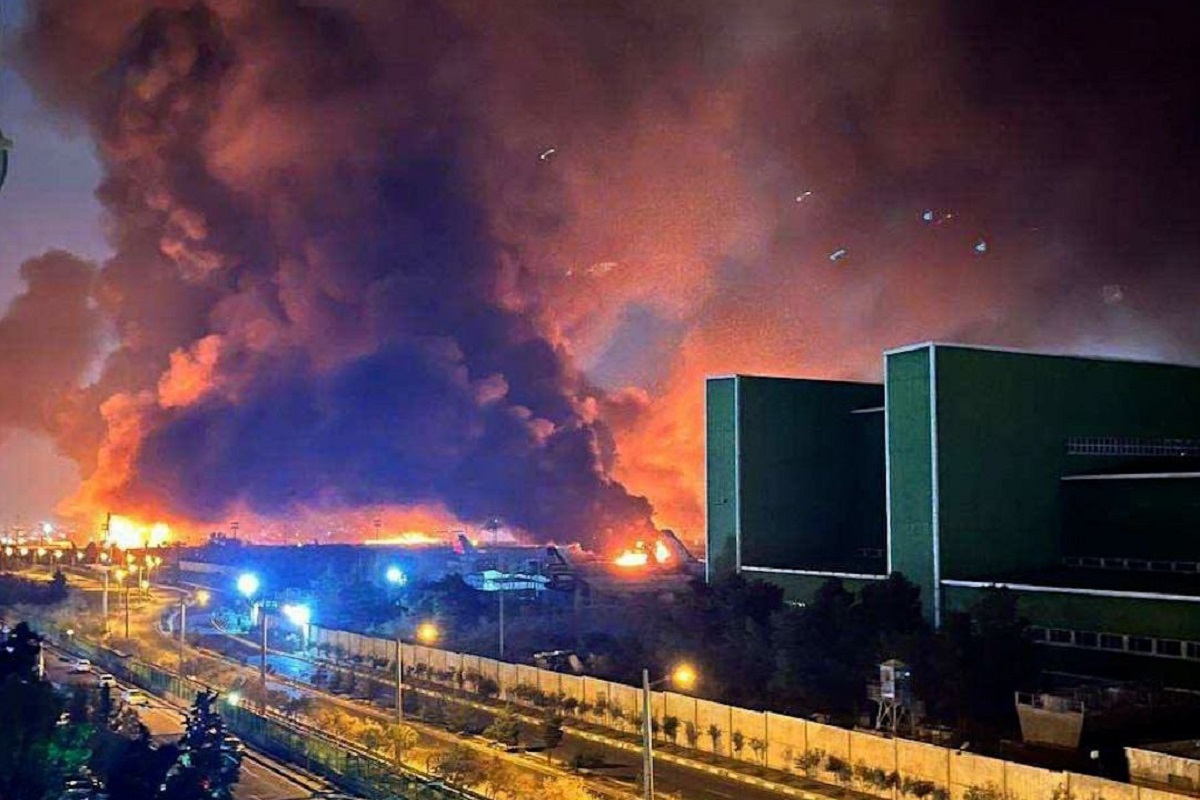
The recent escalation of kinetic activity surrounding Tehran’s aviation infrastructure is not a random act of atmospheric violence; it is a calculated exercise in Signaling Theory and Operational Degradation. When explosions occur at a logistical nexus like an international airport, the objective is rarely the total destruction of the facility. Instead, the actor is aiming to disrupt the Command, Control, Communications, Computers, Intelligence, Surveillance, and Reconnaissance (C4ISR) capabilities of the adversary while testing the response latency of their Integrated Air Defense Systems (IADS).
The Triad of Aerotropolis Vulnerability
An airport in a high-conflict zone is not merely a transport hub; it is a critical node in a state’s military-industrial supply chain. To understand the impact of an attack on Tehran’s airport, one must analyze it through three distinct layers of vulnerability:
- Kinetic Disruption of Logistics: Modern warfare relies on "Just-in-Time" delivery for specialized components. In the context of the Iran-Israel-US triad, the airport serves as the primary entry point for dual-use technologies and advanced missile guidance systems. A strike here creates a "Logistical Bottleneck," forcing the military to reroute high-priority cargo through less efficient land-based or maritime routes that are more susceptible to interdiction.
- Psychological and Informational Asymmetry: The "terror" described by civilian witnesses serves a specific strategic function. It signals to the domestic population and the international community that the state’s sovereign airspace is porous. This degrades the perceived legitimacy of the defending regime and creates a "Security Dilemma" where the state must choose between protecting its capital or its borders.
- Electronic Warfare (EW) Probing: Often, the "loud explosions" reported are the result of kinetic intercepts. When an IADS engages an incoming threat, it reveals its radar signatures, frequency-hopping patterns, and battery locations. This allows the attacker to map the electronic order of battle for future, more devastating sorties.
Technical Analysis of Aerial Interdiction
The efficacy of a strike on a hardened target like an airport is determined by the Probability of Kill ($P_k$). This is not a static number but a function of the delivery platform’s stealth characteristics, the missile's terminal guidance system, and the target's defensive saturation.
$$P_k = 1 - (1 - p)^n$$
In this equation, $p$ represents the probability of a single munition neutralizing the target, and $n$ is the number of munitions deployed. When reports emerge of multiple explosions, it suggests a "Saturation Attack" designed to overwhelm the Russian-made S-300 or domestic Bavar-373 systems protecting Tehran. The goal is to ensure that even if the interception rate is high, the remaining $1 - P_k$ is sufficient to achieve the operational objective.
The Mechanics of Internal Displacement and Social Stability
Public panic is a measurable variable in strategic planning. The "shaking souls" and "horrific scenes" mentioned in populist reporting are categorized by analysts as Social Cohesion Erosion. When a high-security zone like a capital’s airport is breached, the following cascading effects occur:
- Capital Flight: Investors and high-net-worth individuals seek immediate exit, devaluing the local currency.
- Information Vacuum: State media often suppresses details, leading to a "Rumor Economy" that can trigger civil unrest more effectively than the physical blast itself.
- Resource Diversion: The state is forced to move elite units from the front lines to the interior for "Stability Operations," effectively weakening their external power projection.
Assessing the Payload: Kinetic vs. Cyber
While visual reports focus on fire and smoke, the most significant damage in modern theater often happens in the electromagnetic spectrum. A "Soft Kill" involves the use of high-power microwave (HPM) weapons or cyber-intrusions that disable the airport’s Air Traffic Control (ATC) and radar without a single physical explosion. If the reported "loud noises" were indeed kinetic, it indicates a shift from clandestine sabotage to Overt Attrition. This transition suggests that the attacking party is no longer concerned with "Plausible Deniability" and is instead focused on "Absolute Deterrence."
The Geopolitical Friction Point
The geography of Tehran’s Imam Khomeini International Airport makes it a difficult target to defend against low-flying cruise missiles or "suicide" Loitering Munitions. These assets utilize Terrain Contours to stay below the radar horizon until the final seconds of their flight path.
The strategic irony of the US-Israel-Iran triangle is the Escalation Ladder. Every strike is a rung. A strike on an airport is a high-level rung because it straddles the line between military targets and civilian infrastructure. If the response is too weak, the defender loses deterrence; if it is too strong, it triggers a "General War" scenario that neither side may be economically prepared to sustain.
Structural Failures in Defensive Architecture
The primary limitation of current Iranian air defense is the Sensor-to-Shooter Gap. Even with advanced radar, the time required to identify an incoming "stealthy" threat, verify it as hostile, and launch an interceptor is often longer than the threat's time-to-target. This creates a "Defensive Blind Spot" during the terminal phase of the attack.
Furthermore, the integration of different hardware generations—mixing 1970s American airframes with 2020s Russian and indigenous missile systems—creates Interoperability Friction. In the heat of a saturation attack, these systems may fail to "talk" to each other, leading to friendly fire incidents or uncoordinated defensive gaps.
Strategic Recommendations for Theater Observation
Observers must look beyond the immediate imagery of fire to identify the true victor of this exchange. The metric of success is not the volume of the explosion, but the Duration of Operational Downtime. If the airport returns to full capacity within 24 hours, the strike was a "Signal." If the facility remains dark for 72 hours or more, it was a "Structural Degradation."
Analyze the flight data of remaining cargo carriers. If "ghost flights"—aircraft with transponders turned off—continue to land, the logistics chain remains intact despite the kinetic display. If all activity ceases, the attacker has successfully established a "De Facto No-Fly Zone" without the political cost of declaring one.
The final strategic play involves monitoring the relocation of Iranian mobile missile batteries. If these units move toward the coastline, the state is preparing for a "Counter-Value" strike against maritime targets. If they retreat further into the Zagros Mountains, the state is entering a "Survival Posture," indicating that the airport strike successfully compromised their primary defensive perimeter. Focus on the movement of the S-300 Transporter Erector Launchers (TELs) over the next 48 hours; their positioning will reveal the regime's true assessment of its remaining interceptor inventory.