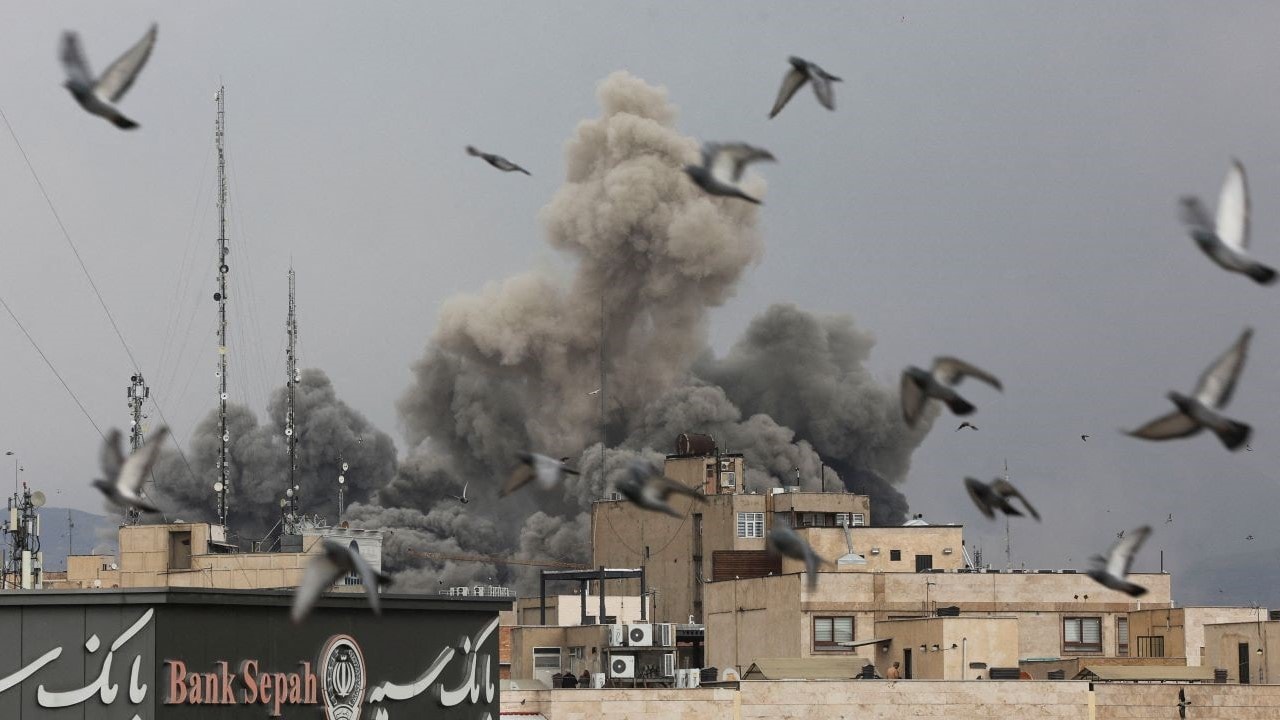
The assertion of "complete control" over the Strait of Hormuz by the Islamic Revolutionary Guard Corps (IRGC) represents a shift from tactical posturing to a stated doctrine of regional hegemony. To analyze the validity of this claim, one must move beyond the inflammatory rhetoric of "live updates" and instead examine the kinetic, economic, and geographic variables that dictate the feasibility of a total maritime blockade. The Strait of Hormuz is not merely a shipping lane; it is a 21-mile-wide choke point where the cost of intervention is disproportionately lower than the cost of protection.
The Geography of Asymmetric Leverage
The Strait of Hormuz functions as a natural bottleneck where the navigable shipping lanes—specifically the incoming and outgoing channels—are each only two miles wide. These lanes are separated by a two-mile buffer zone. Iran’s territorial waters encompass these channels, providing a legal and physical framework for what military theorists define as Anti-Access/Area Denial (A2/AD).
Control in this context is not defined by the presence of a traditional blue-water navy. Instead, it is defined by the density of shore-based assets. The IRGC utilizes three specific layers of interdiction:
- Coastal Defense Cruise Missiles (CDCMs): Mobile batteries of Noor, Ghader, and Ghadir missiles stationed along the Makran coast. These systems possess ranges exceeding 300 kilometers, allowing for overlapping fields of fire across the entire width of the Strait.
- Swarm Command Architecture: The use of hundreds of fast attack craft (FAC) and fast inshore attack craft (FIAC) armed with rocket launchers and short-range missiles. These vessels utilize "swarm" tactics to saturate the defensive capabilities of Aegis-equipped destroyers, which are optimized for high-altitude, long-range threats rather than near-shore, low-profile targets.
- Subsurface Mining Operations: The deployment of bottom-moored and drifting mines. In the shallow waters of the Persian Gulf, mine-clearing operations are slow, dangerous, and easily disrupted by harassing fire from the shore.
The Economic Cost Function of Closure
A closure of the Strait of Hormuz is rarely a binary state of "open" or "closed." It is more accurately measured as a radical escalation in the Maritime Risk Premium. If the IRGC demonstrates the ability to strike even a single Very Large Crude Carrier (VLCC), the insurance markets—specifically the Lloyd’s Market Association’s Joint War Committee—respond by reclassifying the region.
When the risk of hull loss or total cargo loss becomes uninsurable, the Strait is effectively closed to commercial traffic regardless of whether a physical blockade exists. Approximately 21 million barrels of oil flow through this point daily, representing roughly 20% of global petroleum consumption. The mechanism of economic disruption follows a predictable cascade:
- Inventory Depletion: Global markets rely on just-in-time delivery. A 72-hour disruption triggers the release of Strategic Petroleum Reserves (SPR) in IEA member countries.
- Freight Rate Spikes: Tanker owners demand "danger pay" for crews and higher charter rates, which are immediately passed to the consumer.
- Refinery Bottlenecks: Specific refineries in Asia are configured for the "sour" crude typical of the Persian Gulf. Substituting this with "sweet" crude from West Africa or US shale requires significant industrial recalibration, creating a mid-term energy deficit.
The Technical Limitation of "Complete Control"
While the IRGC claims absolute dominance, several structural variables prevent a permanent or uncontested blockade. The primary constraint is the Detection-to-Engagement Cycle. US and allied forces maintain a persistent Overhead Persistent Infrared (OPIR) and Signals Intelligence (SIGINT) presence.
The second limitation is the vulnerability of Iran's own economic infrastructure. The Kharg Island terminal handles over 90% of Iran's oil exports. Any kinetic move to close the Strait invites a counter-strike on this concentrated economic center. This creates a state of Mutual Assured Economic Destruction.
Furthermore, "control" over the Strait requires more than just sinking ships; it requires the ability to prevent an adversary from clearing the wreckage. The US Navy’s 5th Fleet, headquartered in Bahrain, maintains specialized Mine Countermeasures (MCM) capabilities. For Iran to maintain a blockade, it must sustain air and sea superiority over the Strait—a feat that its aging air force, primarily composed of modified F-4s and F-14s, cannot achieve against modern F-35 or F-18 strike packages.
The Proxy Expansion Variable
The current conflict is not localized to the Persian Gulf. The "Axis of Resistance" strategy extends the threat to the Bab el-Mandeb Strait via Houthi forces in Yemen. This creates a dual-choke-point dilemma. If an actor can threaten both the entrance to the Red Sea and the entrance to the Persian Gulf, they control the primary maritime artery between Europe and Asia.
The tactical crossover between these two theaters involves the proliferation of Unmanned Aerial Vehicles (UAVs) and Unmanned Surface Vessels (USVs). These "suicide drones" represent a paradigm shift in the cost-exchange ratio. A drone costing $20,000 can successfully damage a vessel worth $200 million, or force the expenditure of a $2 million interceptor missile. This creates a terminal imbalance in the economics of defense.
Escalation Ladders and Kinetic Thresholds
Military planners categorize the "control" of the Strait into four distinct levels of escalation:
- Harassment and Boarding: Using legalistic or "safety" justifications to seize vessels (e.g., the Stena Impero incident). This tests international resolve without triggering a full military response.
- Stray Kinetic Events: The use of "limpet mines" or "unidentified" drone strikes. This provides plausible deniability while driving up insurance costs.
- Active Interdiction: The targeted firing of missiles at commercial vessels. This marks the transition to an overt blockade.
- Full Choke Point Saturation: The large-scale deployment of mines combined with the targeting of military escorts.
The IRGC's claim of "complete control" suggests they are prepared to bypass the first two stages. However, the logistical reality of maintaining such a position involves a high rate of attrition for their coastal assets. Once a CDCM battery fires, its thermal signature makes it a high-priority target for counter-battery fire or carrier-based air strikes.
Strategic Resilience of Global Energy Markets
The global response to a potential Hormuz closure has shifted due to the expansion of bypass infrastructure. The Habshan–Fujairah oil pipeline in the UAE and the East-West Pipeline in Saudi Arabia allow for millions of barrels to reach the Arabian Sea and Red Sea without passing through the Strait. While these pipes lack the capacity to replace the total volume of the Strait, they provide a critical buffer that prevents a total global energy collapse.
The most significant shift in the strategic calculus is the role of China. As the primary importer of Iranian and regional crude, China is the silent arbiter of this conflict. A total closure of the Strait would damage the Chinese economy more severely than the US economy, which has achieved a high degree of energy independence through shale production. Consequently, Iran’s "complete control" is ultimately checked by the political and economic requirements of its primary strategic partner.
The operational reality is that Iran possesses the capability to close the Strait temporarily but lacks the conventional power to keep it closed against a concerted international coalition. The current posture is a play for Escalation Dominance: the ability to threaten a disruption so severe that it forces diplomatic concessions, rather than a genuine attempt to manage a permanent blockade.
To counter this, maritime powers must prioritize the deployment of autonomous mine-hunting systems and the hardening of regional bypass pipelines. The objective is to decouple the price of oil from the IRGC’s tactical decisions. If the global economy can prove it can survive a 30-day closure without systemic failure, the "Hormuz Card" loses its primary strategic value.
The next tactical shift will likely be the deployment of AI-integrated underwater UUVs (Unmanned Underwater Vehicles) by both sides. These systems can remain dormant on the seabed for months, activating only when a specific acoustic signature is detected. This makes the "complete control" of the Strait a permanent, invisible threat rather than a visible military maneuver. Would you like me to analyze the specific specs of these UUV systems or the current capacity of the Saudi East-West bypass pipelines?