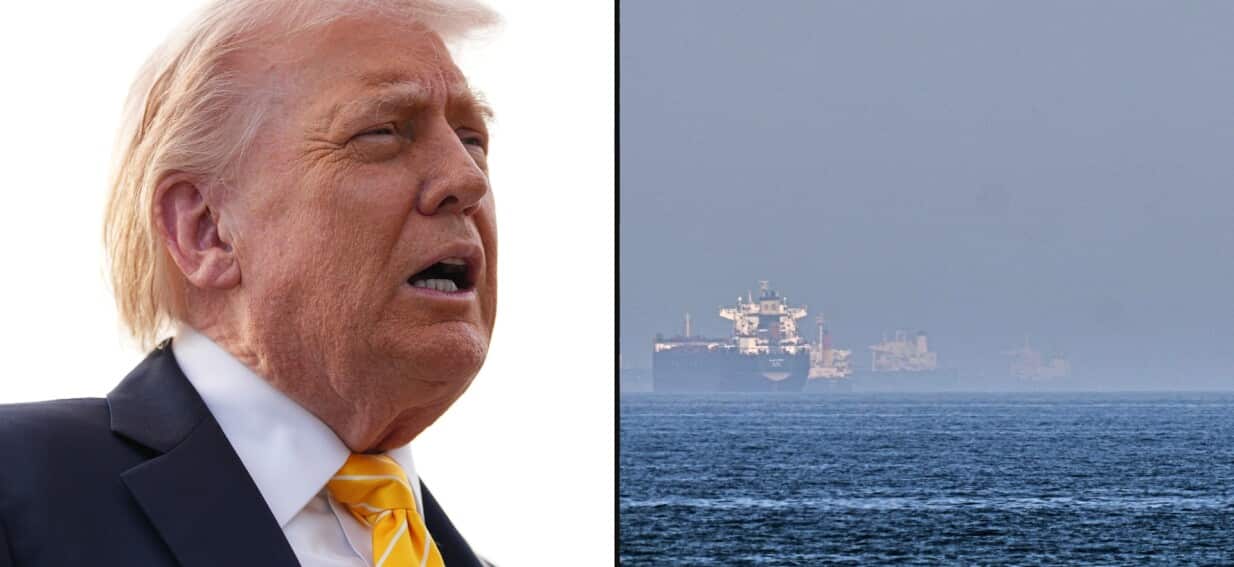
The announcement that the United States will begin a project to guide commercial vessels out of the Strait of Hormuz is a theatrical distraction, not a strategic solution. Politicians and maritime authorities have convinced themselves that a visible naval presence acts as a silver bullet for complex supply chain chokepoints. They are wrong.
I have spent over a decade advising maritime logistics firms on geopolitical risk and insurance hedging. I have watched shipping executives panic at the first sign of geopolitical saber-rattling, throwing millions of dollars at security solutions that provide nothing more than a false sense of security. The narrative that a few patrol boats and a directive from Washington can resolve the economic and physical vulnerabilities of the Strait of Hormuz fundamentally misunderstands the mechanics of global shipping.
The media accepts the premise that US intervention offers a predictable, steadying hand. But let us look at the facts on the ground. A maritime chokepoint is not a highway where a traffic cop can wave a stalled vehicle through. It is a highly constrained, heavily contested volume of water through which millions of barrels of oil transit daily. To understand the delusion of these escorts, we must unpack the physical and economic reality of modern maritime choke points.
The Mechanics of the Strait
Let us define the actual dimensions of the Strait of Hormuz. At its narrowest point, the passage is just twenty-one miles wide. However, the deep-water channel suitable for heavy, deeply drafted commercial vessels is only two miles wide in each direction. This creates a natural bottleneck where ships are forced to travel in narrow lanes governed by the Traffic Separation Scheme.
Imagine a scenario where a fleet of Very Large Crude Carriers (VLCCs) and massive Liquefied Natural Gas (LNG) carriers are forced to slow down, adjust their courses, and wait for naval guidance. The logistics of moving hundreds of these massive vessels through a two-mile wide strip of water require precision, speed, and continuous engine power.
When military vessels attempt to guide or escort these ships, the speed differential becomes a critical problem. A US Navy destroyer operates at much higher speeds and with different maneuvering characteristics than a fully laden commercial tanker. To escort a tanker, the military vessel must match the tanker's speed, which drops to around twelve knots. This makes the warship highly vulnerable to asymmetric threats, such as fast-attack craft or drone swarms, while simultaneously slowing down the entire commercial transit.
The premise that an escort project can be rolled out on Monday and suddenly fix the problem ignores the physics of maritime navigation. Ships cannot simply speed up or change direction because a patrol boat tells them to do so.
The Illusion of Naval Escorts
During the 1980s Tanker War, the United States executed Operation Earnest Will. The goal was to protect Kuwaiti-flagged tankers from Iranian attacks. The operation required a massive deployment of warships, air support, and significant rules of engagement. Even with that level of commitment, tankers were still struck by mines and attacked.
Today, the threat environment is far more complex. The proliferation of low-cost, long-range anti-ship missiles, drone technology, and advanced electronic warfare capabilities makes slow-moving, military-escorted convoys highly attractive targets for adversaries. By grouping vessels together or forcing them to follow a specific route dictated by the US Navy, the intervention actually creates concentrated, high-value targets.
The argument for naval escorts relies on the assumption that a military presence deters aggression. In reality, it can provoke it. Adversaries view the presence of foreign warships not as a stabilizing force, but as an escalation. This increases the risk of miscalculation, leading to rapid tactical escalation in a confined space.
Furthermore, the logistical burden of escorting every commercial vessel is astronomical. Thousands of ships transit the Strait of Hormuz every year. The US Navy simply does not possess enough destroyers and frigates to provide one-on-one escorts for every single bulk carrier, tanker, and container ship operating in the area. The project is a selective band-aid, not a systemic solution.
The Financial Cost of Intervention
The economic impact of the intervention strategy is ignored by most market commentators. Shipping is a volume business built on razor-thin margins. Delays cost money. When a commercial vessel is forced to wait for an escort or alter its route to comply with military directives, the financial clock keeps ticking.
Consider the cost of demurrage. Demurrage is the charge applied to the charterer of a vessel for failing to load or discharge the cargo within the agreed time. If a VLCC sits idle for three days waiting for a military escort to form up, the cost can easily exceed one hundred thousand dollars per day.
The shipping companies bear these costs directly. The promise that a project will guide ships out of danger sounds comforting to investors on Wall Street, but it translates to massive operational inefficiencies for the shipping companies themselves. The companies that absorb these costs are the same ones that will eventually pass them on to consumers, driving up the price of oil, gas, and consumer goods.
The Insurance Calculus
The marine insurance market is the ultimate dictator of shipping movements. The Joint War Committee of Lloyd's of London lists the Persian Gulf and the Strait of Hormuz as listed areas, meaning that ships transiting the area are subject to additional premiums known as war risk surcharges.
When a government announces an escort project, insurance underwriters do not automatically slash war risk surcharges. The underwriters evaluate the risk based on physical incidents, not on political announcements. If the presence of warships increases the likelihood of a conflict in the strait, insurance premiums will rise, not fall.
I have seen companies pay millions of dollars in war risk premiums despite receiving military escorts. The underwriter looks at the statistical probability of a ship being struck by a missile or boarded by hostile forces. Military escorts do not eliminate the threat of aerial drones or mines. They simply place a target next to a target.
The only way to lower these premiums is to reduce the actual threat level through diplomacy and de-escalation, not by turning the strait into a military testing ground.
UNCLOS and the Reality of Transit Passage
The legal framework governing the Strait of Hormuz is the United Nations Convention on the Law of the Sea (UNCLOS). The Strait is an international strait used for international navigation. Under UNCLOS, all ships enjoy the right of transit passage. This right cannot be suspended by Iran or any other coastal state, provided the vessels are engaged in continuous and expeditious passage.
When foreign navies start to "guide" or direct commercial vessels, they interfere with this right of transit passage. The ships are no longer moving under their own independent navigation; they are following military instructions. This alters the legal status of the transit.
Coastal states could view this intervention as a violation of their sovereign rights or an act of aggression, leading to legal and diplomatic disputes that can delay shipments even further. The intervention creates legal friction that complicates the simple, continuous passage of commercial ships.
Dismantling the Standard Questions
Let us address the questions everyone is asking, and dismantle the flawed premises behind them.
Will the United States Navy escort all commercial ships?
The idea that the US Navy can escort every merchant ship in the Strait of Hormuz is mathematically impossible. The US Fifth Fleet has a finite number of vessels. Prioritizing certain ships means leaving others unprotected, creating a two-tier system where smaller shipping companies are left to take the risk.
How does the Strait of Hormuz affect oil prices?
The premise of the question is that oil prices rise because of immediate supply disruptions. In truth, oil prices rise because of the fear premium. The fear premium is driven by uncertainty. When politicians make statements about military projects, they increase uncertainty rather than calming the markets. The volatility in the energy market is a direct result of government interference.
Should ships stop transiting the strait completely?
This is the wrong question to ask. The Strait of Hormuz is the only route out of the Persian Gulf for major oil exporters. Avoiding it means sailing around the Cape of Good Hope, which adds weeks to the voyage and millions in fuel costs. The question should be how to operate safely within the existing parameters, rather than finding a way to avoid the strait.
Operational Reality for Logistics
What should a logistics firm actually do when faced with these military interventions? Do not rely on government guidance to run your business.
First, conduct your own risk assessment. Look at the specific cargo, the flag of the vessel, and the crew's training. Do not assume that a naval escort provides absolute safety. In many cases, it is safer to rely on your own speed and evasive maneuvering capabilities.
Second, negotiate your war risk insurance premiums using data. Show your underwriters that your vessels have advanced tracking systems, trained crews, and clear operating procedures.
Third, diversify your supply chain where possible. Relying entirely on one chokepoint is a failure of risk management. While the Cape of Good Hope is longer, it acts as a reliable hedge against sudden political announcements.
The idea that we can simply guide ships out of danger is a myth created by people who do not understand the logistics of the sea. The sea does not respond to press releases. It responds to logistics, economics, and risk.
The Final Blow
The Strait of Hormuz will not be secured by a project that starts on Monday. It is secured by the quiet, unglamorous work of shipping companies managing their own risks. The intervention is a distraction that adds cost and creates new risks. Ignore the political theater and focus on the mechanics of your supply chain.