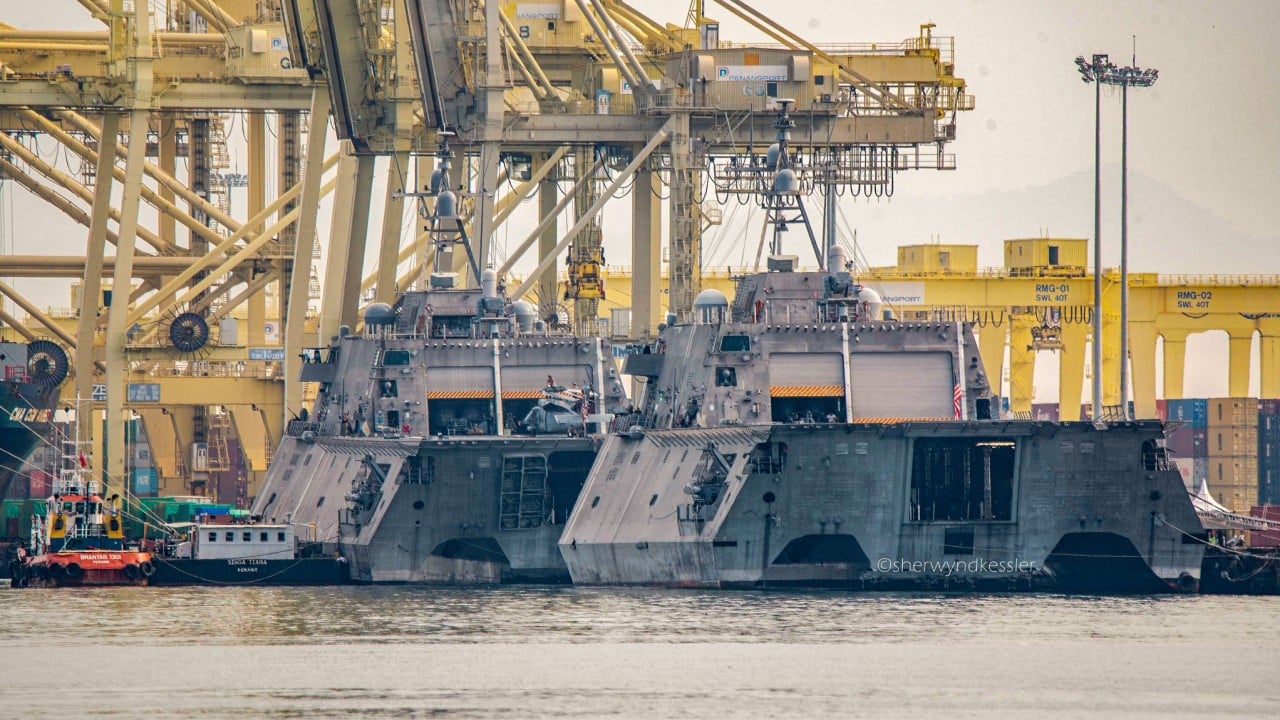
The humidity in Port Klang doesn’t just sit on your skin; it weight-presses the lungs, thick with the scent of salt, diesel, and the frying oil of a thousand street stalls. Usually, the rhythm here is predictable. Massive container ships, stacked like multicolored Lego blocks, glide in and out of the Malacca Strait, fueling the world’s insatiable appetite for gadgets and fast fashion. But recently, the horizon changed. The silhouettes grew jagged. Gray. Lethal.
When a United States Navy warship docks in Malaysia, it isn't just a logistical stop for fuel and fresh vegetables. It is a three-hundred-million-dollar conversation held in the language of displacement and deck guns.
For the shopkeeper in Kuala Lumpur or the fisherman off the coast of Penang, the arrival of these vessels might seem like a distant curiosity. Yet, these steel giants are the physical manifestation of a geopolitical tightrope walk that Malaysia has been performing for decades. To understand why these "pit stops" are suddenly causing whispers from Beijing to Washington, we have to look past the hull plating and into the messy, human reality of a nation caught between two suns.
The Ghost of Geography
Imagine you own a small, prosperous house located exactly on the only path between two warring neighbors. You want to trade with both. You need the protection of one, but the business of the other. If you invite one neighbor over for tea, the other watches through the blinds, counting the sugar cubes you serve.
This is Malaysia’s permanent reality.
The Malacca Strait is the world’s most vital windpipe. Nearly 100,000 vessels pass through it every year. It carries the oil that powers China’s factories and the goods that fill American warehouses. For the U.S. Navy, being able to dock here is about "presence"—the ability to show the flag in a region where China is increasingly treating the South China Sea like a private lake.
But for Malaysia, the stakes are more intimate. It is about sovereignty. It is about the delicate art of not choosing a side while everyone screams at you to pick a jersey.
A Tale of Two Ports
Consider a hypothetical Malaysian port official—let’s call him Ahmad. Ahmad has spent thirty years watching the tides. In the 1990s, a U.S. ship visit was a routine affair, a symbol of a stable, unipolar world. Today, when Ahmad sees a Destroyer like the USS Ralph Johnson or an aircraft carrier looming over the pier, he knows his phone is about to ring.
The first call is often a quiet inquiry from a Chinese trade attaché. The second is a briefing on regional security cooperation.
Malaysia’s Prime Minister, Anwar Ibrahim, has been vocal about maintaining "centrality." It’s a polite way of saying, "Leave us out of your sandbox fight." However, the arrival of U.S. warships suggests a tilt. It suggests that despite the billions of dollars in Chinese investment flowing into Malaysian infrastructure—the rail links, the digital hubs, the industrial parks—there is still a deep-seated, quiet reliance on American hardware to keep the sea lanes open.
The "eyebrows" are being raised because the timing is precarious. We are living in an era where a single miscalculation in the South China Sea could turn a "routine visit" into a flashpoint.
The Language of the Deck
Modern diplomacy isn't just conducted in wood-panneled rooms in D.C. or Beijing. It happens in the "liberty" granted to sailors.
When thousands of American sailors spill out into the streets of George Town or Melaka, they bring more than just US dollars. They bring a culture that is often at odds with the conservative shifts within Malaysia’s own borders. There is a tension there—a friction between the strategic necessity of the military alliance and the domestic political optics of hosting a superpower that is currently viewed with skepticism by a large portion of the Malaysian public, particularly regarding Western foreign policy in the Middle East.
This is the invisible cost of the pit stop.
The government must weigh the benefits of high-level military intelligence and maritime security against the risk of looking like a "client state" to its own voters. It is a brutal calculation. If they turn the ships away, they signal a drift toward China that could spook Western investors. If they welcome them too warmly, they face a domestic backlash and Chinese economic "reminders."
Why the Quiet is Louder Than the Engines
There is a specific kind of silence that follows a massive ship leaving port. The wake settles. The gulls return to the pilings. But the atmospheric pressure stays low.
The U.S. Navy calls these visits "Theater Security Cooperation." It sounds sterile. In reality, it is a high-stakes rehearsal. They are practicing for a day everyone hopes never comes—a day when the "windpipe" of the Malacca Strait is squeezed shut.
Malaysia knows that in any actual conflict between the U.S. and China, the "neutral" ground is usually the first place to get trampled. By allowing these visits, they are effectively buying insurance. They are telling the world that the Strait remains an international waterway, not a regional cul-de-sac.
But insurance has premiums.
The premium for Malaysia is a constant state of diplomatic exhaustion. Every port call requires a flurry of "balancing" statements. Every joint exercise must be mirrored by a trade summit or a friendly nod toward the East. It is a life lived in the middle of a tug-of-war, where the rope is made of steel and the pullers are the two most powerful militaries in human history.
The View from the Shore
If you stand on the coast of the Peninsula at sunset, the lights of the waiting tankers look like a floating city. It’s beautiful, until you realize those lights represent the fragile heartbeat of the global economy.
We often talk about "geopolitics" as if it’s a game of Risk played on a cardboard map. It’s not. It’s the smell of diesel in Port Klang. It’s the anxiety of a prime minister trying to keep the lights on without offending a superpower. It’s the silent, gray shape of a Destroyer cutting through the tropical mist, reminding everyone that the peace we take for granted is actually a very loud, very expensive, and very fragile stalemate.
The ships will keep coming. The eyebrows will stay raised. And the people on the shore will keep watching the horizon, wondering if the next gray shape they see is a guest, a protector, or a harbinger of something they aren't ready to face.
The water remains calm, for now, but beneath the surface, the currents are pulling in two different directions at once.