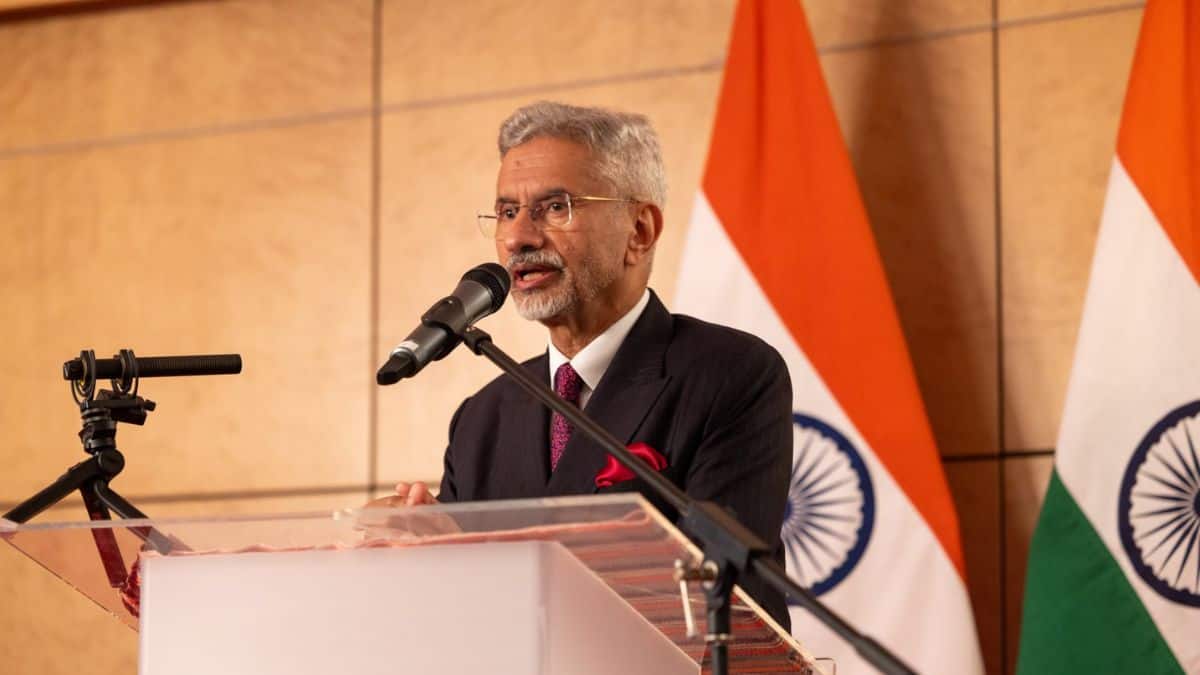
The air in a diplomatic briefing room is usually thin, filtered, and heavy with the scent of expensive stationery and unspoken caution. It is a place where words are weighed on diamond scales before they are uttered. But when S. Jaishankar, India’s External Affairs Minister, stands before a microphone, that manufactured stillness tends to evaporate. He doesn't just deliver a rebuttal; he dismantles a worldview.
Recently, the quiet hum of the geopolitical machinery was jolted by a comment from a high-ranking U.S. official. The remark was framed as a cautionary tale: a suggestion that India might be repeating the "China mistakes" of decades past—essentially accusing New Delhi of walking into a strategic trap by thinking it could manage a complex relationship with an assertive neighbor while growing its own stature.
It was a classic piece of Western paternalism, dressed up as friendly advice. It implied that the path to success is a pre-written script, and if you deviate from the lines established by those who came before you, you are doomed to fail.
Jaishankar’s response was a sharp, clinical strike. "No one can decide India’s rise," he countered. It wasn't just a defense of policy. It was a declaration of identity.
The Ghost of the Cold War Script
To understand why this exchange matters, you have to look past the podiums and the press releases. You have to look at the map of the world as it exists in the mind of a mid-level bureaucrat in Washington or Brussels. For them, history is a series of repeatable patterns. They saw the West "open up" China in the 1970s, hoping that economic integration would lead to political liberalization. They watched as that bet spiraled into a different reality—a superpower rivalry that now defines the century.
When they look at India, they see the same variables. They see a massive population, a surging GDP, and a complex, often friction-filled border with China. They fear that India, in its pursuit of "strategic autonomy," is being naive.
But India is not a sequel.
Consider a small-scale business owner in a bustling market in Pune or a tech lead in Bengaluru. These individuals are the microscopic engines of the "rise" Jaishankar defends. For them, the global chess match isn't about avoiding "mistakes" defined by a foreign capital. It is about the visceral reality of growth. It is about the fact that India is moving at a pace and in a direction that is entirely its own. When a foreign official suggests India is "repeating mistakes," they are essentially telling that business owner that their future is already spoken for by someone else’s past.
The Arrogance of the Mirror
The fundamental friction here is the "China Mirror." For thirty years, the global North has looked at every emerging power and asked, "Will they be like us, or will they be like China?"
Jaishankar’s rebuttal strikes at the heart of this binary. By stating that no one else gets to decide the trajectory of India’s ascent, he is rejecting the idea that India must be a "counterweight" or a "proxy." The stakes aren't just about trade deficits or border patrols. The stakes are about the right to be unique.
When the U.S. Deputy Secretary of State or a similar official warns about "China mistakes," they are projecting their own trauma. The West feels burned by its experience with Beijing. They thought they were the architects of the modern world, and they found out the inhabitants had their own blueprints. Now, they want to hand those same blueprints—scarred and red-lined—to India.
India is politely, but firmly, tossing them in the bin.
The Human Cost of Strategic Paternalism
Think of a young Indian diplomat, perhaps in her late twenties, sitting in the back of one of these high-level summits. She has grown up in an India that is tech-fluent, assertive, and increasingly weary of being told what "responsible" behavior looks like. When she hears a Western official offer a lecture on China, she doesn't hear wisdom. She hears a lack of imagination.
She knows that India’s relationship with China is not a carbon copy of the U.S.-China relationship. It is intimate, ancient, and territorial. It involves 3,488 kilometers of disputed border where soldiers stand eye-to-eye in the freezing dark of the Himalayas. It is a lived reality, not a theoretical "risk" discussed in a climate-controlled office in D.C.
To suggest that India doesn't understand the "mistakes" involved in dealing with China is more than just a diplomatic gaffe. It is a failure to recognize that India has been managing this complexity since before the term "Indo-Pacific" was even coined.
The Logic of the Unpredictable
The world is currently addicted to predictability. Markets want it. Generals want it. Voters want it. But India’s rise is inherently unpredictable because it refuses to join a formal bloc. It buys S-400 missile systems from Russia while conducting joint naval exercises with the U.S. It joins the Quad but remains a founding member of BRICS.
To the Western mind, this looks like indecision. To Jaishankar, it is the only logical way to survive in a multipolar world.
The "China mistakes" narrative assumes there is only one way to handle an adversary: containment or engagement. India is choosing a third path—a messy, difficult, and quintessentially Indian path of "competitive coexistence" where it guards its borders with one hand and builds its economy with the other, refusing to let either hand be guided by a foreign power.
Why the "Rise" Is Inevitable and Unowned
The math of the situation is cold. India is projected to be the world's third-largest economy by the end of the decade. It has a demographic dividend that most of the developed world would trade their last barrel of oil for. This isn't a "rise" that can be switched off or redirected by a clever speech or a pointed warning about historical parallels.
When Jaishankar says, "No one can decide India’s rise," he is speaking to the inevitability of 1.4 billion people moving toward a higher standard of living. He is saying that the momentum of a nation is not a tap that can be turned by external validation.
There is a certain quiet power in that stance. It is the power of someone who knows they don't need an invitation to the table because they are already building their own.
The Invisible Stakes of Every Word
Every time a rebuttal like this is issued, it ripples downward. It affects how an Indian startup approaches a deal with a Silicon Valley VC. It affects how an Indian student in London views their place in the world. It shifts the gravity of the global conversation from "How can we help you?" to "How can we work with you?"
The shift is subtle, but it is seismic.
The Western official who made the "China mistakes" remark likely thought they were being helpful. They thought they were providing the benefit of their "lived experience" in the world of superpower management. But they forgot the most basic rule of human nature: people do not want to be saved by those who don't respect their agency.
The Finality of Choice
We live in an era where the old maps are burning. The neat lines of the post-1945 order are blurred beyond recognition. In this smoke-filled room of global politics, India is moving with a confidence that unnerves those who used to hold the compass.
The rebuttal wasn't just about China. It wasn't just about the U.S. It was about the end of the era where the "rise" of a nation was something granted or permitted by the established powers.
The future isn't a lesson plan to be learned from a textbook of Western failures. It is a raw, unscripted territory. And as the dust settles on this latest diplomatic spat, one thing remains clear: India is walking into that territory with its eyes wide open, its own map in hand, and a very clear message for anyone trying to grab the wheel.
The driver has already been chosen.
Would you like me to analyze how this "strategic autonomy" affects specific trade sectors like semiconductor manufacturing or defense tech?