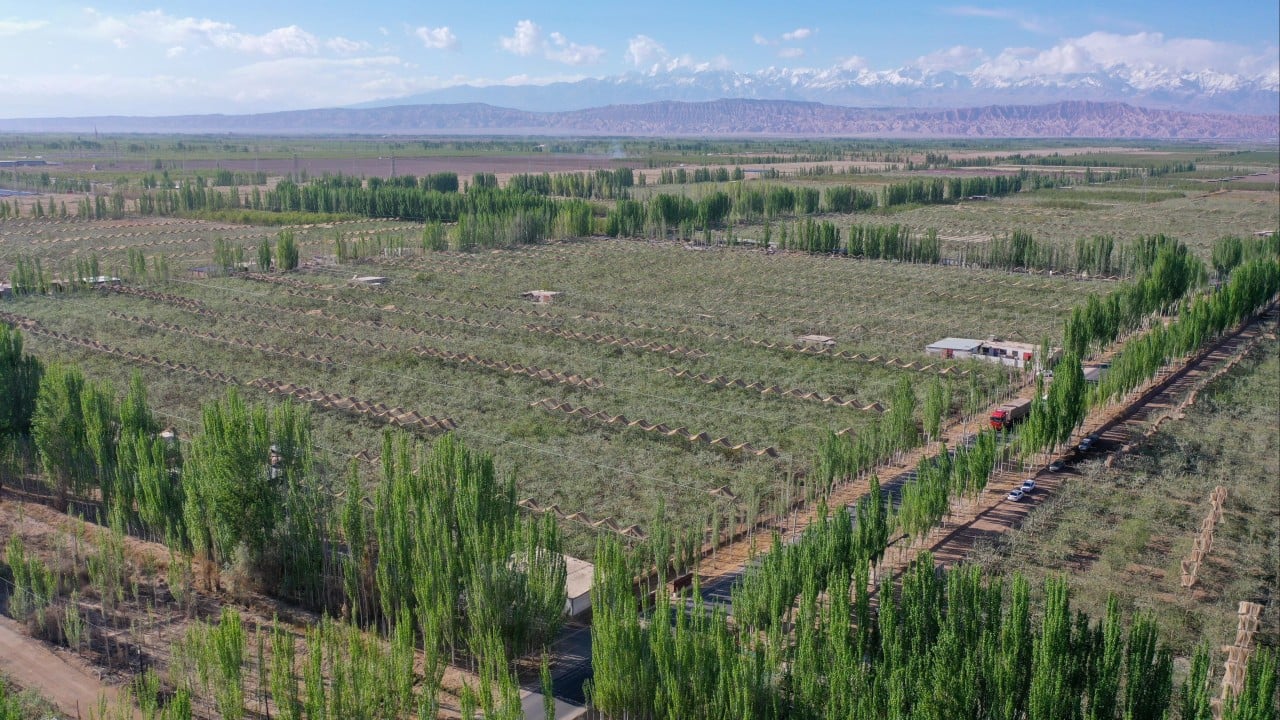
The wind in the Kubuqi Desert does not just blow. It bites. It carries a fine, suffocating dust that gets between your teeth, into your eyes, and under your skin. For generations, the people living on the edges of China’s shifting sands knew a simple, brutal math: the desert advances, and humanity retreats. Every year, the dunes swallowed another pasture, another road, another childhood home.
Gao Changrong remembers when the sand reached the lip of his well. He is a hypothetical farmer, but his reality is shared by millions. To Gao, the desert was a living, breathing monster. It was an unstoppable force of nature that no amount of human sweat could halt. You planted a shrub; the wind buried it by morning. You dug a trench; the sand filled it by afternoon.
Then came the machine that had looked at the stars.
The Lunar Sandbox
To understand how a desolate stretch of Inner Mongolia became the most technologically advanced battleground on Earth, you have to look a quarter of a million miles into the sky.
When China’s space agency planned its Chang'e lunar missions, they faced a daunting engineering crisis. The far side of the moon is covered in regolith. This is a violent, jagged dust untouched by wind or water, whipped into razor-sharp grains by cosmic radiation. To test the drills and rovers meant to survive this alien landscape, scientists back on Earth needed a simulated lunar soil. They needed something incredibly fine, entirely unpredictable, and intensely hostile to mechanical parts.
They found their raw material in the deserts of northern China.
For years, aerospace engineers refined techniques to manipulate, bind, and stabilize this hyper-fine sand so their multi-million-dollar space hardware wouldn’t sink or choke on the moon. They experimented with chemical polymers, mechanical binding agents, and automated deployment systems designed to operate in the harshest environments imaginable.
But as the lunar rovers successfully rolled across the craters of the moon, someone looked back down at the Earth. If we can tame the dust of another world, they reasoned, why are we letting our own world turn to dust?
The Friction Problem
The war on desertification has historically been fought with low-tech desperation. For decades, the standard weapon was straw checkerboards. Workers would manually push straw into the sand in a grid pattern, creating a temporary windbreak that allowed tiny seeds a few weeks to catch before the wind ripped them away.
It is grueling, backbreaking work. It is also a losing battle. The straw rots. The wind changes. The desert adapts faster than a human being with a shovel ever can.
The core problem of a sand dune is friction—or rather, the lack of it. Look at sand under a microscope. Each grain is a tiny, polished sphere. When the wind blows, these spheres roll over each other with zero resistance. They fluidly shift, piling up into massive waves that can bury an entire village in a season.
To stop a desert, you have to change the physics of the sand itself. You have to force those smooth spheres to lock together.
This is where the lunar technology shifted the paradigm. Scientists took the automated binder deployment systems developed for moon bases and adapted them for heavy-duty, terrestrial vehicles. These are not your average tractors. They are massive, automated rovers equipped with high-precision sensors and pressurized tanks filled with eco-friendly, modified polymers—direct descendants of the formulas used to stabilize lunar landing pads.
When these machines crawl across the Kubuqi, they don't just plant seeds. They inject a specialized liquid deep into the sand matrix. The effect is almost instantaneous. The liquid coats the sand grains, creating microscopic bridges between them. Within hours, the shifting, fluid dune hardens into a stable, breathable crust. It holds its shape against gale-force winds while remaining porous enough to absorb every single drop of rare desert rain.
The Microbe and the Machine
But a stabilized dune is still just dead dirt.
The real magic of this space-age intervention is what happens beneath the newly formed crust. In the past, planting vegetation in the desert required an immense amount of water—a luxury these arid regions simply do not have. The lunar-derived polymers solve this by acting as a smart sponge. They hold moisture exactly where a seed needs it, preventing it from evaporating into the scorching air or sinking too deep into the water table.
Into this stabilized matrix, the automated rovers inject a cocktail of resilient desert grasses and tailored microorganisms. These aren't random seeds. They are bio-engineered specimens selected for their ability to thrive in hyper-arid conditions, much like the closed-loop ecological systems being researched for long-term space habitats.
Consider the transformation. A drone scans a ridge of shifting sand. It calculates the wind vector, the moisture content, and the optimal grid density. Then, a fleet of automated vehicles moves in, systematically locking the sand in place and planting a self-sustaining ecosystem in a fraction of the time it would take a human crew.
For people like Gao, the change is jarring. The silent, terrifying advance of the yellow wall has stopped. In its place is something entirely alien to his grandfather’s memory: a quiet, stubborn patch of green that refuses to blow away.
The Invisible Stakes
It is easy to view this as a localized triumph, a neat piece of engineering confined to a remote corner of Asia. That would be a mistake.
Desertification is an existential threat that ignores borders. When the winds howl across the Gobi and Kubuqi deserts, they carry massive dust storms that choke cities thousands of miles away. Beijing grounds flights. Seoul issues respiratory warnings. The economic toll runs into the billions; the human toll, measured in damaged lungs and displaced communities, is incalculable.
More importantly, the arable land of our planet is shrinking at an alarming rate while the global population continues to climb. We are running out of dirt.
What China is testing in the Kubuqi is a blueprint for survival. If these lunar-tested technologies can scale, they offer a radical toolkit for regions across the globe—from the expanding Sahara in Africa to the drying agricultural basins of the American West. It turns a defensive retreat into an offensive reclamation.
Yet, this technological leap brings its own set of anxieties. Critics and environmentalists rightly question the long-term impact of introducing large-scale synthetic polymers into fragile ecosystems. What happens to the local water table over fifty years? Does this permanent crust disrupt the natural migration of desert wildlife? The scientists involved insist the compounds are completely biodegradable and break down into harmless organic matter once the root systems of the plants take over, but the truth is, we are experimenting on a massive scale with no historical precedent.
We are, quite literally, terraforming our own planet.
The Horizon
The sun sets over the Kubuqi Desert, casting long, dramatic shadows across a landscape caught between two identities. On one side of a newly established perimeter lie the raw, undulating waves of yellow sand—restless, unpredictable, and wild. On the other side is the new grid. It is a sterile, precisely engineered matrix of stabilized earth, dotted with green shoots that look too fragile to survive, yet remain stubbornly upright against the evening breeze.
There is a profound irony in how we achieved this. For decades, humanity looked to the stars as an escape hatch, a frontier to conquer when our own world became too crowded or too spent. We poured immense wealth and genius into figuring out how to survive on a cold, dead rock millions of miles away.
But the universe has a way of turning our perspective back on ourselves.
The machines creeping across the northern wilderness of China are a testament to that shift. They carry the DNA of a space race, but their mission is entirely down-to-earth. They are not trying to find life on the moon; they are trying to keep the Earth from dying.
Gao Changrong walks out to the edge of his property. He stoops down and picks up a handful of earth from the stabilized grid. It doesn't slip through his fingers like water anymore. It holds together. It has weight. It has a future. He drops it back to the ground, turns his back to the wind, and walks home, leaving the machines to continue their quiet, cosmic work in the dark.