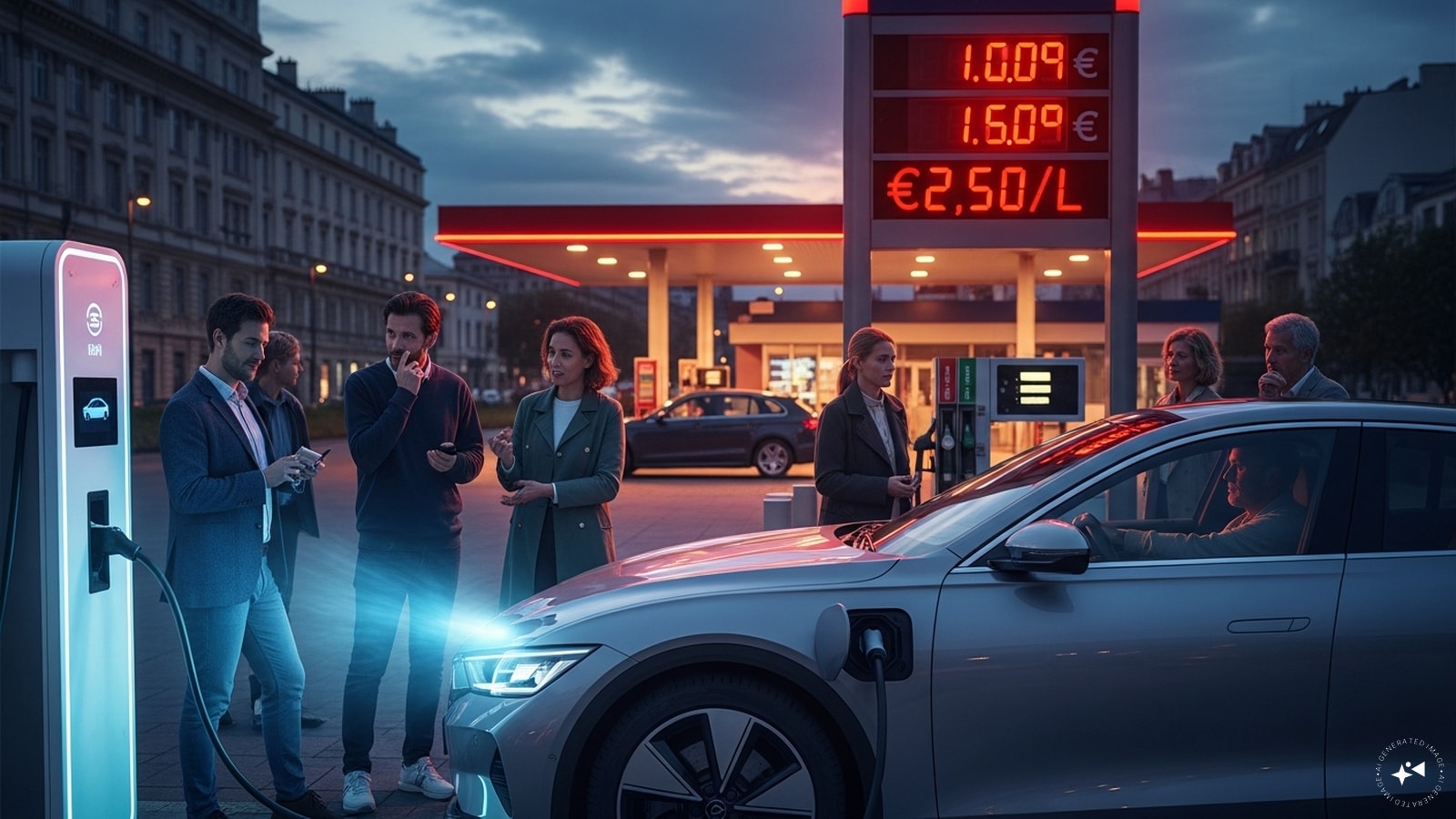
The pump screen flickers. A neon-bright tally climbs, digits spinning with a frantic, rhythmic ticking that sounds suspiciously like a countdown. For Elena, standing on a slick, rain-dusted forecourt somewhere outside Lyon, it isn’t just numbers. It is a theft of her Saturday morning. It is a gouge into the budget for her daughter’s dance classes.
Petrol prices have been dancing a volatile, upward jig for months, but today, the music has turned jagged. She looks at the fuel gauge. The needle barely nudges upward, despite the twenty-euro note she just fed into the machine.
She is not alone. Across the European Union, the ritual of the gas station is becoming a relic of a more predictable, perhaps more naive, era.
The Cost of Attachment
The friction is real. We have spent a century tethered to the rhythmic, explosive combustion of fossil fuels, treating the internal combustion engine as an immutable fact of life. But when the cost of movement becomes a daily source of anxiety, the cultural architecture of how we travel begins to buckle.
Look at the data, though not as a list of cold percentages. View it as a migration. In city centers from Berlin to Milan, the quiet hum of electric motors is replacing the guttural growl of idling engines. This is not driven by a sudden, collective moral epiphany about carbon footprints. It is driven by the gut-level, visceral realization that the old way is becoming prohibitively expensive.
When the price at the pump spikes, the calculus changes. A hypothetical commuter, let us call him Marcus, who drives sixty kilometers a day for work, suddenly finds that his hatchback is a liability. He starts doing the math on his commute. He calculates the price of electricity versus the crushing uncertainty of global oil markets. He discovers that while the upfront cost of an electric vehicle remains a significant mountain to climb, the descent—the daily, weekly, monthly cost of operating that vehicle—is a flat, predictable plain.
A Different Kind of Physics
If you open the hood of a traditional car, you are looking at a chaotic, heat-soaked clockwork of valves, pistons, and oily friction. It is a masterpiece of nineteenth-century engineering, but it is fundamentally inefficient. Much of the energy you buy at the pump is discarded as heat. It is literally thrown away to keep the machine from melting.
An electric drivetrain is the opposite. It is elegant. It is direct. Think of it like swapping a complex, leaky plumbing system for a single, high-efficiency wire. The energy goes from the battery to the wheels with almost clinical precision. Because there is no need for a massive engine block, the vehicle becomes a living space, a mobile lounge.
Yet, there is a lingering fear. The skepticism is justified. I remember my first long trip in an electric car. I sat in a parking lot, staring at a charging station, hoping the app would connect, worrying that I would be stranded in the dark. That uncertainty is the biggest hurdle. It is a psychological barrier, not a mechanical one. We fear being tethered to a grid that we cannot see, rather than a tank that we can measure with a dipstick.
The Shift Beneath the Surface
There is a ripple effect happening in European car markets that goes beyond individual sales figures. Manufacturers are no longer playing a game of "if." They are playing a game of "how fast."
The investment flows are massive, directed toward battery gigafactories and charging infrastructure that looks more like a modern communication network than a collection of gas stations. Governments are layering on incentives, not because they are generous, but because they are terrified of the economic instability that comes with volatile fuel prices. They see the writing on the wall. The transition is now an issue of national economic security.
But consider the human cost of this transition. It isn't just about switching out a car; it is about retraining an entire workforce. Mechanics who spent decades mastering the nuances of a fuel injection system now find themselves staring at software diagnostic tools. The blue-collar backbone of the automotive industry is feeling the ground shift beneath its feet. This is the messy, uncomfortable, and often invisible underbelly of progress.
Beyond the Hype
The narrative that this is a simple, linear path to a green utopia is a fantasy. It is messy. We are dealing with supply chains that span the globe, extracting rare earth minerals from places we would prefer not to think about, to build batteries that require careful recycling. The infrastructure in rural areas is still catching up to the shiny, fast-charging networks of the major corridors.
There is an honest tension here. You want the freedom of the open road, but you also want the stability of a car that doesn't hold your wallet hostage. You want to believe in the technology, but you worry about the resale value. You are right to be skeptical. The technology is still maturing, and the economics are still being written in real-time.
Still, the movement is undeniable. Look at the balance sheets of the major automakers. They are pouring every cent they have into electrification, not because they love the environment, but because they love staying in business. They know that when the consumer finally hits that tipping point—where the range is sufficient and the price is right—the demand will be a tidal wave.
Elena, standing at the pump in the rain, does not care about the geopolitical implications of energy independence. She just wants to get home without checking the price of a liter of petrol like it is a stock market ticker. She wants to be able to plan her month without a looming, fuel-priced debt.
The quiet revolution is not happening in the boardrooms or at international summits. It is happening in the driveways of suburban homes and the charging spots of city streets. It is a slow, steady realization that the internal combustion engine was a brilliant, necessary step in our evolution, but it is one that we are finally, painfully, and inevitably ready to outgrow.
The next time you pull up to a pump, watch the screen. Don't look at the money. Look at the people around you. Watch their eyes. They aren't looking at the numbers anymore. They are looking at the road ahead, trying to calculate the price of a different kind of freedom. That feeling—that silent, collective calculation—is the true engine driving the change. Everything else is just noise.