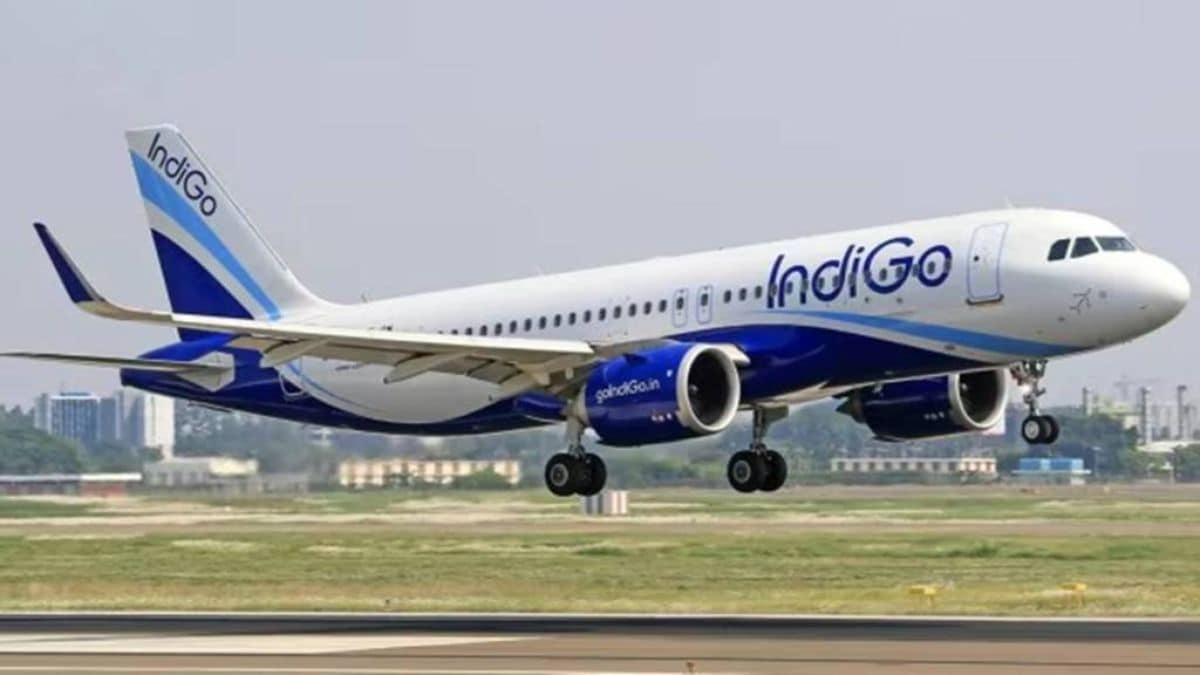
On a standard Tuesday, IndiGo flight 6E 21 departed Delhi for Manchester, carrying hundreds of passengers toward the United Kingdom. Seven hours later, those same passengers stepped back onto the tarmac in Delhi. They had traveled thousands of miles, burned tons of fuel, and spent a full workday in a pressurized tube, only to end up exactly where they started. The official reason cited was a sudden tightening of airspace restrictions over West Asia. But the reality is far more complex than a simple detour. This incident exposes a systemic vulnerability in the budget long-haul model and the increasingly narrow corridors available to commercial pilots in a fractured geopolitical environment.
When an airline commits to a flight path, it relies on a delicate web of Overflight Permits (OFPs). These aren't static. In the current climate, a single missile test or a diplomatic spat can turn a routine corridor into a no-fly zone in minutes. For IndiGo, a carrier built on the relentless efficiency of the low-cost model, the Delhi-Manchester route was already a stretch of its operational capabilities. When the gates to the West Asian corridor swung shut, the flight reached a mathematical "point of no return" that forced a retreat.
The Arithmetic of an Airborne U-Turn
Airlines don't turn back because they want to. They turn back because the math stops working. Every long-haul flight operates on a razor-thin margin of fuel versus weight.
To reach Manchester from Delhi, a narrow-body aircraft like the Airbus A321XLR or even a heavily loaded wide-body must follow a specific, optimized track. When tensions in West Asia—specifically involving the airspace of Iran, Iraq, or the Levant—spike, air traffic control (ATC) often issues NOTAMs (Notices to Air Missions) that reroute traffic.
These reroutes aren't minor. Taking a "scenic route" around a conflict zone can add ninety minutes to a flight. On a journey that already pushes the limits of the aircraft’s range, that extra ninety minutes is the difference between landing safely in Manchester and ditching in the North Sea. The pilot in command of 6E 21 faced a brutal calculation:
- Fuel Reserve Depletion: International regulations require a "contingency fuel" buffer. A massive detour consumes this buffer before the aircraft even crosses into Europe.
- Crew Duty Limitations: Pilots and cabin crew have strict legal limits on how many hours they can be on duty. A seven-hour flight that turns into a fourteen-hour loop hits these limits hard. If the crew "times out," the plane stays on the ground, regardless of where it is.
- Weight and Balance: To carry enough fuel for a massive detour, an aircraft might have to leave bags or even passengers behind.
The decision to return to Delhi, rather than divert to a closer airport like Istanbul or Dubai, suggests a logistical nightmare behind the scenes. Diverting to a third-party airport involves "ground handling" fees, hotel costs for hundreds of people, and the nightmare of securing visas for passengers in a country they never intended to visit. For IndiGo, returning to their primary hub in Delhi was the cheapest way to manage a disaster, even if it was the most soul-crushing for the passengers.
The Geopolitical Chokehold on Indian Aviation
India sits at a geographic crossroads, but that position is becoming a liability. To go West, you must pass through the bottleneck of the Middle East. To go East, you face the complexities of Southeast Asian corridors and the South China Sea.
For years, the "Karakoram hump" and the closure of Pakistani airspace have forced Indian carriers to fly south before heading west. This adds distance and cost. Now, with the escalating instability in West Asia, the available "straws" through which Indian aviation must breathe are being pinched.
We are seeing the end of the "Great Circle" era. In a perfect world, planes fly the shortest distance between two points on a sphere. In our world, they fly a jagged, inefficient zig-zag to avoid surface-to-air missiles and diplomatic embargoes. This inefficiency is a hidden tax on every ticket sold. When a flight like 6E 21 fails, it isn't just an inconvenience; it’s a signal that the infrastructure of global travel is cracking under the weight of regional wars.
Why the Low-Cost Long-Haul Model is At Risk
IndiGo’s foray into longer routes like Manchester is a bold play to disrupt the dominance of "Full Service Carriers" (FSCs) like Emirates or Air India. But the 6E 21 incident highlights why the budget model struggles with long-distance geography.
FSCs often have "interline agreements." If an Emirates flight can't make it to London, they can often re-protect passengers on a dozen different partner airlines through their hub in Dubai. A low-cost carrier (LCC) typically operates point-to-point. When that point-to-point connection breaks, there is no safety net. The passenger is stuck.
The Problem of the Narrow-Body
While we don't know the exact tail number for every single rotation, the industry trend is moving toward using long-range narrow-body aircraft for these routes. These planes are marvels of engineering, but they lack the "slack" of a massive Boeing 777 or Airbus A350.
A wide-body aircraft has massive fuel tanks and can often "tanker" extra fuel if they anticipate a reroute. A narrow-body is often flying at the absolute edge of its envelope. When a corridor closes, the narrow-body has no choice but to turn around. It simply doesn't have the lungs for a detour.
The Passenger as a Statistic
From an analyst's perspective, the "seven hours to nowhere" is a data point in a trend of decreasing reliability. From a passenger's perspective, it is a harrowing experience.
Imagine the cabin mood at hour four. The moving map shows you are halfway to your destination. Then, the captain’s voice comes over the intercom. You aren't going to Manchester. You aren't even going to a nearby city. You are going back to the humidity of Delhi.
The legal protections for these passengers are surprisingly thin. While "extraordinary circumstances" (like sudden airspace closures) usually exempt airlines from paying out cash compensation, they do not exempt them from the "duty of care." The airline must provide food, communication, and a way to the final destination. However, "a way to the final destination" often means waiting three days for the next available seat on a now-overcrowded schedule.
The Hidden Cost of Rerouting
Every time a flight is canceled or turned back, the ripples move through the entire network. That aircraft was supposed to fly Manchester-Delhi on the return leg. Now, hundreds of people in England are stranded because their plane is currently sitting in India.
The financial hit to an airline for a single return-to-base (RTB) event can exceed $200,000 when you factor in:
- Wasted fuel (the most significant cost).
- Airport landing and departure fees (paid twice).
- Crew overtime and "out of base" pay.
- Refunds or rebooking costs.
- Loss of "slot" credibility at major airports like Manchester.
Airspace as a Weapon
We are entering an era where airspace is increasingly used as a tool of soft power and hard kinetic warfare. The closure of Russian airspace to Western carriers changed the economics of flying to Asia forever. Now, the instability in the Levant and the Persian Gulf is doing the same for the Europe-India corridor.
Airlines are now forced to function as amateur intelligence agencies. They have "Flight Security" departments that monitor geopolitical tensions in real-time. If a specific radar signature is detected or a diplomatic cable is leaked, the flight path must change.
In the case of 6E 21, the "West Asia restrictions" were likely a proactive measure. No pilot wants to be the next MH17. If there is even a 1% chance of a stray missile or a loss of GPS guidance due to electronic warfare in a conflict zone, the responsible choice is to stay away. But staying away requires fuel, and fuel requires money or a bigger plane.
The Future of the Delhi-Europe Corridor
If these restrictions become the "new normal," the viability of direct flights from secondary Indian cities to Europe—or even from major hubs using smaller aircraft—will vanish. We will return to the era of the "Megahub," where everyone must fly through a massive, protected gateway like Doha or Istanbul just to ensure they actually reach their destination.
The 6E 21 incident wasn't an equipment failure. It wasn't "pilot error." It was a collision between the optimistic business plan of a growing airline and the harsh reality of a world that is becoming harder to navigate.
Stop looking at your flight as a guaranteed service. In the current climate, it is a conditional offer, subject to the whims of regional powers and the cold, hard limits of a fuel tank. If you are booking a flight across West Asia right now, check the aircraft type. If it's a narrow-body pushing its range limits, you are one geopolitical hiccup away from a seven-hour tour of the clouds that ends exactly where it began.