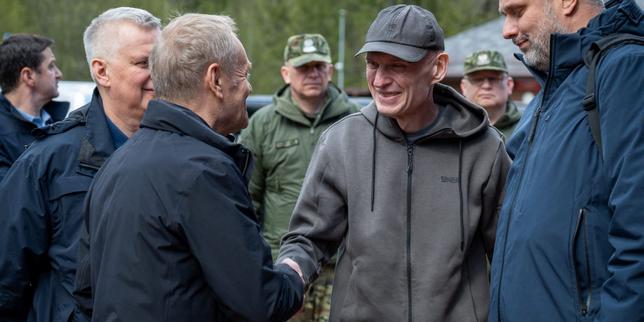
The release of Andrzej Poczobut marks the end of a grueling four-year standoff that turned a journalist into a geopolitical bargaining chip. While official statements from Warsaw and Washington frame this as a victory for human rights and diplomatic persistence, the reality is far more transactional. Poczobut, a prominent leader of the Polish minority in Belarus and a relentless critic of Alexander Lukashenko, was not merely freed. He was traded. This exchange, coordinated through a complex web involving the United States and several European allies, signals a definitive shift in how Eastern European autocracies interact with the West. It is no longer about ideology or border security alone. It is about the commodification of political prisoners.
For over 1,400 days, Poczobut remained a symbol of defiance within the Nawapolatsk penal colony. His refusal to sign a pardon request—a standard requirement for Lukashenko to save face—forced the hand of international negotiators. By integrating his release into a larger, multi-national swap, the Polish government managed to bypass the stalemate of bilateral talks that had failed for years. However, the price of such freedom often involves the release of high-value intelligence assets or convicted criminals held in Western jails, creating a moral hazard that few officials want to discuss openly.
The Architecture of a Continental Swap
The logistics of the Poczobut release were not handled in a vacuum. This was a piece of a much larger puzzle, a massive prisoner exchange that mirrors the high-stakes swaps of the 1980s. To get Poczobut out, Poland had to coordinate deeply with the Biden administration, which was simultaneously negotiating for the return of American citizens held in Russia. This interconnectedness shows that Minsk no longer operates as an independent actor in these matters. Lukashenko’s prison system has become an annex of the Kremlin’s broader strategy to extract concessions from NATO.
Intelligence sources suggest the groundwork for this specific move was laid months ago in neutral capitals. It required a delicate balance of pressure and "gifts." Poland’s decision to tighten border controls and restrict freight movement from Belarus played a significant role. It wasn't just talk. The economic squeeze on the transit of goods from China through Belarus to Europe created a pain point that Lukashenko could not ignore. When the flow of money slows, the value of a political prisoner suddenly shifts from a tool of internal repression to a currency for external relief.
The Polish Minority as a Political Target
To understand why Poczobut was held so long, one must look at the specific demographics of the crackdown. The Polish minority in Belarus, numbering nearly 300,000, has been systematically dismantled as a cultural and political entity. Poczobut was the face of this resistance. His imprisonment was a message to Warsaw that its influence beyond the Bug River was over. By refusing to leave Belarus voluntarily even when offered the chance early in his detention, Poczobut disrupted the narrative. He didn't want to be an exile; he wanted to be a citizen with rights.
The liquidation of Polish schools and the desecration of historical sites across Belarus were the backdrop to his trial. The state charged him with "inciting hatred" and "rehabilitating Nazism," absurd claims that are standard issue for the Belarusian judiciary when dealing with dissent. The trial was held behind closed doors, a hallmark of a regime that fears the transparency of its own evidence.
The Moral Hazard of Modern Diplomacy
Every time a Western democracy swaps a convicted criminal for a journalist, a precedent is set. We are witnessing the rise of "hostage diplomacy" as a primary statecraft tool for authoritarian regimes. If Lukashenko knows that arresting a high-profile journalist will eventually net him the return of an assassin or a deep-cover spy, the incentive to arrest more journalists increases. It is a vicious cycle.
Government officials in Warsaw argue that the life of a citizen outweighs the abstract risk of future captures. They are right, in a sense. A state that does not protect its own loses its legitimacy. Yet, the cost remains hidden. When we look at the individuals released by Western powers in these exchanges, we often find people who have committed genuine crimes—espionage, money laundering, or even murder. Balancing the scales between a journalist’s freedom and a criminal’s justice is an impossible equation.
The Role of the United States as a Global Broker
Washington’s involvement was the catalyst. Without the overarching umbrella of a US-Russia deal, Poland lacked the necessary leverage to move Poczobut. The United States provided the "inventory" for the trade. This highlights a sobering reality for European middle powers: when dealing with the Russian sphere of influence, bilateral diplomacy is often a dead end. You need a bigger hammer.
The Biden administration’s willingness to include Poczobut in a broader deal was a strategic nod to Warsaw’s importance as a frontline NATO ally. It was a clear signal that the security of the Suwalki Gap and the stability of the Polish government are direct American interests. But this dependency has a shelf life. If the political winds in Washington shift toward isolationism, the back door for such rescues may slam shut.
Life After the Penal Colony
The physical and psychological toll of the Belarusian prison system is designed to break a man. Reports from released prisoners describe a regime of sensory deprivation, inadequate medical care, and constant psychological pressure to renounce one's beliefs. Poczobut’s health has been a concern for years, with his family frequently reporting lack of access to basic medication for his heart condition.
His release does not mean he can return to his old life. Most freed dissidents face a choice between permanent exile or a life under constant surveillance where the threat of re-arrest hangs over every word. For Poczobut, the transition will be jarring. He leaves behind a country that has been transformed into a fortress, where the civil society he helped build has been driven underground or across the border into Grodno-sized communities in Bialystok and Warsaw.
The Border Paradox
While Poczobut is free, the border between Poland and Belarus remains a militarized zone. The migration crisis, engineered by Minsk to destabilize the European Union, continues to simmer. This creates a paradox. One man is freed while thousands are used as human projectiles in a different kind of hybrid warfare. The exchange for Poczobut does not signal a thaw in relations. If anything, it is a clinical transaction between enemies who have no intention of becoming friends.
Poland has invested billions in a border wall and electronic surveillance. This infrastructure is a permanent reminder that the "Iron Curtain" has been rebuilt, just a few hundred miles to the east of its original location. The release of a single journalist, however significant, does not change the structural reality of a continent divided by two radically different visions of governance.
The Fragmented Opposition
The release also highlights the struggle of the Belarusian democratic movement in exile. Sviatlana Tsikhanouskaya’s cabinet has been lobbying for Poczobut’s release since 2021, but the final deal was largely a state-to-state affair. This raises questions about the long-term efficacy of the opposition-in-exile. When the real bargaining happens, it happens between the people with the keys to the cells and the people with the keys to the bank accounts.
Many in the Belarusian diaspora worry that Poczobut’s release might lead to a "normalization" of the current situation. There is a fear that Western capitals, exhausted by the war in Ukraine and the constant friction with Minsk, might settle for these small humanitarian wins while leaving the core structure of the Lukashenko regime untouched. We cannot mistake the rescue of a victim for the defeat of the kidnapper.
Tactics of the New Cold War
We must analyze the specific timing of this move. Lukashenko is preparing for a "reelection" in 2025. Clearing out high-profile prisoners who attract international headlines is a way to lower the temperature before another domestic crackdown. It is a tactical retreat, not a strategic shift. By releasing Poczobut now, he removes a primary talking point for European diplomats, potentially opening a narrow window for back-channel discussions regarding sanctions relief.
The West must be wary of this pattern. Dictators often use the "release and arrest" cycle to manage international pressure. They let one famous name go while arresting fifty anonymous activists. The net number of political prisoners in Belarus has not significantly dropped; it has merely been recalibrated.
The Poczobut case proves that in the current geopolitical climate, the pen is only as sharp as the diplomatic and economic leverage behind it. Journalism in Eastern Europe has become a high-risk occupation where the reporter’s body is the ultimate collateral. Andrzej Poczobut is free because he was too expensive to keep, not because his captors had a change of heart.
The struggle for the remaining political prisoners continues in the shadow of this trade. Every handshake in a neutral airport and every flight to freedom is bought with a concession that will be felt for years. We have entered an era where justice is not served in a courtroom, but negotiated in a dark room.
The victory is real, but it is hollow. As long as the mechanism for hostage-taking remains profitable, the cells will never stay empty for long.