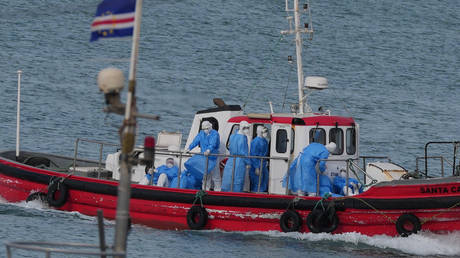
The wind in Las Palmas usually smells of two things: diesel and brine. It is a scent that means money, movement, and the steady heartbeat of a port city that serves as the gateway between Europe and the vast, blue unknown of the Atlantic. But lately, the air feels different. It carries a weight that has nothing to do with the humidity.
Maria stands on her balcony in the Isleta district, squinting at the horizon where the massive white hulls of cruise ships typically bob like oversized bathtub toys. She remembers the spring of 2020. She remembers the silence. Not a peaceful silence, but a heavy, suffocating blanket that fell over the Canary Islands when the world stopped turning. Back then, the vibrant streets of Santa Cruz and Las Palmas became echoing canyons. Now, as news trickles down the docks about a vessel carrying a passenger diagnosed with hantavirus, that old, cold knot in the stomach is tightening again.
The fear isn’t just about a virus. It is about the fragility of a life built on the welcome mat we lay out for the rest of the world.
The Specter in the Harbor
When a cruise ship pulls into a Canarian port, it isn't just a boat. It is a floating city of three thousand souls, a massive injection of capital, and, occasionally, a Trojan horse. The recent reports of hantavirus on a visiting vessel have acted like a stone dropped into a still pond. The ripples are moving fast.
Hantavirus isn't Covid. Scientists will tell you that. They will explain that it’s a zoonotic disease, usually transmitted by contact with the droppings, urine, or saliva of infected rodents. It doesn’t typically leap from person to person in the way a respiratory flu does. But try telling that to a shopkeeper in Triana who lost her livelihood for eighteen months during the last "unprecedented event."
To the people of the Canaries, a ship under quarantine is a hauntingly familiar image. It represents the moment the border becomes a barrier.
Consider the mechanics of the fear. If you are a waiter at a seaside cafe, your entire existence depends on the bridge between the ship and the shore remaining open. You see the white hull and you see rent money. But when word spreads that the medical bay is locked down, that hull starts to look like a fortress. Or a prison.
A Geography of Vulnerability
The Canary Islands are a paradise defined by their isolation. This is our greatest strength and our most profound weakness. We are a speck of volcanic rock thousands of miles from the mainland, tethered to the world by flight paths and shipping lanes.
When a virus arrives here, it has nowhere else to go.
In the high-ceilinged offices of local health authorities, the language is clinical. They speak of "containment protocols" and "risk assessment." They point out that hantavirus is rare in this part of the world and that the threat to the general public is statistically negligible. These are facts. They are true.
But facts are often poor armor against memory.
The collective trauma of 2020 remains an open nerve. During the pandemic, the islands saw their primary industry—tourism—evaporate overnight. The "repeat" that residents worry about isn't necessarily a repeat of the medical crisis, but a repeat of the economic and social paralysis. They fear the return of the red tape, the empty plazas, and the uncertainty of when the next meal might be guaranteed.
The Invisible Stakes
Imagine a young man named Carlos. He works as a tour guide, taking groups into the volcanic heart of Teide. For Carlos, the news of a "virus ship" is a direct threat to his ability to breathe. Not because of the virus itself, but because of the optics.
Tourism is a business of perception. If the world begins to associate the Canary Islands with quarantine flags and medical emergencies, the bookings stop. The emails go unreturned. The vibrant, chaotic energy of the waterfront turns into a cautious, sideways-glancing suspicion.
The invisible stake here is trust.
We trust that the systems meant to screen passengers are working. We trust that the cruise lines are being transparent. We trust that our own government has learned enough from the past to act with a scalpel rather than a sledgehammer. When a ship arrives with a rare pathogen onboard, that trust is tested to its breaking point.
The hantavirus, while frightening in its symptoms—fever, muscle aches, and potentially severe respiratory or kidney issues—is a manageable threat in a modern medical context. But we aren't just dealing with biology. We are dealing with the psychology of a population that has been pushed to the edge before.
Beyond the Statistical Margin
It is easy for an observer in Madrid or London to look at the data and shrug. They see a single case or a small cluster and note that the R-rate is low. They see a "standard procedure" quarantine and move on to the next headline.
They don't see the grandmother in La Laguna who is suddenly afraid to go to the market because she heard a rumor on WhatsApp. They don't see the hotel manager calculating how many weeks of payroll he has left if the port closes again.
The narrative being spun in the local bars is one of "here we go again." It’s a defensive crouch.
There is a specific kind of exhaustion that comes from living through a once-in-a-century event, only to realize that the world is now a place where such events feel like they could happen every Tuesday. The hantavirus ship is a reminder that our interconnectedness comes with a bill that can be presented at any moment, without warning.
The Brine and the Burden
The authorities are working to reassure the public. They emphasize that the patient is isolated, that the ship’s rodent control measures are being scrutinized, and that there is no evidence of a wider outbreak. This is the work of governance, and it is necessary.
But as the sun sets over the Atlantic, casting long, orange shadows across the docks, the residents of the Canaries are doing their own math. They are looking at the ships and wondering if the price of being a global crossroads has become too high.
The air still smells of diesel and salt.
Maria closes her balcony door. She turns on the television, but the news is just a repetition of the same three facts. She looks at the photo of her family on the mantel, taken at a crowded festival years ago, and wonders if the islands will ever truly feel safe again, or if we are simply waiting between the shadows cast by the ships that bring our lifeblood and our fear in the same hold.
The ship sits in the harbor, a silent, glowing mountain of steel. It is a testament to human engineering and the desire to explore. But tonight, to the people watching from the hills, it looks less like a vacation and more like a question that nobody is quite ready to answer.