The British Royal Navy is facing a crisis of confidence exactly when the world can't afford it. As tensions with Iran move from rhetorical jabs to the brink of open maritime warfare, the pride of the British fleet looks increasingly like a giant with glass ankles. You’ve likely heard the official lines about "global Britain" and "carrier strike groups," but the reality on the water is much grimmer. Britain’s ability to protect shipping lanes in the Gulf isn't just stretched. It’s breaking.
Public outcry over the lack of readiness isn't just tabloid noise. It’s a reflection of a decade of budget cuts meeting a wall of technological failure. When we talk about a potential war with Iran, we aren't talking about 19th-century ship-on-ship duels. We’re talking about asymmetric threats, swarms of drones, and high-speed missiles that don't care about a ship’s history. Right now, the Royal Navy is struggling to even get its best hardware out of the harbor.
The embarrassing reality of the carrier program
The HMS Queen Elizabeth and HMS Prince of Wales were supposed to signal a new era. They’re massive. They’re expensive. They’re also frequently stuck in port. Recently, the HMS Queen Elizabeth had to pull out of a major NATO exercise because of a coupling issue on its propeller shaft. Then, the ship meant to replace it, the HMS Prince of Wales, had its own set of problems. It’s a pattern, not a fluke.
If you can't get your flagship to a scheduled drill, how do you expect to deploy it against a motivated adversary like Iran? Iran doesn't need a carrier to win. They have a geography advantage and a massive arsenal of shore-based missiles. Britain, meanwhile, is trying to project power with ships that seem to have a mechanical "check engine" light permanently blinking.
The logistics are a nightmare. A carrier is useless without its support ships. The Royal Fleet Auxiliary, the backbone that provides fuel, food, and ammunition, is facing its own staffing crisis. Sailors are striking over pay and conditions. You can have the most advanced fighter jets in the world on your deck, but if the tanker can’t reach you because of a maintenance backlog or a labor dispute, you’re just a floating target.
Drones and the asymmetric nightmare in the Gulf
Iran’s military strategy is built around your weaknesses. They know they can’t win a traditional naval battle. Instead, they’ve invested in thousands of suicide drones and fast-attack craft. These are cheap. They’re replaceable. And the Royal Navy is poorly equipped to deal with them over a long period.
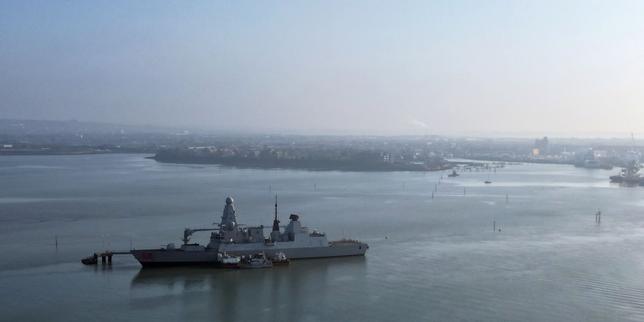
Look at what happened in the Red Sea recently. British destroyers like the HMS Diamond have had to use Sea Viper missiles to intercept Houthi drones. Each missile costs over a million pounds. The drone it’s hitting might cost twenty thousand. Do the math. You can't win a war of attrition when your ammunition costs fifty times more than the target.
British ships are running out of these missiles faster than the factories can replace them. If a full-scale conflict with Iran kicks off, the sheer volume of incoming fire would likely overwhelm the vertical launch systems on these Type 45 destroyers. They only carry 48 missiles. In a swarm attack, a ship could be " Winchester"—military speak for out of ammo—in minutes. Then what? You’re sitting there with a very expensive radar system and no way to defend yourself.
Recruiting a crew for a ghost fleet
Hardware is only half the problem. The Royal Navy is currently shrinking because people don't want to join, and those who are in are leaving. Recruitment has plummeted. It’s so bad that the Navy has considered decommissioning ships not because they’re old, but because there aren't enough sailors to steer them.
The HMS Westminster and HMS Argyll were reportedly sidelined because the personnel were needed for the new Type 26 frigates. It’s a "robbing Peter to pay Paul" strategy. You're losing hulls in the water to staff the ones still being built. In a conflict with Iran, hull count matters. You need ships to escort tankers, ships to hunt submarines, and ships to provide air cover. When your active fleet is down to a handful of reliable vessels, you lose the ability to be everywhere at once.
The life of a sailor has changed. Long deployments on aging ships with broken air conditioning don't make for a great recruitment brochure. The Navy is competing with the private sector for engineers and tech specialists. Right now, the private sector is winning. If you don't have the technicians to fix a high-pressure pipe at 3 AM in the Strait of Hormuz, the ship is a liability.
The hardware gap in the Strait of Hormuz
The Strait of Hormuz is a choke point. At its narrowest, it’s only 21 miles wide. Iran controls the northern shore. They have mobile anti-ship missile batteries tucked into the mountains. This isn't deep-water maneuvering. This is a knife fight in a dark hallway.
Britain’s Type 23 frigates, the workhorses of the fleet, are old. They’ve been patched up and life-extended far beyond their original design. They lack the modern "soft-kill" and "hard-kill" defenses needed to survive a saturated missile environment. The Navy is waiting on the Type 26 and Type 31 frigates to arrive, but they’re years away from being fully operational.
We’re in a dangerous transition period. The old stuff is breaking, and the new stuff isn't ready. Iran knows this. Their intelligence isn't just looking at ship locations; they’re looking at the British Parliament’s defense budget debates. They see the gaps. They see the indecision.
Fixing a navy while the world burns
You can't fix twenty years of underinvestment in twenty weeks. But there are immediate steps that would change the math. First, the Ministry of Defence needs to stop the obsession with "prestige" projects and focus on "availability." A frigate that actually sails is worth more than a carrier that stays in Portsmouth.
Investment in directed-energy weapons—lasers—is the only way to solve the drone cost-curve. The DragonFire system looks promising, but it needs to be on ships today, not in 2027. If the Royal Navy wants to survive a brush with Iran, it needs to stop using million-dollar missiles on plastic drones.
Second, the recruitment crisis needs a radical overhaul. It’s not just about pay; it’s about the state of the ships. People will serve on a ship that works. They won't serve on a ship that’s essentially a floating construction site.
The British public is starting to realize that the "Global Britain" slogan is hollow if the Navy can’t even protect a merchant vessel from a militia-backed drone. The controversy over the Royal Navy's preparation isn't going away. It’s getting louder because the threat is getting closer.
Check the latest naval deployment maps and the Ministry of Defence’s annual equipment plan. If you see more ships listed as "in maintenance" than "on station," you know exactly where we stand. Demand more transparency on fleet readiness. The time for pretending we have a full-strength navy is over. It’s time to fund the one we actually need.