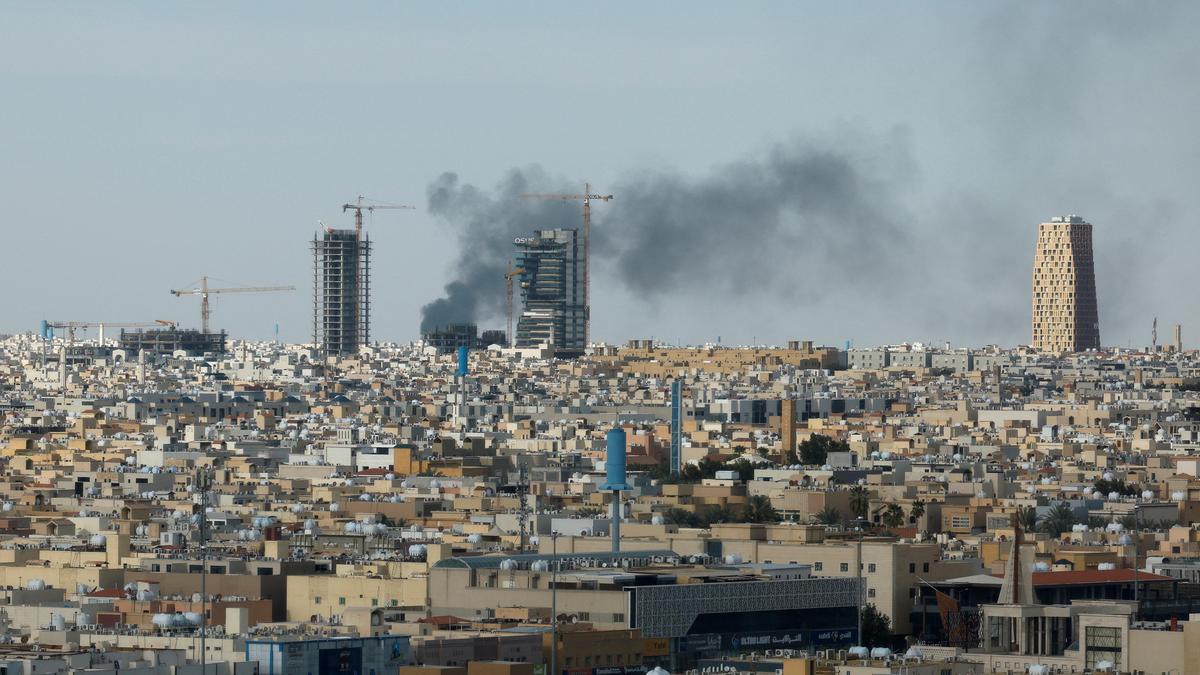
The warning issued by the Saudi Defense Ministry to Tehran is not merely a diplomatic protest. It is a calculated pivot in a decades-long struggle for regional hegemony. By explicitly cautioning Iran against a "miscalculation" following recent escalations, Riyadh is signaling that the era of strategic patience has reached its limit. This shift is driven by a realization that the traditional buffer zones in the Middle East are collapsing. The Kingdom is now forced to balance high-stakes diplomacy with the rapid modernization of its own strike capabilities.
For years, the shadow war between these two powers played out in the periphery. Lebanon, Yemen, and Iraq served as the boards for a grim game of influence. However, the nature of the threat changed when low-cost drones and precision missiles began bypassing multi-billion dollar defense systems. Riyadh’s latest rhetoric suggests they are no longer willing to absorb these "gray zone" attacks without a direct, potentially kinetic, response. For a closer look into this area, we recommend: this related article.
The Architecture of Miscalculation
The term "miscalculation" is heavy with historical baggage in the world of intelligence. It refers to a situation where one state underestimates the resolve of another, leading to a war that neither side initially intended. In the current context, the Saudi leadership believes Iran may be overplaying its hand with its network of regional militias.
Tehran operates on a doctrine of plausible deniability. By using proxies, they hope to exert pressure on Saudi energy infrastructure and maritime routes without triggering a direct state-to-state conflict. Riyadh’s new stance is designed to strip away that mask. The message is clear: the Kingdom will hold the patron accountable for the actions of the client. This is a high-stakes gamble that requires Saudi Arabia to prove it has both the military teeth and the political will to follow through. For broader details on this issue, extensive reporting can also be found at The New York Times.
The Drone Gap and the New Arms Race
One of the most significant factors behind this tension is the democratization of precision weaponry. Ten years ago, only a handful of nations could strike a target with centimeter-level accuracy from hundreds of miles away. Today, that capability can be assembled in a garage in Sana'a or Baghdad using off-the-shelf components and Iranian engineering.
Saudi Arabia has spent decades building a conventional military modeled after Western powers. They have the best fighter jets money can buy. Yet, these $100 million platforms are often ill-suited to intercepting a $20,000 "suicide" drone flying low and slow through a mountain range. The Defense Ministry's warning is backed by a massive internal push to overhaul their electronic warfare and short-range air defense (SHORAD) capabilities. They are learning the hard way that a "robust" defense is not defined by the price tag of the equipment, but by its adaptability to asymmetrical threats.
Energy Security as a Weapon of War
The global economy sits on a knife's edge every time a missile is fired in the Persian Gulf. This is the leverage Iran seeks to use, and it is the vulnerability Riyadh is trying to harden. When oil processing facilities are targeted, it isn't just a Saudi problem; it is a global inflationary event.
By framing the Iranian threat as a "miscalculation," the Saudi Defense Ministry is also talking to Washington and Brussels. They are reminding the West that if the Kingdom’s security is compromised, the cost of heating a home in London or filling a tank in Chicago will skyrocket. This economic dimension is the invisible front line. Riyadh is essentially arguing that allowing Iranian aggression to go unchecked is an act of global economic sabotage.
The Internal Pressure of Vision 2030
There is an overlooked domestic angle to this military posturing. Crown Prince Mohammed bin Salman has staked his entire legacy on Vision 2030, a massive plan to diversify the Saudi economy away from oil. This plan requires immense amounts of foreign investment. Investors, however, are notoriously allergic to falling missiles.
If Riyadh cannot guarantee a stable, secure environment for international business, the skyscrapers and tech hubs planned for the desert will remain blueprints. The Defense Minister’s warning is as much about protecting the balance sheet as it is about protecting the borders. The Kingdom cannot afford to look weak or vulnerable during this critical transition period. Any perception that Iran can disrupt Saudi development with impunity is a direct threat to the internal stability of the House of Saud.
The Intelligence Failure of Proximate Deterrence
The strategy of "proximate deterrence"—the idea that you can keep an enemy at bay by threatening their allies—has failed. Iran has shown that it is willing to let its proxies suffer significant losses as long as the core regime in Tehran remains untouched.
Saudi intelligence analysts are now focusing on the "head of the snake" doctrine. This school of thought argues that the only way to stop proxy attacks is to make the cost of launching them unbearable for the sponsor. This is where the danger of "miscalculation" becomes most acute. If Riyadh decides to retaliate directly against Iranian soil or naval assets in response to a proxy strike, the escalatory ladder has no middle rungs. It goes from zero to total war almost instantly.
The Naval Dimension and the Bab el-Mandeb Strait
While much of the focus is on aerial threats, the maritime theater is where the most dangerous "miscalculations" are likely to occur. The Bab el-Mandeb Strait is a chokepoint through which millions of barrels of oil pass daily. The presence of Iranian-backed forces along this coastline gives Tehran a metaphorical noose around the neck of global trade.
Saudi Arabia has been increasing its naval presence and conducting joint exercises with regional allies to signal that any attempt to close the strait will be met with overwhelming force. But naval warfare is cluttered and chaotic. A stray mine or a nervous ship commander could trigger the very "miscalculation" the Defense Ministry is warning against.
The Role of Cyber Warfare in Modern Deterrence
Behind the scenes, the conflict is already raging in the digital world. Saudi Arabia has been the target of some of the most sophisticated "wiper" malware attacks in history, designed to erase the data of state oil companies. In return, Iranian infrastructure has faced mysterious outages and system failures.
The Defense Ministry’s public warning likely includes a hidden message regarding cyber retaliation. In modern warfare, a line of code can be just as destructive as a cruise missile. Riyadh has invested heavily in offensive cyber capabilities, moving beyond simple defense to a posture of active persistence. They are signaling that they can reach into Tehran’s power grids or command structures if pushed too far.
The Diplomatic Trap of Direct Talks
There is a school of thought that suggests the recent "thaw" in Saudi-Iranian relations, mediated by third parties, was a tactical ruse. It allowed Iran to lower the Kingdom's guard while continuing to build up its proxy capabilities. Riyadh appears to have reached this conclusion.
The current rhetoric suggests that the time for vague diplomatic assurances is over. The Kingdom is now demanding verifiable changes in Iranian behavior. They are no longer interested in the "process" of peace; they want the "result" of security. This shift leaves very little room for the kind of "constructive ambiguity" that diplomats usually love. It makes the environment more predictable, but also more brittle.
The Risk of an Unintended Spark
The biggest threat to regional stability is not a planned invasion, but an accidental encounter. With so many actors operating in such a small geographical space—Saudi jets, Iranian drones, American destroyers, and various militia groups—the "fog of war" is dense.
The Defense Ministry's warning is an attempt to clear that fog. By stating their intentions clearly, they hope to remove any doubt about what will happen if a certain line is crossed. The problem is that once you draw a line in the sand, you are obligated to defend it. If Iran crosses that line, even by accident, and Riyadh does not respond, their deterrence evaporates. If they do respond, the region ignites.
The Shifting Alliance Structure
Riyadh is also looking at its traditional alliances with a new level of skepticism. The realization that they cannot fully rely on a "security umbrella" from the West has led to a more independent, and arguably more aggressive, foreign policy. This "Saudi First" approach means they are more likely to take unilateral action if they feel their core interests are threatened.
This independence is a double-edged sword. It makes the Kingdom a more formidable regional player, but it also removes some of the "braking mechanisms" that Western allies used to provide. When the Saudi Defense Minister warns of a miscalculation, he is speaking as the representative of a power that is increasingly willing to act alone.
Moving Toward a New Equilibrium
The region is currently in a state of violent transition. The old rules of engagement are being rewritten in real-time. Riyadh’s warning is the first chapter of a new strategy that prioritizes direct accountability over indirect containment.
To succeed, Saudi Arabia must ensure that its military capabilities match its rhetorical ambitions. This means not only buying the best technology but integrating it into a cohesive doctrine that can handle both a swarm of drones and a barrage of ballistic missiles. It also means maintaining internal unity and economic momentum in the face of constant external pressure.
The margin for error is non-existent. Tehran is watching for any sign of weakness, while Riyadh is waiting for any excuse to prove its strength. In this environment, a "miscalculation" isn't just a possibility; it is a looming probability that both sides are desperately trying to manage while simultaneously preparing for its arrival.
Audit your own supply chain vulnerabilities and assess how a localized conflict in the Gulf would disrupt your specific operational logistics before the next escalation occurs.