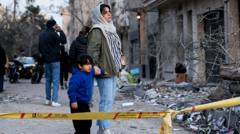
The humanitarian industrial complex has a favorite script. It involves wide-eyed children, crumbling infrastructure, and a prognosis of "permanent psychological scarring." Every time regional tensions flare or internal unrest grips Iran, the international press trots out the same tired narrative: an entire generation is being systematically erased by trauma.
They are wrong. Not because the suffering isn't real—it is—but because they fundamentally misunderstand human psychology and the mechanics of societal adaptation. They treat trauma as a terminal illness. They view the Iranian youth as a passive casualty of history.
This isn't just a mistake in reporting; it’s a failure of imagination. By framing every Iranian child as a broken vessel, we ignore the most potent force in human development: Antifragility.
The Pathology of Pity
Most Western analysis of Iranian social health relies on a "deficit model." This assumes that exposure to conflict, economic sanctions, or state pressure creates a linear decline in human potential. If $X$ amount of stress occurs, $Y$ amount of damage is sustained.
But humans aren't glass. We are muscle.
In clinical psychology, we see a phenomenon known as Post-Traumatic Growth (PTG). While the competitor articles scream about "endless fears," they ignore the data suggesting that individuals who navigate high-stress environments often develop superior cognitive flexibility, higher empathy, and a more sophisticated "theory of mind" than those raised in the sterile safety of the West.
I’ve sat in rooms with aid workers who speak about Tehran’s youth as if they are brittle artifacts. They aren't. They are some of the most tech-literate, politically savvy, and culturally hungry individuals on the planet. They aren't "damaged goods"; they are a generation that has been forged in a pressure cooker.
The Sanctioned Mind Myth
We hear constantly that sanctions and domestic strife have "stunted" the Iranian psyche. This is a lazy geopolitical talking point. Let’s look at the mechanics of how a society actually functions under extreme pressure.
When formal systems fail, informal systems thrive. The "damage" the media laments often leads to the creation of underground educational networks, black-market artistic communities, and a level of digital literacy that puts Ivy League graduates to shame.
The competitor's piece focuses on the "enduring damage" to education. They miss the nuance of Cognitive Desperation. When a child knows that their path to success is obstructed, their drive to innovate doesn't disappear—it pivots. In Iran, this has manifested in a massive surge in STEM participation and self-taught coding skills. The "fear" isn't stopping them; it’s the catalyst for their obsession with global connectivity.
The Problem With "Trauma-Informed" Foreign Policy
If you treat a population as a victim for forty years, you eventually convince them they have no agency. This is the real danger of the "endless fears" narrative.
- Victimhood as Identity: When NGOs prioritize "trauma healing" over economic integration, they create a dependency loop.
- Skewed Data: Surveys in high-conflict zones often suffer from "social desirability bias." Respondents know that reporting high levels of distress attracts more international aid and attention.
- Misdiagnosing Resilience: What a Western therapist calls "hyper-vigilance," a Tehrani youth calls "situational awareness." In their environment, the latter is a survival asset, not a clinical disorder.
The Resilience Tax
Let’s be brutally honest: there is a cost. I am not suggesting that living under the threat of violence or economic collapse is a net positive. It is a "resilience tax."
But the tax is paid in the present. The "enduring damage" the media predicts is often a projection of Western fragility. We assume that because we couldn't handle the stress of 40% inflation and constant political volatility, they must be falling apart.
This is a form of cultural narcissism. It assumes our standard of "mental health"—which is largely based on a lack of conflict—is the only valid baseline.
Dismantling the "Lost Generation" Trope
The media loves the phrase "The Lost Generation." They’ve used it for Iran in the 80s, the 90s, the 2000s, and they’re using it now.
If every generation is "lost," then the term has no meaning.
In reality, the youth of Iran are far more engaged with the world than their counterparts in stable democracies. While an American teenager might be doom-scrolling on TikTok, an Iranian teenager is using a VPN to bypass government firewalls, learning Python to build decentralised tools, and studying English through pirated masterclasses.
Who is more "damaged"? The one who is entertained into apathy, or the one who is pressured into excellence?
The Fallacy of the "Cessation of Fighting"
The competitor article suggests that "even if fighting stops," the damage is done. This implies that peace is a static state that automatically begins the healing process.
It’s the opposite. The most dangerous time for a post-conflict society isn't the war; it's the boredom that follows.
When the external pressure is removed, the internal structures—the secret schools, the underground economies, the shared sense of struggle—can collapse. The "damage" isn't the trauma; it’s the potential loss of the purpose that trauma provided.
Instead of worrying about the "enduring fears," we should be worrying about the Institutional Void. If the fighting stops tomorrow, the youth don't need therapists—they need markets. They need access to the global banking system. They need the ability to compete on a level playing field.
Why the Pity Narrative is a Tool of Suppression
By focusing exclusively on the "psychological damage" to children, the international community creates a justification for paternalism.
"They are too traumatized to lead."
"They need our guidance to rebuild."
"Their mental state is too fragile for democracy."
This is a convenient lie. It allows global powers to treat Iran like a psychiatric ward rather than a nation of 85 million capable individuals.
I’ve seen this before in post-Soviet states and across the MENA region. The "trauma" narrative is often used to bypass local leadership in favor of "expert-led" international interventions. These interventions usually fail because they address a clinical symptom while ignoring the structural strength of the people.
The Real Numbers
If you want to see the "damage," look at the statistics that actually matter.
- Literacy Rates: Despite decades of "upheaval," Iran’s youth literacy rate is near 100%.
- University Enrollment: Women outnumber men in Iranian universities, particularly in the sciences.
- Entrepreneurship: The Iranian tech ecosystem—built entirely under the weight of sanctions—is one of the most robust in the Middle East.
Does this look like a generation crippled by fear? Or does it look like a population that has learned to thrive in the gaps of a failing system?
Stop Pathologizing Survival
The most "trauma-informed" thing we can do for Iran’s youth is to stop telling them they are broken.
We need to shift the conversation from "How do we fix their trauma?" to "How do we get out of their way?"
The "fears" mentioned in the headlines are not endless. They are acute, they are managed, and they are being transformed into a fierce, uncompromising drive for change. The Western media’s obsession with the "scars" on these children is a distraction from the iron in their blood.
The Actionable Truth
If you actually want to support the next generation of Iranians, stop donating to "trauma awareness" campaigns that produce nothing but glossy brochures.
Invest in tools that enable bypass.
- Support open-source communication protocols.
- Advocate for the removal of tech-specific sanctions that hurt the people more than the state.
- Acknowledge that an Iranian child is a survivor, not a victim.
The damage isn't enduring. The people are.
Stop looking for the cracks in the pavement and start looking at the grass growing through them. The "endless fears" are a headline; the reality is an endless, stubborn, and highly skilled defiance.
Bet on the defiance. Every single time.


