Russia just reminded the world that "peace talks" are often just a backdrop for more violence. Early Saturday morning, March 7, 2026, a massive wave of Russian missiles and drones tore through Ukraine, leaving a trail of collapsed apartment blocks and shattered families. While early reports suggested six dead, the reality on the ground in Kharkiv has turned much darker. At least 11 people are now confirmed dead in that city alone, including a primary school teacher and her nine-year-old son.
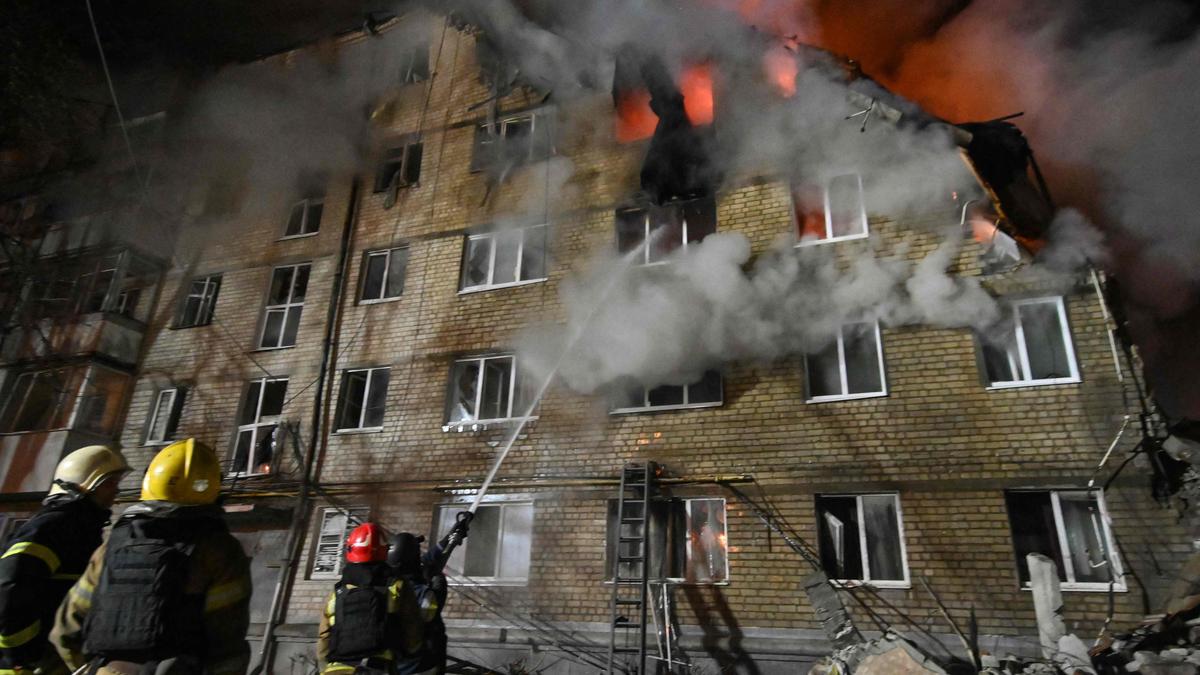
If you're following the headlines, you've likely seen the generic "six killed" figure. That number is outdated. By the time rescuers finished sifting through the remains of a five-story residential building in Kharkiv's Kyivskyi district, the toll had nearly doubled. This wasn't a "military target" gone wrong. It was a direct hit on a civilian housing block by a weapon Ukraine identifies as the Izdeliye-30—a new subsonic cruise missile designed to dodge jamming and find its way into your living room.
The Strategy Behind the Slaughter
Moscow claims it targets "military factories and air bases." I’ve seen enough of these reports to know that’s the standard script. But you don't find second-grade students under the rubble of a legitimate military objective. This latest barrage involved 29 missiles and a staggering 480 drones. To put that in perspective, that's more drones in a single night than Russia used in entire months back in 2024.
It's not just about the numbers; it's about the tech. The Izdeliye-30 has a range of 1,500 kilometers and uses a satellite navigation system that's allegedly "jam-proof." Russia is testing its newest toys on apartment buildings while the rest of the world debates whether to keep sending aid.
Kharkiv Is the Heart of the Pain
The destruction in Kharkiv is absolute. An entire section of a five-story building was leveled. Mayor Ihor Terekhov confirmed that among the victims were a teacher and her son, along with an eighth-grader and her mother. These aren't just statistics. They're names and lives snuffed out while they slept.
- 11 dead in Kharkiv (including 2 children).
- 1 dead in the Dnipro region.
- 1 dead in Sumy (a 24-year-old man hit in his car).
- Over 15 injured in Kharkiv, including toddlers and teenagers.
The strikes didn't stop at the border. Poland had to scramble military jets because the Russian missiles were flying so close to NATO airspace. It's a calculated move to keep the West on edge, a game of "how close can we get before you actually do something?"
What Most People Miss About the Timing
This isn't happening in a vacuum. Just 48 hours before this attack, Ukraine and Russia exchanged 500 prisoners of war each. There were whispers in Geneva about a breakthrough in negotiations. Then, boom. This is a classic Kremlin tactic: negotiate with one hand and strike with the other to show that "peace" will only happen on their terms.
President Zelenskyy was blunt about it. He’s calling for a "response from partners" that goes beyond words. Honestly, can you blame him? He’s watching his energy grid and railway infrastructure get systematically dismantled by 480 drones in a single night.
The Energy Crisis is Back
While the human cost is the most gut-wrenching, the tactical goal was the energy infrastructure. Kyiv, Khmelnytskyi, and Chernivtsi all saw hits. In the capital, Mayor Vitali Klitschko reported that nearly 2,000 more homes are now without heating. It’s March, but it’s still freezing in Ukraine. Knocking out the heat isn't a military strategy; it's a way to break the spirit of the people.
The U.S. and EU are currently debating another round of sanctions, but even that feels sluggish. Treasury Secretary Scott Bessent mentioned lifting some oil sanctions to stabilize global prices, which feels like a slap in the face to Kyiv while their civilians are being pulled from the rubble.
The Reality of Air Defense
Ukraine's Air Force did some heavy lifting, downing 453 drones and 19 missiles. That sounds impressive until you realize that 26 drones and 9 missiles still got through. When the volume is this high, "good enough" air defense isn't good enough. The math is simple: if Russia sends 500 objects, even a 95% success rate means 25 explosions in residential areas.
Don't wait for the next news cycle to see how this plays out. If you want to help, the most effective move right now is supporting organizations that provide immediate medical and search-and-rescue equipment to Kharkiv. Groups like the State Emergency Service of Ukraine and United24 are the ones actually digging people out of the concrete. Keep an eye on the NATO response in Poland; if those scrambles turn into interceptions, the war enters a whole new phase.