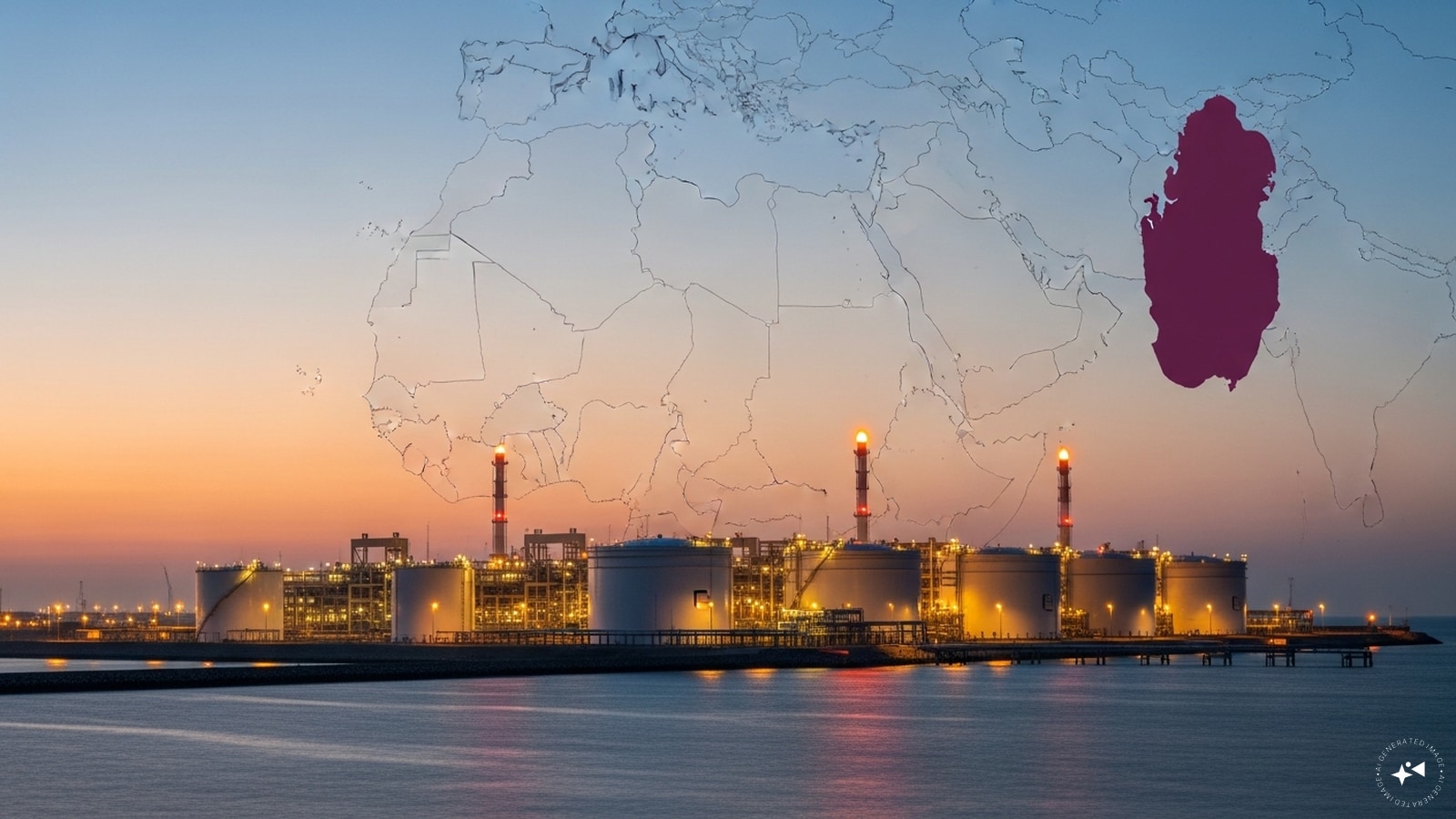
The fragility of Europe’s energy security was exposed on Monday as Dutch TTF natural gas futures, the continent's benchmark, rocketed nearly 50% in a single trading session. This wasn’t a slow burn or a speculative drift. It was a violent market reaction to the news that QatarEnergy has indefinitely halted liquefied natural gas (LNG) production at its massive Ras Laffan and Mesaieed complexes. By midday in Amsterdam, prices hit €47.94 per megawatt-hour, a level not seen in a year, as traders scrambled to price in the sudden disappearance of roughly 20% of the world’s LNG supply.
While mainstream headlines are quick to blame "supply chain disruptions," the reality is far more clinical and dangerous. This is a targeted surgical strike on the global energy heartland. Qatar’s decision to shut down production followed Iranian drone attacks that damaged critical infrastructure, including a power plant water tank and an energy facility. The halt is officially "precautionary," but in the world of high-stakes energy trading, precaution is often a synonym for a long-term blackout.
The Hormuz Chokepoint and the Myth of Diversification
For the past four years, European policymakers have congratulated themselves on "breaking the habit" of Russian pipeline gas. They replaced Siberian molecules with Qatari and American super-cooled liquid, convinced that a maritime supply chain offered superior security. This week’s events have shattered that illusion.
The Strait of Hormuz is currently a ghost town for LNG carriers. Since the escalation of hostilities between the U.S., Israel, and Iran on February 28, 2026, not a single Qatari tanker has successfully transited the waterway. While Europe physically imports less Qatari gas than Asian giants like Japan and South Korea, the market is a closed-loop system. When 77 million tonnes of annual capacity vanish from the board, the bidding war begins.
Europe is now forced to compete directly with Asia for the few available "floating" cargoes from the U.S. Gulf Coast and Australia. This is a zero-sum game played with a checkbook. Goldman Sachs analysts have already warned that a month-long closure of the Strait could send prices toward €74 per megawatt-hour—a 130% increase that would trigger the same industrial demand destruction we saw in 2022.
Storage is the Silent Crisis
The timing of this strike is particularly malicious. Traditionally, March marks the end of the winter heating season, a time when prices should naturally soften. However, Europe’s gas storage levels are currently sitting at a precarious 31%, significantly lower than the 40% seen at this time last year.
- Inventory Gap: Europe entered 2026 with only 46 billion cubic meters (bcm) in reserve, compared to 60 bcm in 2025.
- The Refill Challenge: The region needs to import massive volumes this summer to prepare for the 2026-2027 winter.
- Cost Prohibitions: Buying gas at a 50% premium just to put it in a hole in the ground is a fiscal nightmare for utilities already reeling from high interest rates.
If Qatar remains offline for more than three weeks, the "refill season" effectively fails before it begins. We are looking at a structural deficit that cannot be filled by simply asking the Americans to turn up the dial. U.S. export terminals are already running at 98% capacity. There is no "spare" gas.
The Force Majeure Domino Effect
Behind the scenes, the legal machinery is already grinding. QatarEnergy is reportedly preparing to declare force majeure on its long-term contracts. This is the "nuclear option" of the energy world. It allows a supplier to walk away from its delivery obligations due to circumstances beyond its control—in this case, an act of war.
When a supplier like Qatar invokes force majeure, the downstream impact is immediate. European industrial giants in the petrochemical and fertilizer sectors, which rely on gas not just for power but as a raw feedstock, face sudden contract cancellations. We aren't just talking about higher heating bills; we are talking about the potential for a complete halt in the production of plastics, pharmaceuticals, and agricultural chemicals across the Rhine Valley.
Fixing the Fragility
The current crisis proves that Europe hasn't solved its energy problem; it has merely changed the coordinates of its dependency. Moving from a pipeline-based dependency on Russia to a maritime-based dependency on the Middle East was a lateral move in terms of risk.
True energy security requires a fundamental pivot toward structural resilience. This means moving beyond the "just-in-time" delivery model for gas.
First, the European Union must mandate a permanent Strategic Gas Reserve, similar to the Strategic Petroleum Reserve in the United States. Private companies cannot be trusted to manage storage based on market signals alone; the state must floor the inventory levels regardless of price.
Second, the continent must accelerate the "electrification of everything" with a brutality that matches the current geopolitical climate. Every cubic meter of gas saved in a domestic heat pump is a cubic meter that doesn't have to run the gauntlet of the Strait of Hormuz.
The market is telling us that the era of cheap, reliable bridge fuels is over. We can either listen to the price signal and rebuild the architecture of our energy system, or we can continue to pay a 50% "volatility tax" every time a drone flies over a Qatari water tank.
The price surge is a symptom. The dependency is the disease.