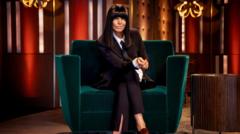
The British public has spent the last three years watching Claudia Winkleman in a state of high-drama evolution, trading the sequins of Strictly Come Dancing for the hooded fingerless gloves of The Traitors. But as the first episode of The Claudia Winkleman Show aired on BBC One this Friday night, the industry was forced to confront a sobering reality. Simply being the most popular woman in British television does not guarantee a functioning talk show format. The launch was more than just a debut; it was a high-stakes stress test of whether a star can survive the jump from scripted tension to the loose, unpredictable requirements of the green sofa.
Critics are already sharpened. The Guardian called the opening hour "a mess," while The Sun praised its "full-on banter." This polarization isn't accidental. It is the result of a fundamental structural gamble by the BBC and So Television—the production house that owns the Friday night DNA through Graham Norton. By placing Winkleman in Norton’s 10.40pm slot with an almost identical production team, the broadcaster hasn't just given her a platform; they have invited a direct comparison that, on night one, she was never going to win.
The Ghost of Graham Norton
The primary issue isn't Winkleman’s talent. She is objectively brilliant at what she does. However, the production team at So Television appears to have fallen into the trap of thinking the format is the talent. On Friday, the set featured the "classic" Norton formula: four guests, all on the sofa at once, mixed with audience participation.
But a chat show is a delicate ecosystem of energy management. Graham Norton is a master of the "invisible hand," a presenter who steers the ship while making the guests feel they are the captains. In contrast, Winkleman’s energy is reactive and high-octane. In the first episode, featuring Jeff Goldblum, Vanessa Williams, Jennifer Saunders, and Tom Allen, the host's self-professed "first-night nerves" were palpable.
When you have a guest like Jeff Goldblum—a man whose conversational style can best be described as an improvisational jazz solo—the host needs to be the rhythm section. Instead, the debut felt like two lead guitarists trying to play different songs. Goldblum’s eccentricities, which usually delight, became a hurdle that stalled the momentum of the other guests. Jennifer Saunders, a titan of British comedy, was left appearing ready for bed, while Vanessa Williams sat in graceful but quiet bafflement.
Why the Multi Guest Format Failed
There is a technical reason why the "all out at once" approach backfired.
- Pacing Overload: With four unrelated guests, the depth of conversation is sacrificed for the speed of the "bit."
- The Alpha Guest Problem: Tom Allen, a seasoned pro, worked hard to inject life into the room, but it often felt like he was doing the heavy lifting for a nervous host.
- Identity Crisis: The show felt like The Graham Norton Show without the specific sardonic detachment that makes that show work.
Winkleman’s greatest strength has always been her ability to make the viewer feel like they are in on the joke. On The Traitors, she is the gothic narrator. On Strictly, she was the chaotic big sister. On her own show, she has yet to find her persona. Is she the interviewer, the fan, or the entertainment? Trying to be all three in a fifty-minute window is a recipe for the "unholy mess" some critics observed.
The Traitors Trap
We have to look at the "Claudia Effect" to understand why the BBC took this risk. Her brand is currently at an all-time high. Her wardrobe alone creates 900% spikes in Google searches for tartan trousers and Fair Isle jumpers. She has successfully transitioned from a light entertainment fixture to a genuine cultural phenomenon.
The BBC is clearly banking on this goodwill to carry the show through its teething period. They are betting that the audience doesn't want a "better" interview; they want more Claudia. This is a dangerous assumption in the streaming era. While 11 million people might tune in to see who gets "murdered" in a Scottish castle, the Friday night chat show audience is more fickle. They want a destination, a "salon" feel that provides a smooth transition into the weekend.
The first episode felt less like a salon and more like a chaotic house party where the host has forgotten to provide enough chairs. The inclusion of audience participation—a divisive element of the debut—felt like an attempt to "freshen up" the genre that actually just cluttered the frame.
The Pivot to Personality
To save the series, the production needs to lean into what makes Winkleman unique rather than what makes Graham Norton successful. Winkleman is at her best when she is being "awful" by her own standards—meaning, when she is being messy, self-deprecating, and fiercely informal.
The rigid structure of the "pre-recorded live" format doesn't suit her. She needs more space to breathe. If the BBC wants a "quietly revolutionary" TV moment, they should stop trying to replicate 2005-era chat show aesthetics and let Winkleman break the fourth wall entirely.
The irony is that Winkleman’s own promotional tour for the show was more entertaining than the show itself. Her interviews on podcasts and morning TV, where she joked that the show would be "excruciating" and that people would "fall asleep," showed more of her genuine wit than the scripted segments of the debut.
What Happens Next
The "mixed reviews" narrative is the standard first-week headline for any major television launch. It is rarely the final word. However, the data from Friday night suggests that the show has a structural identity crisis. It isn't enough to be liked; a talk show host must be a conductor.
The second episode will be the true test. If the production team continues to force the "Norton Lite" template, the goodwill of the "Claudia Effect" will evaporate by mid-series. The audience will accept a mess, but they won't accept a boring mess.
Winkleman is a generational talent who has spent twenty years earning this spot. The tragedy of the opening night wasn't her performance—it was a production that didn't know how to frame her. They gave her a teal sofa when they should have given her a blank canvas.
The BBC must now decide if they are producing a talk show or a Claudia Winkleman experience. If they choose the former, she needs to learn to herd the celebrity cats with more authority. If they choose the latter, they need to burn the rulebook and let the orange-tanned chaos reign supreme.
The green sofa is currently a very lonely place.