The air inside a massive sports arena during a listening party is thick with a specific kind of electricity. It is the scent of expensive pyrotechnics, the hum of ten thousand subwoofers vibrating in the marrow of your bones, and the desperate, hungry anticipation of a crowd waiting for a god to descend.
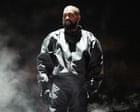
In February 2024, thousands of fans poured into the United Center in Chicago to witness Kanye West—now known as Ye—unveil Vultures 1. They weren't just there for the music. They were there for the spectacle. They were there to see a man who has built a career on the audacious claim that the rules of creative ownership don't apply to him. If you liked this article, you might want to check out: this related article.
But as the speakers roared and the bass rattled the rafters, a ghost was hidden in the mix.
That ghost belonged to Ozzy Osbourne. Specifically, it was a live snippet of Black Sabbath’s "Iron Man." It was a fragment of a performance recorded in 1983, a piece of sonic history that Ye had requested to use and had been explicitly denied. For another angle on this event, refer to the latest update from E! News.
Ozzy, the Prince of Darkness himself, had been vocal. He didn't want his work associated with a man who had spent the previous year embroiled in antisemitic controversy. He said no. He slammed the door. He locked the deadbolt.
Ye kicked the door down anyway.
The Anatomy of a Heist
To understand why this matters, we have to look past the celebrity drama and into the engine room of the music industry.
Sampling is the heartbeat of hip-hop. It is an art form built on the conversation between the past and the present. When a producer takes a drum break from a 1970s funk record or a vocal run from a jazz diva, they are weaving a thread through time.
But there is a social contract involved. You ask permission. You pay the toll. You respect the architect.
When Ye played that "Iron Man" sample at the United Center—and later at a similar event in New York—he wasn't just playing a song. He was committing a calculated act of creative defiance. It was a signal to the world that his vision superseded the consent of the original creator.
Consider the hypothetical perspective of a young, independent artist. Let's call her Sarah. Sarah spends years perfecting a single melody. It is her soul captured in digital amber. One day, she wakes up to find a global superstar has stripped that melody, looped it, and played it for millions without ever mentioning her name or sending a check.
For Sarah, that isn't "artistic freedom." It’s a mugging.
In the case of Vultures 1, the stakes were higher because the refusal was moral, not just financial. This wasn't a disagreement over royalty points. It was a veteran rock legend saying, "I do not want my legacy used to bolster your platform."
The Courtroom as a Mirror
The legal fallout was inevitable. Despite the sample being scrubbed from the final streaming version of the album, the damage from the live events was already done. Intercept Music, representing the rights holders of the Black Sabbath recording, filed suit.
They didn't just want a payout. They wanted an admission that the stadium is not a lawless zone where copyright goes to die.
The legal reality is often colder than the creative impulse. In the eyes of the law, a "listening party" is a public performance. If you use someone else’s intellectual property to sell tickets, hoodies, and brand equity, you owe them. You cannot hide behind the ephemeral nature of a live event.
Recently, the gavel finally fell. A federal judge in Florida handed down a victory to the plaintiffs. Ye lost.
The loss wasn't just a line item on a balance sheet. It was a judicial reassertion of a simple, grounding truth: you do not own the air you breathe if that air is made of someone else’s lungs.
The Invisible Toll
Why do we care about a billionaire losing a lawsuit over a few seconds of a heavy metal song?
Because the way we treat the smallest fragments of creativity dictates the health of the entire cultural ecosystem. If the most powerful figures in music can ignore the "no" of their peers, then the "no" of the small creator becomes completely meaningless.
The "Iron Man" riff is iconic. It is a three-note herald of doom that shaped a generation of rock. When it was played that night in Chicago, it carried the weight of four decades of history. To use it without permission is to attempt to hijack that history, to peel the stickers off someone else’s luggage and claim it as your own.
There is a certain irony in the fact that Ye, a man who has often railed against the "industry" for trying to control his own output, would be the one to ignore the boundaries of another artist. It reveals a fracture in the logic of the modern superstar—the idea that the "genius" tag provides a permanent hall pass.
The Sound of Accountability
This isn't just about Kanye West. It’s about the shift in how we consume and respect the "bits and pieces" of our world. We live in a remix culture. We live in an era where everything is a derivative of a derivative.
In this environment, the lawsuit serves as a necessary friction. It is the sand in the gears of a machine that wants to turn everything into free content.
The court’s decision is a reminder that even in a world of digital abundance, the "original" still has a heartbeat. It reminds us that when Ozzy Osbourne says his music is off-limits, that choice has to mean something. It has to be more than a suggestion.
The victory for Intercept Music isn't just a win for a corporate entity holding a catalog. It’s a win for the concept of creative agency. It’s a win for the right of an artist to choose who they stand next to in the record bin of history.
As the lights dim on the Vultures era, the echoes of that stadium event linger. They sound like a warning.
Genius is a powerful engine, but it requires a track to run on. And when you try to build that track out of stolen timber, eventually, the whole thing comes off the rails.
The silence that follows a lost lawsuit is the loudest sound in the room. It is the sound of the ghost finally leaving the machine, reclaiming its name, and walking back into the dark where it belongs.