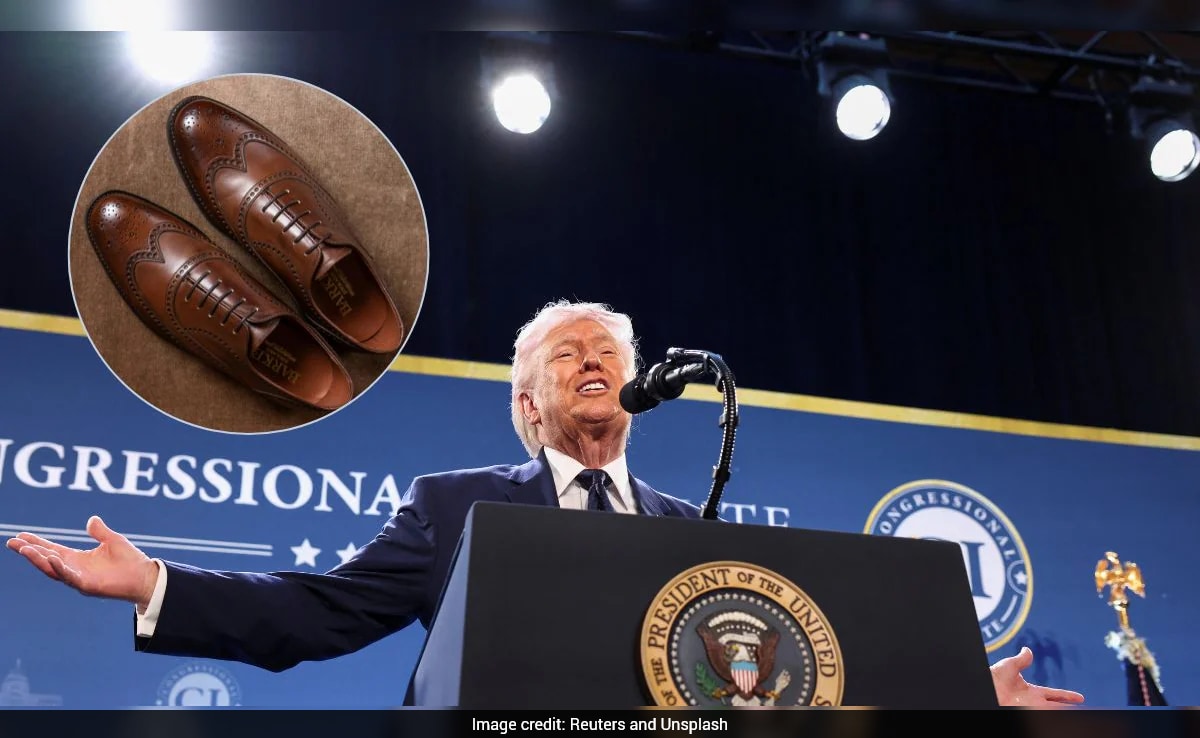
Donald Trump has spent decades crafting a persona built on gold-plated towers and private jets, yet his most consistent tool for building loyalty is a mid-range leather shoe that retails for less than a round of golf at Mar-a-Lago. For years, Trump has bypassed the luxury boutiques of Fifth Avenue to gift friends, aides, and political allies pairs of Florsheim shoes. This is not a story about a lack of taste or a billionaire being thrifty. It is a calculated study in brand loyalty, a specific type of nostalgia-driven networking, and the way a $145 piece of footwear can act as a more effective "thank you" than a generic plaque or a luxury watch.
Most observers dismiss the habit as a quirky billionaire's obsession. They shouldn't. In the world of high-stakes influence, the choice of a Florsheim—specifically the brand’s traditional oxfords and loafers—is a deliberate signal. It represents a specific era of American business reliability that resonates with Trump’s core demographic and his own sense of personal history.
The Florsheim Strategy
To understand the gift, you have to understand the recipient. When Trump hands over a box of Florsheims, he isn't trying to impress a tech mogul in Silicon Valley who wears $800 sneakers. He is communicating with the "old guard." The Florsheim brand, established in Chicago in 1892, was once the gold standard for the American middle class and the aspiring executive. By gifting these shoes, Trump anchors his inner circle in a shared aesthetic of 20th-century success.
It is a low-cost, high-impact move. In the context of a multi-billion dollar real estate empire or a presidential campaign, $145 is a rounding error. But a physical gift that requires knowing a person’s shoe size implies a level of intimacy that a standard political contribution does not. It forces a conversation about personal details. It creates a bond through the mundane act of dressing.
Why Price Does Not Define Value
In the luxury market, price is often a barrier to entry. In Trump’s political and business ecosystem, the Florsheim serves as a bridge. If he gifted $2,000 Berluti shoes, the gesture might feel alienating or like a bribe. By choosing a brand available at most suburban malls, he maintains the "man of the people" image while still playing the role of the benefactor.
There is also the matter of consistency. Trump is a creature of habit. From his diet to his wardrobe, he finds a "win" and repeats it until it becomes a trademark. He has been wearing and recommending these shoes for decades because they represent a version of America that he feels comfortable in—one where quality is measured by longevity and name recognition rather than avant-garde design.
The Logistics of Loyalty
The process of gifting these shoes has become a ritual within his organizations. It often starts with a compliment. A staffer or a guest mentions they like his shoes, or he notices theirs are looking worn. Shortly after, a box arrives. This isn't just about the leather; it’s about the fact that the boss noticed a detail as small as what is on your feet.
This creates a "uniform" of sorts. When multiple people in a boardroom or a campaign office are all wearing the same brand of shoe gifted by the man at the head of the table, it fosters a subtle, unspoken sense of belonging. It is a soft-power tactic that costs less than a single dinner at a high-end steakhouse but lasts for years.
The Decline and Rebirth of an American Icon
Florsheim's history mirrors the trajectory of the American manufacturing landscape that Trump often references in his rhetoric. The company was a powerhouse for a century, fell into financial trouble as the world moved toward casual dress, and was eventually bought back by the founding family to find a new niche.
By sticking with the brand, Trump is effectively subsidizing a piece of Americana. He isn't interested in the latest trends from Milan. He is interested in the perceived "sturdiness" of the past. For his followers, seeing him elevate a standard brand over a European luxury house reinforces the idea that he shares their values, even if his bank account says otherwise.
The Psychological Hook
Psychologically, receiving a gift you can actually use daily is more effective for building long-term memory than receiving a luxury item that sits in a box. Every time a political advisor ties their laces in the morning, they are reminded of the person who gave them the shoes. It is a constant, physical presence.
This is the "merch" of the elite level. While supporters at rallies buy hats and T-shirts, those in the inner sanctum are given the shoes. It is a tier-based system of branding. The shoes are the secret handshake of the Trump orbit.
The Counter Argument
Critics argue that this obsession is just another example of Trump being stuck in the 1980s. They suggest that a modern leader should be more aligned with contemporary brands or that the gift is cheap given his purported net worth. But this misses the point of the "common man" billionaire persona. If he started gifting Tom Ford, he would lose the very connection that makes his brand work. The "cheapness" is the point. It is accessible. It is relatable. It is, in his view, "sensible."
The shoes also serve as a distraction from more complex issues. It is much easier to talk about a candidate’s favorite footwear than it is to deconstruct their tax policy or their international trade agreements. In this sense, the Florsheim obsession is a masterclass in controlled narrative. It provides a humanizing, slightly eccentric detail that the media can latch onto, which ultimately softens his image.
Beyond the Leather
Ultimately, the $145 shoe is a symbol of a specific type of loyalty. In the high-velocity world of New York real estate and Washington politics, where people are traded like commodities, a pair of shoes is a remarkably stable currency. They are practical. They are predictable. And in the world of Donald Trump, predictability is a rare and valuable asset.
The next time you see a high-ranking official or a long-time Trump associate walking through a lobby, don't look at their tie or their watch. Look at their feet. The brand of the shoe will tell you exactly how close they are to the center of power.
Check the soles of the people in the next televised meeting at Mar-a-Lago.