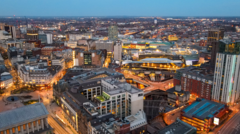
The electoral landscape of Birmingham currently functions as a high-friction environment where traditional party loyalty has decoupled from localized voter priorities. This transition is not a mere shift in sentiment but a structural breakdown of the post-war consensus, driven by a trifecta of fiscal insolvency, geopolitical friction, and the erosion of the "neighborhood-as-constituency" model. To understand the looming election, one must move beyond the superficial narrative of "frustration" and analyze the specific mechanics of voter disenfranchisement and the rise of the specialized independent candidate.
The Fiscal Insolvency Feedback Loop
The Section 114 notice issued by Birmingham City Council represents more than a budgetary failure; it serves as a primary driver of political alienation. When a local authority declares effective bankruptcy, the social contract is fundamentally renegotiated under duress. If you found value in this article, you might want to look at: this related article.
- Service Degradation as a Catalyst: The reduction in non-essential services—street lighting, waste collection, and community centers—functions as a daily, tangible reminder of institutional failure. This creates a "visible neglect" metric that overrides national policy debates. Voters in impacted wards no longer judge candidates on macroeconomic platforms but on the immediate restoration of municipal utility.
- Council Tax Inflation: The 21% increase in council tax over two years acts as a regressive tax on a population already facing high deprivation indices. This creates a "taxation without utility" sentiment. The financial burden shifts from the institution to the individual, forcing a defensive voting posture where the primary objective is the mitigation of personal financial loss rather than the pursuit of collective progress.
- The Liability Chain: Labor, as the incumbent party in the council, carries the branding of this insolvency. The challenge for the party is the inability to decouple its national brand from its local administrative performance. This linkage allows independent and minor-party challengers to frame a vote for Labor as an endorsement of fiscal mismanagement.
Geopolitical Localism and the Gaza Variable
Birmingham’s demographic composition makes it a primary theater for "Geopolitical Localism." This occurs when international conflicts are internalized as domestic litmus tests, disrupting historical voting blocks.
The conflict in Gaza has transformed from an external humanitarian concern into a domestic electoral wedge. In constituencies with high Muslim populations, such as Birmingham Ladywood and Birmingham Hall Green, the Labour Party’s perceived hesitation on a ceasefire early in the conflict created a representation gap. This gap is being filled by independent candidates who operate on a single-issue platform or a "community-first" mandate. For another perspective on this development, refer to the recent coverage from The Guardian.
The mechanism at play here is The Cost of Entry for Major Parties. While a national party must maintain a nuanced, often centrist foreign policy to appeal to the median voter, an independent candidate has zero cost associated with adopting an absolutist position. This creates an asymmetric electoral battleground where the major party is punished for its complexity while the challenger is rewarded for their simplicity.
The Rise of the Specialized Independent
The "extraordinary" nature of this election is defined by the professionalization of independent candidates. Historically, independents were protest votes; today, they are strategic operators. They target specific failure points in the major parties’ armor:
- The Hyper-Localist Strategy: Using the council’s bankruptcy to argue that national parties prioritize Westminster games over Birmingham’s basic infrastructure.
- The Identity Alignment Strategy: Leveraging shared cultural or religious values to bypass traditional class-based voting patterns.
- The Tactical Split: Independents do not need to win a majority; they only need to siphon enough votes from the incumbent to force a shift in party behavior or create a hung council scenario.
This creates a Volatility Coefficient. In wards where the margin of victory was historically high, the emergence of a credible independent can trigger a cascade effect. Once the "certainty" of an outcome is removed, undecided voters feel their vote has higher leverage, further increasing the unpredictability of the result.
Mapping the Apathy Gradient
Apathy is often mischaracterized as laziness. In a data-driven model, apathy is a rational response to a perceived lack of ROI (Return on Investment) for the act of voting.
The Apathy Gradient in Birmingham is shaped by three variables:
- Utility Ceiling: The belief that regardless of the winner, the Section 114 restrictions will prevent any meaningful change for at least five years.
- Representation Fatigue: The feeling that local representatives are "parachuted in" or are more accountable to party whips than to the streets of Handsworth or Erdington.
- Information Friction: The difficulty in discerning actual policy differences between major parties when both are constrained by the same national fiscal rules.
When the perceived difference between Candidate A and Candidate B approaches zero, the "cost" of voting (time, effort, travel) exceeds the expected "benefit." This leads to the high turnout variance seen across the city, where affluent areas maintain engagement while deprived areas—those most in need of effective governance—see a collapse in participation.
The Infrastructure of Hope vs. The Infrastructure of Governance
The article referenced "hope" as a sentiment, but in a strategic context, hope must be viewed as an infrastructure. It requires a credible path from current state (insolvency and division) to future state (stability and growth).
The disconnect in Birmingham is that the "Infrastructure of Hope" is currently disconnected from the "Infrastructure of Governance." Voters see a city undergoing massive physical transformation—Big City Plan, HS2 integration, the Curzon Street development—while simultaneously seeing their local library close. This creates a Divergent City Narrative:
- The Macro Narrative: Birmingham is a rising global city, a hub for professional services and tech.
- The Micro Narrative: Birmingham is a failing municipality that cannot manage its own payroll or trash.
The election will be decided by which narrative the voter adopts as their primary reality. If they vote on the Macro, the established parties (specifically Labor and the Conservatives) maintain an edge. If they vote on the Micro, the city faces a fragmented future where small, focused interest groups hold the balance of power.
Strategic Recommendations for Electoral Management
For any entity attempting to navigate this volatility, the following maneuvers are required:
- Decouple the Brand: Candidates must aggressively separate their personal "ward-first" identity from the broader party failures. This involves public breaks with the council’s leadership on specific, high-visibility issues like waste management or low-traffic neighborhoods.
- Quantify the Recovery: Vague promises of "better days" must be replaced with a transparent fiscal recovery timeline. Voters will tolerate austerity if they believe it has a definitive end date and a clear set of milestones.
- Re-engage the Peripheral Voter: The focus should shift from the "convinced partisan" to the "rational abstainer." This requires lowering the information friction by communicating through non-traditional channels—WhatsApp groups, community leaders, and local business networks—rather than relying on standard leafleting.
- Anticipate the Independent Surge: Assume that every ward with a high concentration of specific demographic or fiscal grievances will face a high-quality independent challenge. The response should not be to dismiss these candidates as "fringe," but to co-opt their hyper-local focus.
The structural integrity of Birmingham's political system is under its greatest stress test since the 1970s. The outcome will not be determined by who speaks loudest about frustration, but by who provides the most convincing blueprint for navigating the city's insolvency while respecting its complex, localized geopolitical realities. The movement toward a more fragmented, independent-heavy council seems less like a possibility and more like a mathematical inevitability based on current voter ROI calculations.