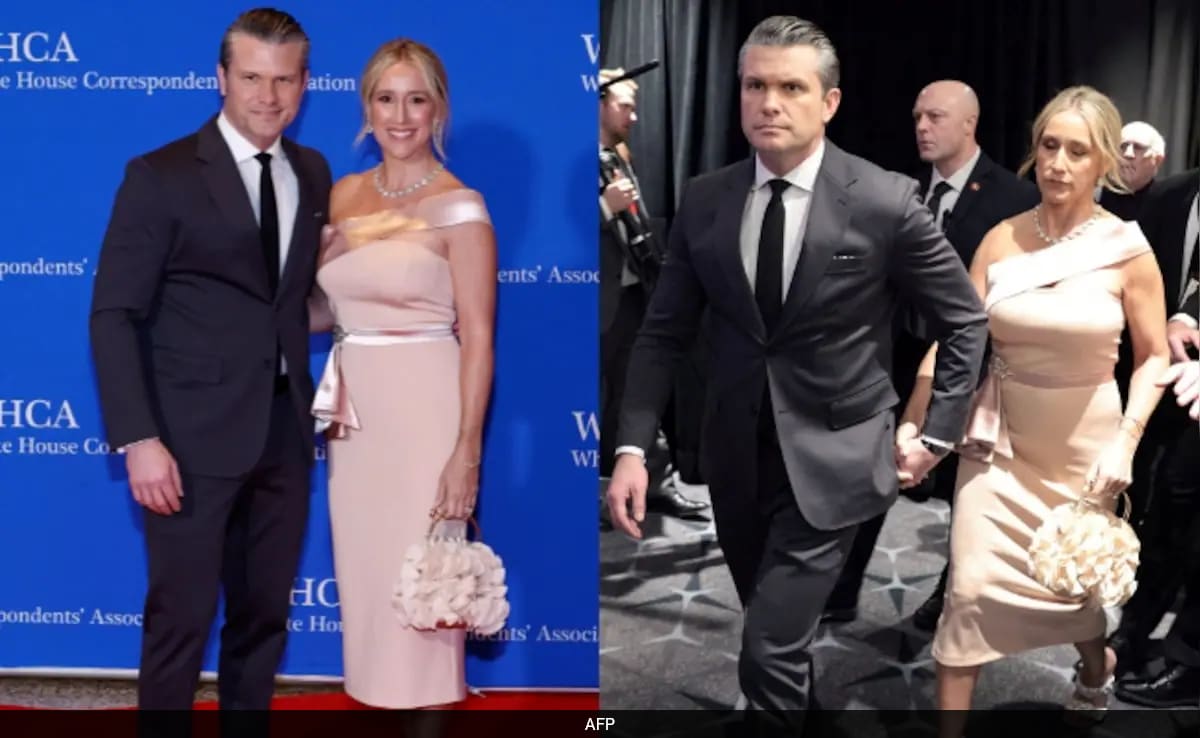
The optics of political attire function as a high-stakes signaling mechanism where the price point of a garment often outweighs its aesthetic utility. When Pete Hegseth’s wife, Jennifer Rauchet, appeared in a dress valued at approximately Rs 4,000 (roughly $48 USD), she triggered a predictable but analytically significant friction point within the "America First" ideological framework. This friction arises from a fundamental contradiction between populist signaling—which favors relatability and thrift—and protectionist economic policy, which views low-cost, foreign-manufactured goods as a threat to domestic industry.
The Signaling Paradox of the $48 Dress
Political figures and their families operate within a constrained optimization problem. They must project an image that is simultaneously aspirational and accessible. High-fashion choices often lead to "out-of-touch" critiques, while low-cost choices invite scrutiny regarding the provenance of the goods.
The choice of a Rs 4,000 dress serves as a deliberate signal of fiscal modesty. However, in the context of a nationalist economic platform, the price tag becomes a data point for a broader debate on supply chains. The core conflict resides in three distinct analytical pillars:
- Consumer Accessibility vs. Domestic Protectionism: The "America First" movement advocates for the repatriation of manufacturing. Yet, the price point of Rs 4,000 is almost exclusively achievable through high-volume, offshore production (often in Southeast Asia or South Asia).
- The Optics of Austerity: Using inexpensive clothing signals a rejection of the "coastal elite" archetype. It suggests the wearer shares the budgetary constraints of the median voter.
- The Provenance Gap: There is an inherent difficulty in finding US-made garments at a sub-$50 price point due to labor cost differentials. This creates a "compliance trap" for political figures who wish to look relatable but are ideologically committed to domestic production.
The Cost Function of Political Branding
To understand why a $48 dress causes a media cycle, we must quantify the "Political Brand Equity" (PBE).
$PBE = (Authenticity \times Relatability) - (Hypocrisy Variance)$
In this equation, Hypocrisy Variance is the delta between a stated policy (e.g., imposing 60% tariffs on foreign goods) and personal consumption habits. When the variance is high, the brand equity diminishes. The Rs 4,000 dress represents a low-cost entry into the "Relatability" variable, but it increases the "Hypocrisy Variance" if the garment's origins are inconsistent with the wearer’s public-facing economic nationalist stance.
Critics of the "America First" movement use these instances to highlight the "Market Reality Gap." This gap is the distance between the theoretical desire for domestic-only consumption and the actual availability of affordable goods for the American consumer.
Mapping the Global Supply Chain Constraint
The dress in question likely originated from a high-efficiency manufacturing hub in India or Vietnam. The economics of such a garment are driven by:
- Labor Arbitrage: The difference between the hourly wage of a US textile worker ($15–$25) and a worker in a developing market ($1–$3).
- Scale Efficiency: Large-scale retailers utilize "Just-In-Time" manufacturing to keep inventory costs low, passing the savings to the consumer.
- Material Sourcing: Access to regional cotton and synthetic blends that do not require high-cost transoceanic shipping during the raw material phase.
For a political spouse, selecting this garment is an act of "Retail Populism." It validates the reality of the American consumer who, despite supporting nationalist trade policies, relies on the deflationary pressure of global trade to maintain their standard of living. This creates a secondary effect: the "Tariff Realization Moment." If the "America First" policies were fully enacted, that Rs 4,000 dress would theoretically cost Rs 6,400 or more, potentially alienating the very base the movement seeks to protect.
The Three Pillars of Modern Political Fashion Criticism
Analysis of the public reaction reveals three structural layers of critique that define the current media landscape.
1. The Class-Based Critique
Opponents argue that the use of cheap, mass-produced clothing is a form of "costume play" by wealthy individuals. They suggest that the choice is not born of necessity but is a calculated move to mask the wearer’s true socioeconomic status. The logic here is that the wealthy can afford the "luxury" of domestic-made products, whereas the working class cannot. By choosing the cheaper option, the figure avoids the "Elite" label but incurs the "Hypocrisy" label.
2. The Economic Nationalist Critique
This critique comes from within the movement. Hardline protectionists argue that every purchase of a foreign-made garment is a micro-betrayal of the American worker. From this perspective, the price of the dress is irrelevant; its country of origin is the only metric that matters. This group views the Rs 4,000 dress as a missed opportunity to showcase an American brand, even if that brand is significantly more expensive.
3. The Feminist Autonomy Critique
A subset of the analysis focuses on the scrutiny applied to women in the political sphere. The argument holds that male figures (like Pete Hegseth) are rarely interrogated for the fabric origin of their suits, while their spouses are expected to carry the full weight of the household’s ideological consistency through their wardrobe.
The Mechanism of "Outrage Cycles"
The transition of a dress from a social media post to a national debate follows a specific mechanical path:
- Detection: Independent researchers or "fashion watchdog" accounts identify the brand and price.
- Aggregation: News outlets frame the price point against the political background of the individual.
- Polarization: The story is bifurcated into two narratives: "The Relatable Patriot" vs. "The Globalist Hypocrite."
- Saturation: The debate moves from the specific garment to the broader feasibility of the underlying economic policy.
This cycle ignores the practical limitations of modern logistics. The global textile industry is so deeply integrated that even a "Made in USA" garment often uses imported thread, buttons, or zippers. Total decoupling is a logistical impossibility in the short term, yet political commentary demands binary purity.
Strategic recommendation for high-profile political consumption
To mitigate the Hypocrisy Variance, political figures must shift from a "Price-First" strategy to a "Value-Chain" strategy.
The primary failure in the Hegseth dress incident was not the price, but the lack of an accompanying narrative regarding the garment's lifecycle. A more robust approach involves "Strategic Transparency." If a figure wears a low-cost, foreign-made item, they should frame it as a testament to the current economic reality that they intend to change.
The move is to acknowledge the garment as a symptom of a system that has exported its middle class. Instead of ignoring the "America First" debate, the figure should lean into it by stating: "I am wearing this because, like most Americans, affordable domestic options are currently unavailable. Our goal is to fix the market so that the $50 dress of the future is made in Ohio, not overseas."
This converts a defensive posture into an offensive policy argument. It acknowledges the consumer's struggle while reinforcing the ideological goal. The current approach—passive consumption followed by reactive defense—is a suboptimal strategy that allows the opposition to define the narrative of the "Relatability Gap."
Ultimately, the Rs 4,000 dress is not a fashion statement; it is a quantified example of the friction between neoliberal market efficiency and the rising tide of economic nationalism. Future actors in this space must treat their wardrobe as a policy white paper, where every stitch is a line of data subject to audit.