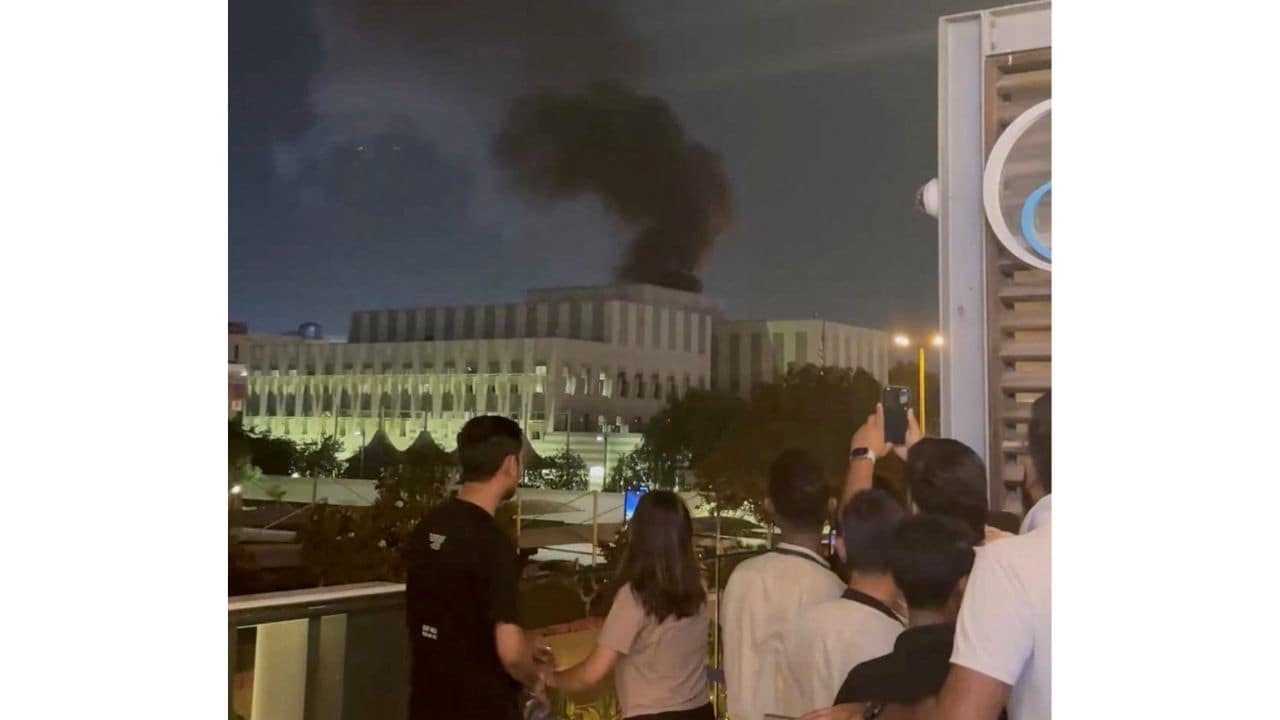
The headlines are screaming about a "sparked fire" near the US Consulate in Dubai. The markets are twitching. The pundits are dusting off their maps of the Strait of Hormuz. They want you to believe we are on the precipice of a regional conflagration that will melt your portfolio and redraw the map of the Middle East.
They are wrong. Meanwhile, you can find similar stories here: The Calculated Silence Behind the June Strikes on Iran.
This isn't the beginning of a world war; it’s a high-stakes marketing campaign. If you’re tracking this as a military event, you’re looking at the scoreboard while the real game is being played in the counting-house. This drone strike wasn't designed to destroy a building. It was designed to destroy a narrative of stability, and by reacting with predictable hysteria, the West is providing the ROI the attackers dreamed of.
The Myth of the "Surgical" Strike
Mainstream media loves the word "surgical." It implies precision, intent, and a localized outcome. When a drone hits a target near a diplomatic mission in a global hub like Dubai, it is anything but surgical. It is a loud, messy, and deliberate piece of kinetic theater. To explore the complete picture, check out the recent analysis by TIME.
We have to stop treating these incidents as isolated tactical failures. In my years analyzing regional security architecture, the "lazy consensus" is always to ask: "How did it get through the defenses?"
That is the wrong question.
The right question is: "Why was the defense bypassed so cheaply?"
We are seeing a massive asymmetry in cost-per-effect. An Iranian-designed suicide drone might cost $20,000 to manufacture. The interceptors we use to stop them—like the Patriot MIM-104—cost roughly $4 million per shot.
$$Cost Ratio = \frac{4,000,000}{20,000} = 200:1$$
When the math looks like that, the attacker doesn't need to win the battle. They just need to keep showing up until you go bankrupt or lose the political will to stay in the neighborhood. This isn't "war" in the Clausewitzian sense. It’s a hostile takeover through attrition.
Dubai is Not a Battlefield—It’s an Escrow Account
The reason this specific strike matters isn't because of the US Consulate. It matters because Dubai is the neutral ground of the global economy. It is where the East meets the West to wash their money and sign their contracts.
By hitting Dubai, the aggressor is sending a message to the global C-suite: Your safe haven is a mirage. The competitor articles focus on "staff safety." Of course the staff are safe. The goal wasn't to kill a mid-level diplomat; that would trigger a conventional response that the attackers aren't ready for. The goal was to trigger a "Force Majeure" clause in a thousand shipping contracts.
If you think this is about US-Israel-Iran geopolitics, you’re missing the commercial layer. This is an attack on the Abraham Accords via the balance sheet. The goal is to make the cost of doing business in the UAE so high—through insurance premiums and security surcharges—that the economic logic of regional integration collapses.
The Drone Fallacy: Technology is Not the Solution
Every time a drone makes it past a "state-of-the-art" defense grid, the immediate outcry is for more technology. "We need better AI tracking," they say. "We need directed energy weapons."
I have watched defense contractors pitch these "solutions" for a decade. They are selling you a faster treadmill.
The drone that hit near the consulate likely used simple GNSS (Global Navigation Satellite System) coordinates or even basic visual recognition software that can be bought off the shelf. You cannot "out-tech" a threat that is built from parts found in a hobby shop.
The Three Stages of Defensive Failure:
- Over-Reliance on Signature Detection: Modern radars are tuned to find fighter jets, not plastic lawnmowers with engines.
- The Saturation Gap: Even if your system is 99% effective, the attacker only needs to send 100 drones to ensure one gets through.
- The Political Optic: If a $20,000 drone causes a fire that shuts down a billion-dollar port or consulate for a day, the drone has already achieved a 50,000% return on investment.
Stop Asking if This Leads to "Total War"
People also ask: "Is this the start of World War III?"
No. Stop asking that. It’s a lazy question rooted in a 20th-century understanding of conflict. Total war between nuclear-armed or heavily proxied states is bad for business. Nobody—not Tehran, not Washington, not Jerusalem—actually wants the oil to stop flowing entirely.
What they want is Grey Zone Dominance.
This is the space between "peace" and "war" where you can blow things up, cause market panics, and shift borders without ever having to sign a surrender document or face a war crimes tribunal. The drone strike in Dubai is the ultimate Grey Zone tool. It provides plausible deniability while delivering maximum psychological impact.
The Brutal Reality of "Safe" Zones
We are entering an era where "Consulate Safe" is an oxymoron. If you are an executive or a government official operating in the MENA (Middle East and North Africa) region, you need to abandon the idea that the US military umbrella is a physical shield. It is a deterrent, not a bulletproof vest.
The "safe" status of the staff in Dubai is a temporary courtesy, not a permanent condition. The fire near the consulate was a range-finding exercise. They were testing the response time of local civil defense, the speed of the US military's public affairs reaction, and the volatility of the Brent Crude index.
The Contrarian Investment Play
When the "fire near the consulate" news broke, the instinct for many was to hedge or exit. That is exactly what the "lazy consensus" dictates.
But look at the data. These regional shocks are becoming shorter in duration and more frequent. We are becoming desensitized. The real risk isn't the drone; it’s the over-correction of the markets.
The downside to my perspective? If I'm wrong and this is the 1% scenario where an accidental hit on a high-value target triggers a massive conventional response, the "Grey Zone" vanishes and the "Total War" you fear becomes a self-fulfilling prophecy. But betting on the end of the world has a 0% historical success rate. Betting on calculated, cynical escalations that stop just short of the brink? That’s where the smart money has lived since 1945.
Logistics are the New Front Line
Forget the infantry. Forget the "staff safe" platitudes. If you want to know what happens next, watch the Lloyd’s of London war risk ratings.
The strike in Dubai was a direct hit on the maritime insurance industry. By proving they can touch the UAE's "protected" soil, the attackers have effectively taxed every gallon of fuel that passes through the region. This is a "kinetic tax."
If you are a logistics manager or a supply chain lead, you should be diversifying your routes now—not because a war is coming, but because the "peace" is becoming too expensive to afford.
The Intelligence Failure Nobody Admits
The competitor article won't tell you this, but every drone strike like this represents a massive intelligence blind spot. Not a technical one, but a cultural one. We keep assuming the "enemy" wants to destroy us.
They don't want to destroy us. They want to exhaust us.
They want us to spend our nights worrying about consulate fires while they spend their days building the next 10,000 low-cost delivery systems. They are playing a game of "Volume vs. Value," and as long as we value our "surgical" reputation more than our tactical flexibility, we will continue to lose these skirmishes.
Stop looking for the "fire." Look for the hand that held the match, and realize they aren't trying to burn the building down—they’re just checking to see how much you’ll pay for the smoke.
Accept the fact that the old "security" is dead. The new security is redundancy, decentralization, and a very thick skin. If you’re still waiting for a "return to normal" in the Gulf, you’re standing in the middle of a target zone, wondering why it’s getting hot.
Pull your head out of the sand. The fire wasn't an accident. It was an invoice.